






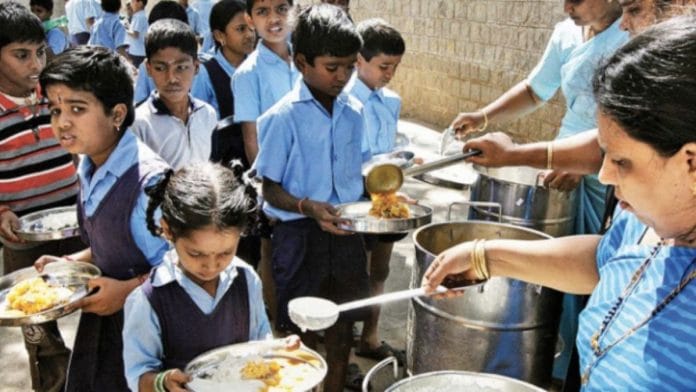


The egg has become the first casualty of the BJP’s promise to respect Bengal’s food culture. During the election season, the BJP read the room — and the fish market. Leaders flaunted fish and devoured mutton before television cameras. They assured Bengalis that nobody was coming for their plates. Once the kursi was secured, however, performance yielded to policy and the new government decided that school mid-day meals will no longer include eggs.
The irony would be amusing if the people paying for it were not children.
The new government has entrusted the preparation of mid-day meals in nearly 1,800 Kolkata schools to ISKCON and its Annamrita Foundation. ISKCON runs a vegetarian-only kitchen, meaning eggs will be replaced by paneer, soya, rajma, and pulses to meet children’s protein requirements.
To be fair, ISKCON has done exactly what one would expect of it. It has never hidden its commitment to vegetarian food. Nor is this the first time a religious organisation has insisted on serving meals that reflect its beliefs. The Akshaya Patra Foundation has spent years defending a similar position, even as nutritionists questioned whether ideology should dictate what children eat under a government welfare scheme.
A government has no business following the dietary beliefs of the institution it hires. Mid-day meals are not some kind of religious charity. They are one of independent India’s most successful welfare interventions designed to keep children in school, combat malnutrition, and ensure that poverty does not decide what ends up on a child’s plate and fate. So the menu must answer to public health and children’s needs. And eggs are a perfect solution to that.
But every few years, somewhere in India, the egg is dragged into a political argument. It is too ordinary to inspire passion and too nutritious to ignore. It has survived precisely because it sits in a rare sweet spot: cheap, acceptable across much of India, easy to cook and nutritious. That’s why governments chose them for mid-day meals.
Now, ISKCON’s alternatives are soya and paneer. But the two are not interchangeable with eggs. Doctors have said as much for years. Eggs have valuable nutrients. That is the science. But politics is science’s toughest contender in ‘New India’.
Also read: Rajma-chawal in the morning? How breakfast exposes the hidden hierarchies of Indian cities
Food, science, faith
The BJP understood perfectly well during the election that Bengal’s relationship with food is unlike that of many northern states. Food holds a different reverence in Bengal. A fish could be gifted to a bride, offered to goddesses, and cooked for lunch without inviting debate. Outside Bengal, it scandalises those determined to flatten Hinduism into a single vegetarian template.
The Bengali kitchen never developed that anxiety.
Its genius lay in accommodation rather than exclusion, in appetite rather than orthodoxy. Vegetarian and non-vegetarian food coexisted without becoming moral categories. A widow’s austere meal and a Sunday kosha mangsho belonged to the same universe. Food is governed by season, geography, and household custom.
So, politicians, well aware of the maachhe-bhaate Bangali instinct, quickly acquired a taste for mustard oil during campaigns. BJP leaders sampled fish before television cameras because they recognised that Bengal’s culinary habits could not be lectured into submission. They performed familiarity because it carried an electoral cost.
But their governing has been entirely different.
The egg’s exit from school meals shows how quickly symbolic gestures give way to ideological preferences once power is secured. The tragedy is that children have become collateral damage in a debate that was never about them.
Welfare schemes exist because governments are expected to privilege outcomes over beliefs. If science and doctors say eggs are essential for a daily diet in childhood, that should settle the matter. The role of the government is to simply provide it to those who depend on it.
Bengal has always found room for faith at the dining table. It has also known where faith must end and science should prevail.
The kitchen is one thing. The classroom is another.
Views are personal.
(Edited by Aamaan Alam Khan)
I don’t remember Ms. Stela Dey covering Bengal issues at ThePrint. As long as the TMC was in power, I don’t think I ever came across any article from her on Bengal.
Now that the BJP is in power, she has suddenly chosen to remember her Bengali roots – and started reporting on Bengal. While her decision (and her ‘concern’ for Bengal) is quite appreciated, what is not helpful is her deliberate attempt at crafting a narrative and peddling propaganda.
Instead of reporting on an issue from the AC office of ThePrint in Delhi/NCR, she should hit the streets of Kolkata and taste for herself what children currently eat at schools. Almost every other day, there are horror stories of cockroaches and other insects being found on the food being prepared. Not to mention the large scale loot and corruption by local TMC leaders from the mid-day meal funds.
ThePrint must resist publishing such propaganda pieces on it’s platform.
The children of Bengal have also paid a price for English not being taught at the primary level in government schools.
Ofc it’s written by a Muslim. You guys don’t care about the life and suffering of a conscious being who can feel pain. Hypocrite animal lovers
For the life of me, I can’t imagine why they would do something like this. It’s eggs, not a bovine, which they pretend to care about! What do they achieve by taking an egg away ftom a child’s plate? What possible argument could they have for this mean, petty, unconscionable action. Truly pathetic.
Making an issue where none exists should be ceased and desisted with.