






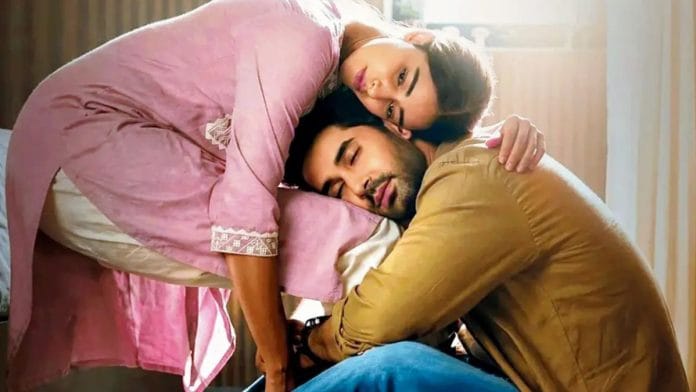

Dharma Productions’ latest Chand Mera Dil seems like any other love story—the fluttering of butterflies and the young cast does what all birds and bees do—before it takes a darker turn. A fight between the lovers turns physical. The relationship fractures. Then it is all about redeeming the man who crossed that line. I ask why.
This is not a review about the movie but rather a commentary about the stories we keep telling ourselves, about love and violence.
Somewhere along the way, Bollywood started treating abuse as a narrative obstacle rather than a definitive rupture. Violence is packaged as a momentary lapse in judgement, an error that can be corrected with an apology, if the guilt is big and loud enough for the world to see. If the violent man unravels like a ball of yarn, shows remorse, then his actions are forgivable. It makes for a grand act of self-restitution.
Cinema loves this arc because redemption is dramatically satisfying. It gives people hope that love conquers all, time heals and people are capable of change. That broken things can become beautiful again.
Unfortunately, reality is far less generous.
When someone turns violent in an argument, physically, emotionally or psychologically, something fundamental is revealed. Their capacity for it. And once you see that they have the capacity to hurt you, to make fear a fundamental part of the dynamic, what can a person trust? Their apology? Their regret? The usual empty promise that it will never happen again?
Unfortunately, this vocabulary is a shared language for all women. We are asked to believe potential over evidence, remorse over behaviour, and the possibility of change over the memory of harm. Women, the default empathisers of the universe, are expected to “understand” and forgive the very human beings who violate their dignity, in more ways than one.
The irony is that this conversation arrives at a grimly relevant moment. The monstrous social evil of dowry has claimed more lives. The deaths of Twisha Sharma and Deepika Nagar are a scary reminder of how women are treated after the happily-ever-after moment at the mandap. Their stories prove that abuse rarely comes out of nowhere. It escalates, and then it normalises itself. It festers in cracks of a relationship, and it thrives because women are always asked to give second chances to their abusers.
The moment we minimise violence to a mistake, we teach the victim to shrink as well, and we let it get to a point where it becomes undeniable. That is what abuse does: it tells you that the violence was an exception and not something inevitable. Something that won’t happen again.
Also read: Adnan Sami’s ‘Lipstick’ refuses to smash patriarchy. It only talks about ‘buri nazar’
Leaving is brave
Another show, Off Campus on Amazon Prime, captures this with painful accuracy. The father of the main character Graham, played by Steve Howey, is abusive, and the woman he is with, Cindy, doesn’t leave the relationship, even after Graham (played by Belmont Cameli) insists her to. Not because she can’t leave, but because it is “complicated”. She reasons with it, saying he was “sorry after” and that “he’d never do it again”.
That is what abuse does. It complicates what should be simple.
It makes leaving feel cruel. It turns self-preservation into guilt. It convinces people that staying is proof of loyalty, that forgiveness is maturity, that love means enduring someone at their worst until they become better. It does not. And we have seen that so many times in movies and real life. Women who don’t leave their abusive partners and reward them for feeling guilty are put on a pedestal.
Abuse does not need redemption. It needs recognition. The moment someone shows you that they can use love as a weapon, that is the cue to leave. Not because people cannot change, they can. But because someone’s growth is not the victim’s responsibility to witness at the cost of their own safety.
We don’t need more stories teaching women to wait for broken men to become whole.
We need to remind them that sometimes the bravest love story is the one where they walk away.
Because there are no happy endings with someone who has already shown you they can become dangerous when love disappoints them.
Sometimes the ending is not redemption. Sometimes the ending is escape. That is the real happy ending.
Views are personal.