




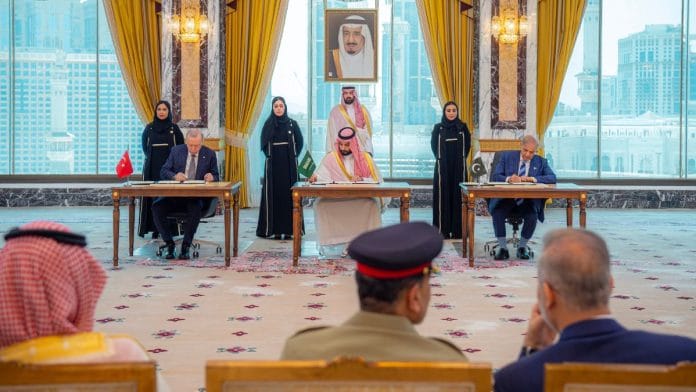

The recently announced Mecca Agreement grouping Pakistan, Turkey, and Saudi Arabia deserves careful attention from Indian defence planners. In the build-up to it, Delhi read it through a geopolitical lens, asking whether it represents another alignment in the Middle East or a diplomatic signal to regional rivals. The commentary has overwhelmingly focused on regional and strategic implications.
The question for the Indian military, however, is operational. Military campaigns are shaped by two key paradigms: the battlefield on which they are fought and the political conditions under which they are conducted. This grouping can alter both. It can strengthen Pakistan’s battlefield capability while adding to the political pressure that ends hostilities early, which shortens the time India has to turn military success into strategic outcomes.
The shrinking political timeline
Operation Sindoor indicated that future India-Pakistan conflicts are likely to be politically compressed campaigns rather than prolonged wars of attrition. Such operations would unfold under intense international scrutiny, with diplomatic efforts to end the fighting beginning almost as soon as it starts.
The effect of a shorter conflict is more adverse for Indian strategy. India fights for credible objectives that require sequenced operations: degrade, exploit, consolidate, and demonstrate a result large enough to alter Pakistani calculations. Each stage takes time. Pakistan fights to absorb and hold until the ceasefire is declared. Every day removed from the political timeline costs India more than it costs Pakistan.
Saudi Arabia holds substantial interests on both sides of the divide. It has deep energy, investment, and economic ties with India. And it has expanding defence cooperation, financial support, and strategic engagement with Pakistan. Riyadh’s interest lies in preventing a prolonged conflict that threatens regional stability, energy markets and its economic ambitions under Vision 2030. Those interests existed before the grouping, and Riyadh acted on them during Op Sindoor.
What the grouping changes is Saudi standing. The nation transforms from a benign third-party mediator to Pakistan’s treaty partner. It has direct equity in Pakistan’s military establishment, institutional access to its command structure, and a claim to be consulted. And Pakistan too has a legitimate right to Saudi treaty support. Riyadh’s motive may stay constant, but the authority behind it and the speed of its application will both increase. Indian commanders are left with a narrower window in which to convert tactical success into operational gain.
Also read: Shoot and scoot—what Pakistan’s SH-15 guns mean for India’s artillery
The emerging defence ecosystem
The grouping also has the potential to change the battlefield itself. It builds on China’s central role in Pakistan’s military modernisation rather than replacing it.
China remains the strategic backbone. Islamabad fields Chinese fighter aircraft, long-range air defence, precision weapons, naval platforms, and satellite-enabled navigation. Chinese support in intelligence, surveillance, and reconnaissance (ISR), artificial intelligence, command-and-control, missile technology, and electronic warfare continues to deepen. Cooperation in fifth-generation combat aviation, including possible induction of the J-35, would strengthen that relationship further and give Beijing another lever over the military balance in the subcontinent.
Turkey contributes a different set of capabilities. Firms such as Baykar, Aselsan, Roketsan, Havelsan, and Turkish Aerospace Industries have developed electronic warfare systems, battlefield communications, loitering munitions, precision-guided weapons, cruise missiles, and naval combat systems, along with operational experience in integrating them. This builds on years of bilateral work, including the MILGEM corvette programme and the modernisation of Pakistan’s Agosta-90B submarines. Additionally, the Turkish and Pakistani military, especially the air forces, train together in a regular institutional manner. Saudi Arabia contributes financial depth and industrial capacity, which allows faster acquisition and sustained modernisation over time.
Much of what follows is driven by the China-Pakistan relationship and would continue without the Saudis. The grouping’s own contribution is speed and reach. Saudi finance converts Pakistani requirements into orders. Turkish industry offers items that China supplies less. The arrangement creates a second wartime resupply channel, through a NATO member alongside the Chinese one.
Integration carries friction. Chinese command architectures, data links, and satellite networks join awkwardly to Turkish battlefield management systems, electronic warfare suites, and communications. Differences in standards, software, and cybersecurity protocols are real, and they matter mainly for timing. Deep sensor-to-shooter fusion across two supplier architectures takes years, and Indian planners can consider that as a long-term problem. Munitions, loitering munitions, electronic warfare consumables, and spares are easily available. They are supplied from existing inventory and production lines, requiring commercial arrangements rather than systems integration. Systems integration takes years, but wartime resupply takes weeks. Short wars are decided by sustainment.
Also read: RSS-BJP are playing good cop, bad cop with Indian youth
How the battlefield is changing
The significance of the recent grouping lies in its targeting of architecture rather than in individual platforms. China provides strategic ISR through satellites and airborne sensors. Turkey adds drone ISR and battlefield surveillance at operational and tactical levels. Together, they can create a more persistent picture of the battlefield, which makes Indian mobilisation and deployments, reserve movement, logistics, and headquarters harder to conceal.
This architecture is a force multiplier for Pakistan’s new Army Rocket Force. Long-range precision fires need targeting network support. Chinese strategic ISR combined with Turkish tactical surveillance improves Pakistan’s ability to find, track, and engage targets in depth. Indian headquarters, logistics hubs, bridges, reserve concentrations, airbases, ammunition depots, as well as defence manufacturers and strategic industries become more vulnerable. India holds substantial long-range missile capability but has yet to establish a dedicated Army Rocket Force integrating theatre-level ISR, targeting, and long-range fires under a single operational command.
Turkish experience in integrating drones, electronic warfare, and precision weapons with ground manoeuvre complements the Pakistan Air Force’s long tradition of close work with the Pakistan Army, built during operations in the former Federally Administered Tribal Areas, Khyber Pakhtunkhwa, and along the Afghanistan border. Turkish unmanned combat aerial vehicles combined with Chinese fighters, long-range weapons and command systems improve Pakistan’s ability to provide responsive tactical air support, conduct deep interdiction, and synchronise air and land operations. The Indian Air Force operates with fewer fighter squadrons than authorised, which forces choices between counter-air, strategic strike, air defence, and support to land forces. Delays in theatre integration complicate rapid synchronisation during short campaigns of high tempo. Pakistan’s improvements do not create new operational challenges for India. They magnify existing vulnerabilities.
Modern operations depend on resilient, encrypted, and mobile communications linking sensors, commanders, and shooters. Turkish work on battlefield networking and command systems, with Chinese investment in AI, command-and-control, and electronic warfare, improves Pakistan’s ability to hold operational coherence under attack while disrupting an adversary’s decision cycle. The contest will increasingly turn on whose communications survive longest under sustained electronic attack.
Ukraine, Nagorno-Karabakh, and the Middle East have shown that inexpensive drones working alongside electronic warfare impose disproportionate costs on conventional forces. Counter-unmanned aerial systems and electronic warfare will increasingly determine the survivability of manoeuvre forces, logistics columns, artillery positions, and headquarters. Indian operational concepts, while beginning the transition to integrated battle groups, still largely rest on large headquarters, concentrated logistics nodes, and armoured formations designed for an earlier era. Persistent ISR, drones, electronic warfare, and precision fires raise questions about how long those structures survive. These are no longer just procurement challenges. They are operational design questions that should shape how the Indian Army plans to fight its next war.
Also read: India-Bangladesh ties need to move beyond Sheikh Hasina
Two paths to modernisation
Pakistan has adopted a partnership-driven model, acquiring capability from several external partners and integrating it rapidly. The approach carries real costs. Dependence on foreign suppliers limits strategic autonomy, creates technological dependencies, and exposes Pakistan to external political leverage, as has been its repeated experience. Given its threadbare industrial and financial base, however, Pakistan has few realistic alternatives if it wants to modernise quickly.
India’s circumstances differ. As a major economy with substantial scientific and industrial capacity, Atmanirbharta remains an essential long-term objective, since no major power can depend indefinitely on foreign suppliers for critical military capability. The question is one of sequencing. Indigenous development is lengthy and prolonged, hence the operational environment calls for a dual-track approach. Build the domestic defence-industrial base while retaining the flexibility to procure, co-develop, or induct critical technologies quickly where near-term gaps threaten battlefield effectiveness. Industrial sovereignty and operational readiness should reinforce each other.
The Pakistan-Turkey-Saudi grouping needs evaluation as an operational development rather than only a diplomatic one. It can strengthen Pakistan’s battlefield capability while adding to the political conditions that compress the time India has to use force. The two work together.
One consequence is the most critical, and that is traditional Pakistani hubris. Capability shapes conduct; assurance shapes initiation. A Pakistani leadership that comprehends Saudi treaty backing, Turkish resupply, and Chinese depth as a strategic carte-blanche may resort to adventurism. It may price escalation cheaper than earlier, judging that intervention will halt the fighting before costs accumulate. That raises the likelihood of a crisis rather than the difficulty of any single campaign.
For Indian military planners, the central challenge extends beyond preparing for a stronger adversary. It is to generate decisive operational effect inside a narrowing political window. That will require a reassessment of operational concepts, force structure, command arrangements, and the pace at which critical technologies reach the field.
Brigadier Anil Raman (retd) is a Research Fellow at The Takshashila Institution. Views are personal.
(Edited by Prasanna Bachchhav)
Not by military strategy alone. It is not in India’s interest to actually fight a war, with one or both nuclear armed neighbours. This defence pact, enlarging the Mutual Defence Agreement signed by Pakistan and Saudi Arabia one year ago, speaks to our diplomacy as well. Why is the world becoming a steadily less congenial place for India to pursue its development goals. The melting away of the indissoluble bind with USA.