




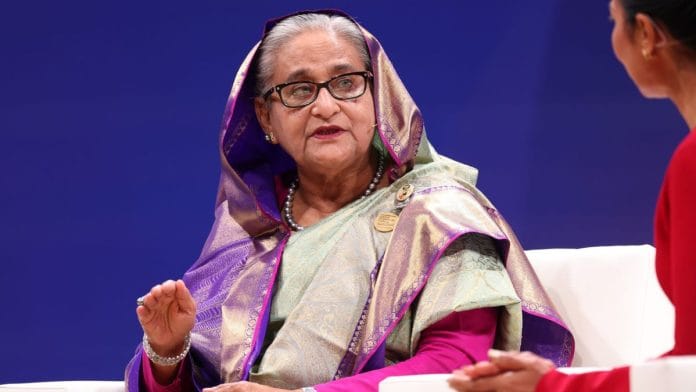

Bangladesh marks the second anniversary of the “July Movement”, which ousted then Prime Minister Sheikh Hasina. In the last two years, it has moved past the events of 2024, seen an interim government led by Muhammad Yunus, and now has an elected government led by Prime Minister Tarique Rahman. Many in Dhaka believe Bangladesh is moving toward law and order.
But the first question many ask: is it over for Hasina?
Addressing the press conference at the Foreign Correspondents’ Club of South Asia in Delhi on 5 August, Hasina recalled her father—Sheikh Mujibur Rahman. She highlighted the sacrifices her family made during Bangladesh’s independence, promising to return and be with the people whom she loves.
Hasina joined an audio-only virtual media, and her son Sajeeb Wajed dialled in from the US. In her 20-plus-minute speech, she made three key points—the 2024 July-August movement was a ‘coordinated assault’, the country is unsafe, and she would go back irrespective of “whatever fate awaits me. I cannot stay away while my beloved countrymen are suffering.”
Hence the second question: will Hasina ever go back?
The comeback that may not happen immediately
Beyond local Bangladeshis and the media, questions about whether she may eventually return remain a matter of interest among diplomatic observers and international stakeholders. It reflects the broader political significance of developments in Bangladesh and their potential regional implications, as it could cause further instability in the neighbouring country, impacting investments, trade, etc.
Equally, the experts in New Delhi are racing to provide the best view of India’s thinking and strategic outlook on her return, but eventually, the conclusion seems to be in one voice—unlikely that she will, at least not in the present circumstances.
If a July movement was required to out Hasina, her comeback would need another movement backed by Awami League cadre and supporters.
Hasina herself observed during the press conference, “At least 10,000 people have been killed or disappeared” and “around 6,50,000 have been arrested over the last two years, 3,500 cases have been filed, nearly 4,50,000 leaders, workers and supporters” have been “accused, and against her at least “600 cases have been filed.”
In the given circumstances, where Awami League cadres are either underground or have been detained or jailed, creating a movement to bring her back is unlikely.
Although she seems to care less about the “fate” and wants to return at any cost for her people, her return remains out of the question. But her words do echo with people who may not necessarily be just Awami Leaguers but also people who saw Rahman and later his daughter as a symbol of the country’s struggle against Pakistan in 1971 and as founders of an independent Bangladesh’s cultural and ideological identity.
While Hasina’s comeback is unlikely, it is not impossible. However, waiting may be too long, and it may even take a generation. By the history of Bangladesh, movements and comebacks are not new.
Even the current ruling Bangladesh Nationalist Party (BNP) was underground until 2024. Rahman lived in self-exile for more than a decade in the UK, and so did Jamaat-e-Islami’s fate and existence. Now one sits in power, and Jamaat leads an 11-party opposition in the Parliament.
Therefore, Bangladesh is wedded to movements, revolutions, and turns and twists of leadership, and Awami League’s over-grounding may be delayed but possible.
However, the situation poses even a bigger challenge for the present government; it will have to prove constantly how different it is from the Hasina administration, and a burden of performance would loom large throughout.
Also read: Hasina’s shadow ends careers in Bangladesh. After president, now army chief faces heat
Impact on India
Following Hasina’s presser in New Delhi, Bangladesh’s Ministry of Foreign Affairs released a strong statement, stating, “Bangladesh is outraged that the absconding convicted genocider Sheikh Hasina was allowed this evening to engage in live interaction with the media in New Delhi where she and her henchmen launched venomous vitriol against the State of Bangladesh and her people,” reflecting unease that she could still cause even when she is away.
There remains no doubt that Hasina’s stay in India causes friction in the bilateral ties. But some of us in New Delhi tend to mistake her stay in New Delhi as the only reason. But some observers make no mistake in conveying that even if Hasina is ‘extradited’, there is no guarantee that ties will be back on track.
Some even ask further: weren’t Dhaka-New Delhi ties strained when Hasina was in power? Sometimes it was because of Dhaka’s seemingly pro-China stance or violence against minorities in Bangladesh. However, the difference then was that the hotline between Delhi and Dhaka was working, which seems to be non-existent at present.
At the same time, New Delhi needs to take into account a new Bangladesh, one that has undergone internal and external shifts—shaping where it stands today in terms of public opinion toward India or a pro-China approach, growth, and global standing.
Today, Bangladesh’s nominal GDP is projected to reach about $510 billion in 2026, a growth rate of 4.7 per cent, and a nominal GDP per capita of $ 2,911. Between 2025 and 2026, the GDP per capita is expected to rise by 10.5 per cent.
At the same time, China is Bangladesh’s top trading partner. It also holds key strategic value in the Bay of Bengal and larger Indo-Pacific region. Hence, an attractive strategic destination for key global powers, including the US.
Conversely, Bangladesh’s military is pursuing “Forces Goal 2030” for modernisation—a mission launched in 2009. Having changed a few times under Hasina’s tenure, the mission is bound to change even under the current administration, but that is part of the course.
Most importantly, Bangladesh enjoys the best geography and location, unlike landlocked or island countries—making it a key player in the region.
At the same time, its demography is worth noting: a median age of 26-27 years, with people seeking education and employment beyond local and regional boundaries; and a generation that does not carry the burden of history, particularly of 1971.
With these in the backdrop, when Dhaka conveys to India that “Bangladesh desires to maintain a constructive, mutually beneficial, and forward-looking relationship with India based on sovereign equality, mutual respect, non-interference in each other’s internal affairs, and national dignity,” it comes with the challenge of hostility.
Objecting to Hasina’s presser in New Delhi, Bangladesh’s Ministry of Foreign Affairs message to Delhi that, “allowing her the opportunity to openly interact with the media under the pretext is deeply hurtful to our people’s sentiment and detrimental to the development of harmonious bilateral relations” also comes loaded.
While the government and media in Dhaka find it easy to question New Delhi on how Hasina is allowed to engage with the media or public as a guest in India, the same rule, one asks, should arguably have been applied when Rahman spent years in exile in the UK while continuing to participate in Bangladeshi politics and public discourse. Did Dhaka make it a condition in relations with the UK? The answer is no.
Loathing India has become a trend and a convenient political tool to create narratives, and if Bangladesh is doing so today, it is following the trend. Unfortunately, for the longest time, geographically smaller countries in the region found it convenient to blame India for their political and economic shortcomings.
What makes this narrative harder to sustain today is that these neighbours have grown stronger, more prosperous, and far more influential, enjoying an equal or greater influence in the region and earning a global standing. Yet the instinct to portray New Delhi as the source of every challenge persists—a contradiction that increasingly appears less like strategic assessment and more like political convenience.
Challenges between Bangladesh and India continue to persist, and ties are likely to deteriorate even further. But the only way to bring them back on track is by protecting ties from letting one individual dominate the relationship, and by letting a broader canvas of concerns and cooperation take the lead.
While it raises questions with India and uses a strong tone, Dhaka needs to be mindful of New Delhi’s security concerns, including Bangladesh’s drift into the Chinese sphere of influence.
Rishi Gupta is a commentator on global strategic affairs. The opinions expressed in this article are those of the author alone and do not reflect the views of the author’s current or past affiliations in any form.
Views are personal.
(Edited by Saptak Datta)