






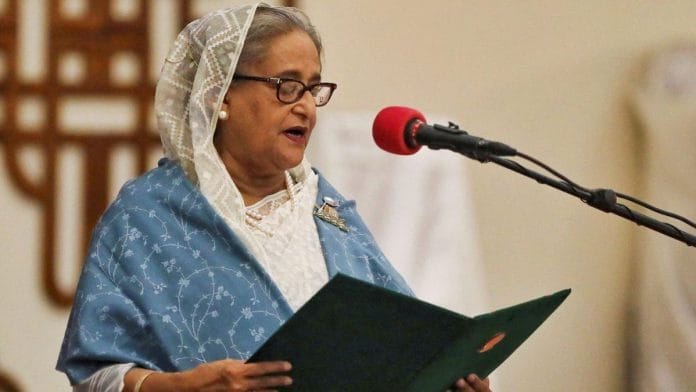


Any association with ousted Bangladesh Prime Minister Sheikh Hasina carries severe legal, political, and social risks in today’s Bangladesh. And you don’t have to be directly linked to her banned party, the Bangladesh Awami League, to feel the heat. Even a whiff of rumour linking you to the former prime minister will either make you a political untouchable or land you in jail.
In the case of Bangladesh’s former President Mohammed Shahabuddin Chuppu, it has led to a resignation two years earlier than the stipulated time, citing bad health. The Bangladesh press has been writing reams on how the resignation came under political pressure ever since Hasina began speaking to the press of her wish to return to Bangladesh. It was also alleged that he held a secret phone call with Hasina in May during a medical trip to London.
With Chuppu gone, the spotlight is on yet another high-profile appointee, the Bangladesh Chief of Army Staff General Waker-Uz-Zaman. The question is, after Hasina’s first presser since her ouster two years ago, would there be pressure on the Tarique Rahman government to replace General Waker? Or would he manage to survive these testing times?
Phone call with Hasina
I had met Chuppu at his Dhaka office in February 2023, a day after he was declared president-elect. Chuppu had spoken to me about the horrific riots of 2001 after the Awami League lost power and the Bangladesh Nationalist Party (BNP) sat on the throne under the leadership of Khaleda Zia in coalition with the Bangladesh Jamaat-e-Islami. That alliance isn’t there today, and Jamaat is the principal opposition in Bangladesh.
Chuppu had chaired a judicial inquiry commission and spoken to victims of the post-poll violence, he said, adding, “They were mostly Hindus who were attacked by the Jamaat and the BNP workers. Hindus were safer under Hasina.”
Naturally, such close going wasn’t easy for Chuppu after the Hasina government fell on 5 August 2024. Though he survived the Muhammad Yunus period, he had to step down on 24 July, two years before his tenure ended, after reports surfaced of an alleged phone call between him and Hasina.
When asked directly by a reporter from Bangladesh’s largest circulated English daily, The Daily Star, if he indeed spoke to Hasina over the phone, Chuppu said, “It’s an embarrassing question”.
“Only when someone has lost their mind will come up with such concocted stuff. It is baseless, baseless and baseless. Totally baseless. I have acted fairly all my life. I do not like to manufacture any news,” Chuppu said.
Bangladesh expert and UNI editor Jayanta Roy Chowdhury told ThePrint Chuppu was never the best president Bangladesh could have got.
“But he showed some spine in contradicting Yunus by stating emphatically that Hasina never resigned, implying that legally she may still be the prime minister. This, and the fear of Hasina’s return, saw (PM) Tarique Rahman forcing his exit,” Roy Chowdhury said.
After Hasina’s Wednesday audio presser at the Foreign Correspondents’ Club of South Asia, where she said she would return to Bangladesh regardless of the consequences, will Rahman replace the other high-profile Hasina appointee, Waker?
Also read: Sheikh Hasina’s Bangladesh return can be her last political gamble. She must plan it well
The betrayer?
To Hasina loyalists, Bangladesh’s army chief is the great betrayer. To his critics, Waker is too close to Hasina for the comfort of her rivals. Not only is Waker Hasina’s distant relative, but he was also the Principal Staff Officer at the Armed Forces Division in the Prime Minister’s Office before Hasina appointed him the army chief. After Hasina’s ouster, though, his role during the 2024 July uprising came under question.
Hasina’s Home Minister Asaduzzaman Khan Kamal told me during an interview for my 2025 book ‘Inshallah Bangladesh: The Story of an Unfinished Revolution’ that it was Waker who had promised Hasina that the army would stop the mob from entering her official residence but had gone back on his word, forcing Hasina to flee to India.
Whether Kamal’s accusations are true or not, Waker was looked at with suspicion after the fall of the Hasina government. The National Citizen Party or the Jatiyo Nagrik Party—the students’ party that came into force after the July uprising—had staged protest rallies at the Dhaka University campus on 22 March last year, vowing to thwart at any cost a “military-backed plot” to rehabilitate the Awami League and bring Hasina back to Bangladesh. The army had rejected the allegations as “hilarious and an immature array of stories”.
Bangladesh watchers believe Waker had tried to counter such allegations by turning to religion. Under him, the Bangladesh Army is shifting toward Islamist alignment, whether it is through Waker sporting a bearded look from the previous clean-shaven one or the raising of a new battalion with four companies named after the first four Caliphs of Islam, or the army’s battle cry changing from the secular Joy Bangla (Victory to Bangladesh) to the Islamic Allahu Akbar.
Chowdhury said that Waker did indeed play a dubious role in Hasina’s exit, but tried to ingratiate himself with Islamist forces to keep his job despite run-ins with Yunus and “not-so-great relations with the BNP”.
“The Islamic mould and his reported statements against the Arakan corridor have gained him adherents within the rank and file of the Bangladesh army,” Roy Chowdhury said.
But will that be enough to save Waker’s job? Senior journalist Pratim Ranjan Bose said that after Hasina’s presser in New Delhi, Bangladesh politics will undergo severe churn from here.
“With Hasina announcing her return and India allowing her to address a press conference, a lot of possibilities are on the horizon. The army chief may also play a role, depending on the signal from the international community,” Bose said.
The choice of that role may well determine if Waker keeps his job or loses it like the former Bangladesh president.
Deep Halder is an author and a contributing editor at ThePrint. He tweets @deepscribble. Views are personal.
(Edited by Saptak Datta)