




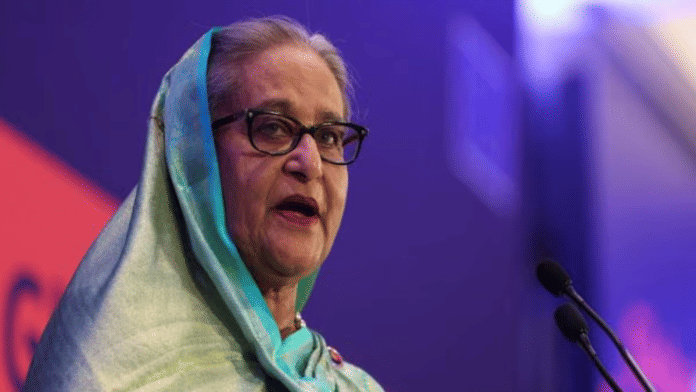

In politics, like in poker, you don’t show your hand. Which is why the reasons behind Sheikh Hasina’s Wednesday evening presser are hard to fathom. If indeed she wished to return home after being given the death verdict by the International Crimes Tribunal of Bangladesh on 17 November 2025, with her party Awami League remaining banned in Bangladesh and her top and middle rung leadership either abroad, in jail or in hiding, should she have been talking about it so many times?
Hasina’s homecoming, if it happens, would undoubtedly be the biggest political spectacle in Bangladesh after the 2024 student-led July uprising that brought down her government and forced her to flee.
Why take the surprise element out of such an event and blunt its impact on Bangladesh’s people and politics by repeatedly talking about it? Is Hasina merely testing the waters or getting desperate to find a place in Bangladesh’s politics that seems to have moved on without her?
Same statement, many times over
Sheikh Hasina had spoken to me and my co-authors on 7 June last year after we approached senior Awami League leaders requesting to speak to the former Bangladesh Prime Minister over the phone for our book Inshallah Bangladesh: The Story of an Unfinished Revolution. She had clarified it was not an interview but an interaction, and that we could use the contents of our conversation in the book.
It was a scoop of sorts when Sheikh Hasina told us that the 2024 July uprising was a calculated terror attack on Bangladesh rather than an organic public revolution. She said her country was being taken over by the same Islamist forces that she had managed to contain during her time as the premier of Bangladesh. Our conversation took place at a time when Muhammad Yunus was the caretaker to the interim government of the country and Hasina told us she would return to Bangladesh. Her exact words: “Inshallah, I shall return”.
Since then, Hasina has given a string of interviews to Indian and foreign media where she spoke about her willingness to return to Bangladesh. In June this year, Hasina gave an email interview to NDTV’s Neha Chandra where she specifically mentioned she would return to Bangladesh in 2026. “I want to say clearly: overcoming every obstacle and every conspiracy, I will return to my country this year,” she said.
Then, on 9 July, in a telephonic interview to Krishna N Das of Reuters, Hasina clarified she would return home with party colleagues to surrender around December. “They may arrest me on my return, they may even kill me. Still, I have to go,” she told Das.
Hasina repeated the same statements at her first public media appearance in two years on Wednesday at the Foreign Correspondents’ Club of South Asia in New Delhi. “They may arrest me on my return; they may even kill me … still, I have to go,” she told the packed room.
Apart from the fact that this was her first public media appearance after being ousted, though only through audio, there was nothing new that Hasina had to say. Through her Facebook live sessions with her party cadre and through her many interviews, email or telephonic, over the last few months, she has maintained that July 2024 was not merely a students’ uprising but a sinister plot to take over Bangladesh, that the international community should stand by the people of Bangladesh, and that she would return to her country.
Even her son Sajeeb Wazed, who also joined the Wednesday presser virtually from the US, repeated what he had earlier said: “Bangladesh has become another Pakistan on India’s eastern front.” A similar statement was made by Wazed at the Kolkata launch of Inshallah Bangladesh via video conference as the keynote speaker on 2 February this year.
“Islamist-leaning political shift would give terrorism a free hand and destabilise the region,” he had said. Wazed’s statement had made news in Kolkata and Dhaka, and Hasina’s statements on her possible homecoming made headlines every time she spoke up.
A big section of the Bangladesh media and users on social media have now started taking Hasina’s statements regarding her return lightly, even jokingly, which is not the kind of reaction that she and her team would want.
In a podcast on Wednesday Tasneem Khalil, editor-in-chief of Netra News, said he would bet one lakh Bangladeshi taka that Hasina would not return to Bangladesh.
Sharing the link to the podcast on Facebook, Bangladeshi political scientist Mubashar Hasan wrote he would top Khalil’s bet “with 1 more lakh”.
On the streets of Bangladesh, student activist Shadik Kayem, who is a prominent face of the 2024 July uprising, took out a mock hanging procession of Hasina even as the crowd cheered.
Meanwhile, calling Hasina “absconding convicted genocider”, Bangladesh’s Ministry of Foreign Affairs said on 5 August: “Dhaka deeply regrets that in spite of concerns conveyed apriori to the Government of India about the likely ramifications of this event on the reset of our bilateral relations, this public event was permitted to be held.” The official statement added that giving Hasina such a platform is also detrimental to the “development of harmonious bilateral relations between Bangladesh and India”.
According to journalist Nazmul Ahasan, this was the angriest reaction he could recall from Bangladesh’s foreign ministry toward any foreign country. “Sheikh Hasina’s appearance has further dimmed hopes of a bilateral reset, with Tarique Rahman’s visit to New Delhi suddenly plunged into uncertainty,” he wrote on X.
So, what did Hasina achieve with the Wednesday presser?
Also read: Stop selective prosecution of Awami League. Bangladesh’s credibility depends on it
Would Hasina return?
Former Indian High Commissioner to Bangladesh Veena Sikri told ThePrint that December return may well be Hasina’s last gamble but it is a laudable one. “She may have read the mood of the country and taken the decision to go. The Tarique Rahman government is no better than Yunus’s caretaker administration. Bangladeshi people are fed up with what’s going on, and media is under the control of the new government and therefore not reflecting the mood of the country which wants change,” Sikri said.
But an Awami League leader, who is in exile in a foreign country, told ThePrint on the condition of anonymity that Hasina’s close coterie is making her believe that Tarique Rahman’s elected government would be overturned if she returns to Bangladesh, but that may well not be the case.
“Our leader has become restless. She has been in India for two years now and counting, the country has had an election without the Awami League, an elected government is in charge of the affairs of the state while our party members are either in jail or have become Facebook warriors calling for a 1971-style revolution. The hard truth is we do not have a concrete plan for the leader’s return. We are simply testing waters,” he said.
Hasina’s homecoming, whenever it happens, would dominate the news cycle not just in the Indian subcontinent but across the globe. The former Bangladesh premier should plan it well with her team and not use it as a political gimmick as this may well be her last political gamble to reclaim her legacy.
Deep Halder is an author and a contributing editor at ThePrint. He tweets @deepscribble. Views are personal.
(Edited by Aamaan Alam Khan)
Sincerely hope she will be treated well, not forgetting the contribution she has made to the economic development of Bangladesh. Her legal team should be accorded the fullest opportunity to safeguard her legitimate rights.