








Walking through the magnificent Musée de l’Armée collection in Les Invalides, one can see the bronze cannon cast in 1688, during Louis XIV’s reign. Inscribed on it is Ultima Ratio Regum—“the final argument of kings.”
Centuries later, drones have crowded the skies, but the good old cannons have not fallen silent. They have now been combined with evolving technologies and battle lessons to strengthen firepower, range, and survivability.
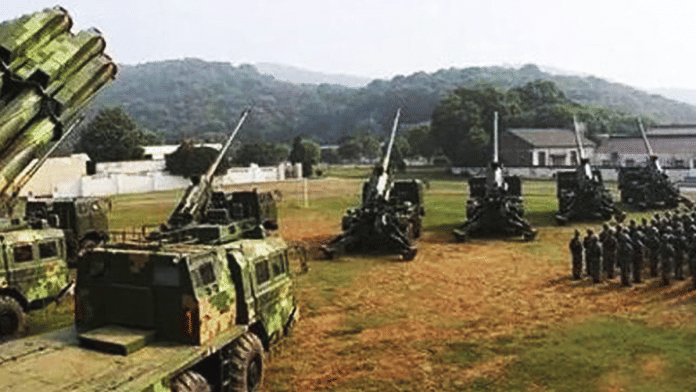
A recent development in the artillery world has drawn considerable attention in India—Pakistan is reportedly more than doubling its purchase of China’s SH-15 truck-mounted howitzers. A howitzer is a large artillery gun—a cannon designed to fire huge explosive shells over long distances at high angles. The SH-15 is China’s version of a modern, mobile howitzer mounted on the back of a military truck rather than towed by another vehicle. Because of its lighter weight, 40 km range and mobility, they are easier to manoeuvre in difficult terrains like the mountains, faster to deploy and quicker to escape from enemy counter fire—the capability to ‘shoot and scoot’.
In 2019, Pakistan ordered 236 of these SH-15 units. These carry the standard 155mm/52 calibre configuration. At its simplest, 155 mm is the diameter of the barrel, and 52-calibre is a ratio that denotes the length of the gun barrel. It means the barrel is 52 times longer than its internal bore diameter (155 mm), resulting in a barrel roughly 8.06 meters long. A longer barrel allows burning propellant gas (gunpowder) to push the artillery shell farther, resulting in more pressure and more muzzle velocity that increases range.
If either the diameter of the barrel (105 mm or 130 mm) or the calibre is lower (at 30 or 45) or higher than 52, it would impact the range of the gun sub-optimally.
Deliveries for SH-15 to Pakistan began in 2022. Latest reports say Pakistan plans to acquire more than 500 SH-15 howitzers, and over 200 have already been inducted into its army. That is enough to equip around 12 artillery regiments, with 18 guns in each regiment.
While in isolation, there is little need to over-read into the acquisition per se, but other dimensions need to be analysed simultaneously. First, SH-15 could be another Chinese piece of equipment given to the Pakistanis that isn’t a dumbed-down export variant, but the one closer to what China fields. The same gun is called PCL-181 in China. Second, Pakistan has also received technology transfer (ToT) from Beijing, allowing it to assemble—and possibly manufacture—the SH-15 locally at Heavy Industries Taxila.
In that sense, Islamabad has not only got its hands on a big gun but also the capacity to maintain, replenish and progressively localise it. Does that make it a game-changer? Not really.
However, the recent discussions in Indian circles have been about the country’s lack of a mounted gun despite domestic manufacturing capabilities.
Different dimensions—range, firepower, mobility, whether to import or to indigenise, how to integrate firepower at large and artillery, drone lessons from ongoing wars—need to be placed coherently in the larger picture.
Neighbours and their guns
The export relative of the SH-15, People’s Liberation Army’s PCL-181 supplies wheeled firepower in China’s layered artillery family. The 155mm barrel of these mounted guns is carried on 6X6 trucks. There is also a heavier version called PCL-181, which is mounted on tank-like tracks instead of wheels. The lighter PCL-161 and PCL-171 are truck-mounted 122mm guns that support mountain and high-mobility formations. Meanwhile, the PCL-191, often mentioned alongside them, belongs to a different category—it is a long-range rocket launcher, not a howitzer. China has deployed both PCL-181s and PCL-191s along its border with India.
Pakistan already operates American M109A5 tracked self-propelled howitzers and M198 towed guns, alongside older systems. Some years ago, it also obtained Turkey’s Panter, which also has a 155 mm howitzer gun of 52-calibre. Twelve of these were supplied for evaluation in 2007, followed by licensed production in Pakistan at Taxila. The Panter has an auxiliary power unit that permits some movement after being set up, but it still needs to be towed by another vehicle. The SH-15, therefore, fills a distinct gap by placing comparable 155/52 firepower (capable of firing heavy artillery shells over long distances- Already explained above) on a mobile truck able to enter and leave action much faster.
Pakistan had also reportedly employed Chinese-origin guns during Operation Sindoor. Some accounts identified the SH-15, although how it performed is not in the public domain.
To cut a long story short, India now faces Chinese-made truck-mounted guns across both continental fronts. While it would be wrong to suggest that Pakistan and China operate a seamless artillery doctrine, using similar equipment could make it easier to share ammunition, maintenance, training and operational feedback. Pakistan could also give China something military exercises cannot—combat data against Indian artillery systems.
That said, ground reality is more complex than the utility of mounted guns alone.
India’s artillery mix
Our neighbours fielding mounted guns stings because India’s Regiment of Artillery remains an uneven inheritance of several technological generations. Much of the inventory is still towed by another vehicle: old 155mm FH-77B Bofors, 105mm Indian Field and Light Field Guns, Soviet-origin 130mm M-46s, Dhanush, and Sharang guns upgraded from 130mm to 155mm barrels. Soviet-legacy M-46 guns originally fired 130 mms, with a range of 27 km. They were modernised using 155mm/45 calibre barrels from Israel’s Soltam systems.
India also operates 145 American M777 ultra-light howitzers and five regiments of K9 Vajra-T tracked guns (with five more in the pipeline). Rockets like Smerch, Pinaka and Grad add rocket artillery. Important to note that rockets perform a crucial but different function from tube artillery. Their dispersion being greater, they are used for area saturation and soft skin targets.
Each version mentioned above has a rationale. The M777 ultra-light howitzers can be carried via Chinook helicopters and enter terrain where heavy trucks may struggle. The tracked K9 can accompany armoured formations, which comprises tanks and mechanised infantry and has been very effective.
But several calibres and gun families complicate ammunition supplies, spares, training and maintenance. India’s intended transition toward 155mm firepower remains unfinished. Our Field Artillery Rationalisation Plan (FARP) roadmap was formulated in 1999 following the Kargil War. The Rs 20,000 crore ($3 billion) programme aimed to replace older weapons across more than 160 regiments with 3,000 to 3,600 standardised, 155mm howitzers by 2027.
The Advanced Towed Artillery Gun System (ATAGS) story captures part of this challenge. Developed in India by the Defence Research and Development Organisation (DRDO) with Bharat Forge and Tata Advanced Systems, the 155mm/52-calibre towed gun was ready. However, domestic procurement moved slowly, and the gun found export customers before getting some orders from the Indian Army.
Armenia tested six ATAGS and pursued additional systems; it also bought truck-mounted Mounted Artillery Guns made by Bharat Forge’s subsidiary company, Kalyani Strategic Systems. Only in March 2025 did India’s Ministry of Defence sign a contract with Bharat Forge and Tata Advanced Systems worth Rs 6,900 crore for 307 ATAGS weighing as heavy as 18-20 tonnes. However, since the era of towed artillery has passed, the likelihood of more orders is rather low.
Why ‘shoot-and-scoot’ matters
Mounted artillery is not simply a gun placed on a truck. Its operational value lies in the speed with which it can receive coordinates, enter action, fire and relocate in a contested environment. Today’s advanced counter-battery radars calculate a gun’s position from the trajectory of its shells and aim for destruction at source. Drones add another layer in firing areas, performing both surveillance, reconnaissance and destructive roles. When radar, UAVs and digital command systems are connected, the time between detecting enemy artillery and firing back can shorten to just a few minutes.
In Ukraine, this means that guns need to be moved quickly before they are detected. This is how they survive for more rounds of firing. Towed artillery needs a separate vehicle and crew paraphernalia to displace. A mounted gun carries its weapon, fire-control system and often ammunition on the same (or matching) platform, making it better suited to firing missions followed by rapid movement. In simple terms, it can quickly scoot to designated safe hides to protect itself after launching fire.
But truck-mounted artillery is not invulnerable. A truck on wheels still provides less protection to its crew and fire unit than a K9 on tank-like tracks. Loitering munitions may follow the trucks after they leave firing positions, while heat, electronic emissions and predictable roads reveal their movement
Therefore, “Shoot-and-scoot” is not the magic wand. It must be combined with dispersion, saturation, camouflage, deception, electronic warfare and counter-drone protection.
Can drones make up the shortfall?
The apparent answer is that India need not replicate Pakistan or China gun for gun. The Indian Army is pushing drones for target acquisition, battle-damage assessment and direct attack. Artillery units are training with Unmanned Aerial Vehicles (drones) while surveillance drones and loitering munitions are shortening the time between spotting the target and opening fire (sensor-to-shooter chain). Modern artillery is also flexible because of its longer range, allowing guns to switch targets from one battle area to another. The next challenge is making better use of this firepower. That will require operationalising Integrated Battle Groups ( IBGs), by breaking down turfism and silos within the armed forces.
Here, I must mention a valid lesson from Russia–Ukraine, though with some calibration.
Ukraine didn’t replace artillery with drones. It has demonstrated their optimal fusion. The Hague Centre for Strategic Studies reached precisely this conclusion: drones make artillery more accurate, reveal enemy batteries and provide a cheaper means of attacking individual targets. They are also vulnerable to jamming, weather and rapid attrition, and carry much smaller payloads. A swarm of First-Person View drones cannot easily reproduce the sustained, all-weather suppression delivered by a 155mm battery.
Other armies have reached similar conclusions. France has ordered 109 CAESAR MkII wheeled guns. Sweden is sending Archers to Ukraine along with drones. Britain and Germany are jointly pursuing the automated RCH 155. This artillery can move at the speed of 100km/h. China and Pakistan are themselves investing in drones and electronic warfare alongside mobile artillery. Beijing, in particular, has replicated the Ukrainian drone line along the border highway spanning over 10,000 kilometers in addition to integrating firepower at large.
These players have not missed Ukraine’s lesson; they have added drones to artillery gun formations with many more factors such as missiles, rockets, weapon locating radars and counter-battery measures and optimally linked to Electronic Warfare networks. Please note that modern militaries rely heavily on the electromagnetic spectrum (EMS) to function. From communications and radar to satellite navigation and drone targeting, dominating the EMS is an actual force multiplier—whoever controls the spectrum controls the battlefield.
Also read: Pakistan’s paradox under Asim Munir: A broker for the world, a bruised state for citizens
Optimally networked layers
India’s preferred way forward should therefore have all the above-mentioned parts.
Accelerating 155mm standardisation remains key, but adding Pinakas, drone batteries such as the Divyastra and drone regiments such as Shaktibaan have become crucial. This process has already begun but needs to be sped up across artillery regiments.
Second, there is reasonable value in time-bound competitive trials of indigenous mounted systems to address the shoot-and-scoot demand. But no indigenous know-how is likely to translate into ground capabilities until the Indian military’s General Staff Qualitative Requirements registers large enough orders, followed up by timely deliveries and upgrades.
This reverts us to a familiar underlying issue with complicated GSQRs—where the Army wants the best of everything within a tight budget and long procurement timelines, a stumbling block in today’s era of fast, a stumbling block in today’s era of fast technological innovation.
Swasti Rao is a Consulting Editor (International and Strategic Affairs) at ThePrint. She tweets @swasrao. Views are personal.
(Edited by Ratan Priya)