






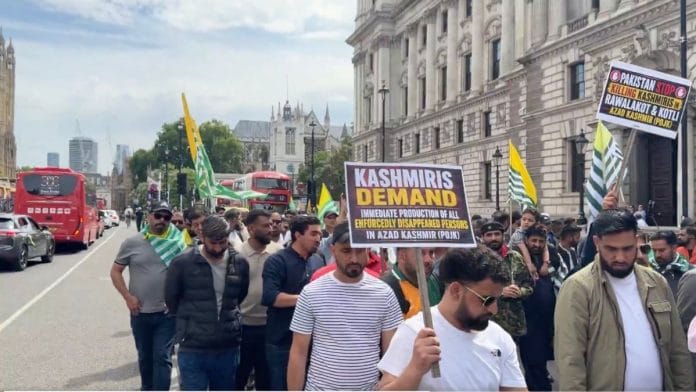

Thousands of British Kashmiris marched through central London on Sunday, voicing concern over the treatment of Kashmiris in Pakistan. A crowd of around 4,000 to 5,000 people, comprising mainly men but also women, raised slogans in support of the Jammu Kashmir Joint Awami Action Committee, which was recently banned by Islamabad under anti-terrorism laws. Some of the flags carried by the protesters bore the words “Freedom for Kashmir”, reflecting the sentiments of Kashmiri nationalists who seek independence for the entire region on both sides of the contested border. However, many of the protestors I spoke with said they were neither opposed to the Pakistani state nor supportive of separation. They did, however, want freedom from what they described as political oppression at the hands of Islamabad.
It seems that Pakistan’s Kashmir, which has historically been important to Pakistan in its contestation with India, has also begun to feel the consequences of being treated as a peripheral region. The sense is growing in Kashmiris that they too will not be granted genuine political freedom and will continue to be managed from Islamabad.
In the past two weeks, people in Pakistan’s Kashmir have experienced the whip of the state. Their organic political movement, JAAC, has been banned, curfew has been imposed across towns, and security forces have used violence, resulting in the deaths of an estimated 15 people, including four law enforcement personnel.
Although conditions remain under-reported in Pakistan’s mainstream media, information from local sources suggests that not only are thousands of people continuing to protest, but women have also joined the agitation. Crowds have gathered outside Rawalakot while police and the paramilitary Rangers continue their crackdown, reportedly breaking open shop doors and using force. The targeting of shopkeepers may be linked to the fact that some JAAC members are local traders and businessmen. It may also, as some people I spoke with suggested, be intended to pressure communities that support the protests. The security establishment is certainly in no mood to relinquish control.
Why Kashmiris are defying Islamabad
State-friendly politicians such as Bilawal Bhutto-Zardari have appealed to Kashmiris to call off the protests. His argument is that, with Pakistan close to its big moment of securing a US-Iran peace deal that could earn the country greater respect internationally, the moment should not be muddied by unrest and such disputes instead be resolved through democratic means. Such arguments find little sympathy in Pakistan’s Kashmir, where many view protest itself as a legitimate democratic process.
Bhutto-Zardari’s position is also understandable given the political circumstances. The current prime minister of Pakistan’s Kashmir, installed in November 2025, is led by Pakistan Peoples Party and emerged from a political arrangement between the PPP and the establishment. It was a quid pro quo for the party’s support of the controversial 27th Amendment, which extended the tenure of service chiefs from three to five years and elevated General Syed Asim Munir to the rank of field marshal.
Kashmiris protests the uprising of sort depicts years of exhaustion that people in Pakistan’s Kashmir feel regarding the way they have been managed by Islamabad.
While media figures close to the establishment have been busy portraying the protests as a foreign conspiracy, the uprising reflects years of exhaustion among people in Pakistan’s Kashmir over the manner in which they have been managed by Islamabad.
Also read: PoK’s revolt is the clearest sign of the unravelling of Pakistan’s political and military rule
Why grievances behind JAAC
The JAAC, which was banned on 5 June under the anti-terror legislation, is basically an organic coalition of lawyers, traders and some civil society activists. It emerged a couple of years ago to protest rising electricity prices and Islamabad’s bureaucratic control over the territory. It also expressed unhappiness with the politics of mainstream parties, which many Kashmiris said were complicit in loot and plunder.
People I spoke with said there was resentment towards the previous Pakistan Muslim League-Nawaz (PMLN) government led by former Kashmir prime minster Chaudhry Anwarul Haq. They argued that by appointing most legislators as ministers, the government effectively eliminated any meaningful opposition in the assembly, allowing everyone in power to share in the spoils of office.
The 38 demands put forward by JAAC are nothing more than a list of accumulated grievances. The primary one is the abolition of the 12 reserved seats in the legislative assembly of Pakistan’s Kashmir allocated to refugees from Indian Kashmir who resided elsewhere in Pakistan. The issue is that these 12 seats, out of a total of 53, are usually manipulated by the establishment, enabling it to engineer governments of its choosing.
Not that elections in the rest of Pakistan are fair, but such manipulation in peripheral territories is often used to deny them resources. There is also the problem of selection of the Kashmir Council, which is dominated by Pakistani bureaucrats and exercises control over the finances of the territory.
The protests were inevitable. Political manipulation has left ordinary people with little choice against rising costs of living, while Pakistan’s overall economic difficulties have only worsened the situation. Protesters argue that rising electricity and food prices are unfair, especially given that much of Pakistan’s hydropower is generated in Kashmir. Many believe this entitles them to subsides electricity at the very least.
They also want an end to political engineering, especially with Kashmir’s next general election approaching. Gilgit-Baltistan just held legislative elections that were also widely criticised as manipulated and engineered, which means Kashmir cannot hope for a different outcome.
Some sources I spoke with were of the view that the establishment may agree to reduce the number of refugee seats from 12 to six. But even that does not necessarily indicate that elections would be fair. JAAC itself is not keen on contesting elections independently, fearing that doing so would damage their movement.
People I spoke with argued that there is support for JAAC protests among the lower rungs of all major political parties, including the PMLN, PPP and Imran Khan’s Pakistan Tehreek-e-Insaf (PTI). This is despite the top leadership expressing a different view. Hence, JAAC leaders do not want to dilute this support for their larger cause.
Also read: PoK unrest is a 1971 moment for Pakistan. It’s a strategic opportunity for India
The diaspora factor
It is also important to note that the Kashmiris derive the confidence to stand up to the establishment from the fact that while the territory itself may not be resource-rich, millions of Kashmiris living abroad contribute significantly through remittances.
Besides the Gulf and West Asia, large Kashmiri communities from Pakistan’s Kashmir reside in the UK, Europe and North America. These communities have greater freedom and resources to raise their concerns internationally. This is one reason protests are taking place across different parts of the world and drawing attention to what participants describe as a lack of political and economic justice in Pakistan’s Kashmir.
Around 53 British parliamentarians have reportedly written to their prime minister expressing concern over the situation in Pakistan’s Kashmir. Yet it doesn’t seem likely that a lot of international pressure will be asserted on Islamabad. The US, UK and EU are too busy sorting out the Iran crisis to give attention to Pakistan’s domestic issues.
This lack of international attention, however, is not likely to bring the protests to an end. At best, the establishment may be able to tone down its intensity.
Interestingly, several people I spoke with during the London march were themselves not hopeful of any major shift in Pakistan government’s approach. Nevertheless, their willingness to continue marching shows a determination to challenge issues of severe political and economic misgovernance.
It is an issue Islamabad will eventually have to confront, once it is done celebrating its geopolitical victories.
Ayesha Siddiqa is a senior fellow at the Department of War Studies at King’s College, London. She tweets @iamthedrifter. Views are personal.
(Edited by Prashant Dixit)