






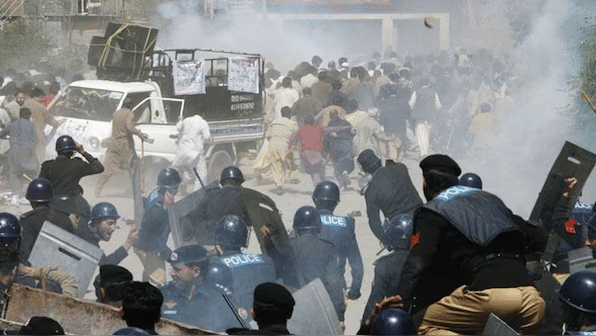


Pakistan is a living paradox. Over the past week, protests in Pakistan-occupied Kashmir have seen the Asim Munir-led military put its tried-and-tested modes of authoritarianism on brutal display. And just like that, the Pakistani establishment’s carefully curated façade of Islamabad being a peacemaker in the region evaporated as bullets and bans brought a different reality to the fore.
A political dispute over legislative representation has erupted into one of the deadliest episodes of unrest in the region in decades, with at least 15 people dead and 70 injured, according to local reports. Over the past week, thousands of protesters took to the streets after authorities moved to suppress demonstrations against the abolition of reserved legislative seats for refugees who migrated to Pakistan from Kashmir in India.
Pakistan is a country living in two realities—one projected by its rulers, with a Field Marshal who leaves no chance to gloat about the country’s growing global stature; the other is the reality that plays out on the ground, leaving blood and bodies in its wake.
The violence began after the Joint Awami Action Committee (JAAC), an umbrella coalition of civil society organisations, trade bodies and socio-religious groups formed in 2023, called for a march to Muzaffarabad on 9 June, the regional capital and largest city in the illegally occupied region. The protesters demanded that the seats be abolished before 27 July, when the region goes to polls.
Authorities responded by banning the JAAC under anti-terrorism laws on 5 June, accusing it of sedition, violence and activities prejudicial to state security. A bounty was announced for the arrest of some of the group’s leaders. The ban did little to halt the mobilisation.
For a large part of its history, PoK was seen as a hotbed of nationalist sentiment. The region has given rise to multiple senior-ranking generals in Pakistan’s military. Even the country’s current Director General of Military Intelligence, Major General Wajid Aziz, is from Palandri in PoK.
To see the region now rise against increasing military intervention signals a shift that is a telling sign of the domestic unravelling of Pakistani politics and military rule.
And that is why the protests in Pakistan-occupied Kashmir are ThePrint Newsmaker of the Week.
Also read: PoK unrest is a 1971 moment for Pakistan. It’s a strategic opportunity for India
Why PoK is protesting
Structurally, the region’s Legislative Assembly has a total of 45 seats, of which 12 are reserved for refugees from India who settled in PoK and Pakistan. The total population is around 50 lakh, with about 34 lakh registered voters.
The reservation policy was originally introduced to ensure that displaced Kashmiris retained a political voice in the territory’s affairs while awaiting a resolution to the broader Kashmir dispute after 1947.
The 12 seats are contested by individuals who do not reside in PoK. Local residents therefore argue that the system prevents those living within the territory from contesting a significant portion of legislative seats and allows outside political actors to exert influence over local governance. The JAAC has demanded that all representatives be elected by, and from among, residents of the region.
The Supreme Court of PoK ruled on 7 June that the refugee seats could not be altered through administrative measures, political agreements or public pressure. Any change, the court indicated, would require a constitutional amendment.
This is not the first time. The latest unrest follows a year of growing tensions between the JAAC and authorities. Last year in September, violent clashes between protesters and security forces left nine people dead, including three police officers. Following those protests, Islamabad dispatched a negotiating team to Muzaffarabad in an attempt to reach an agreement with the movement. Talks failed to produce a breakthrough.
The JAAC had presented a list of 38 demands covering political, economic and governance issues. Government officials say 37 of those demands have either been accepted or addressed. The sole unresolved issue remains the abolition of the refugee seats.
Also read: Why Pakistan-occupied Kashmir is in turmoil again. It has reached British Parliament now
More than a dispute over seats
Although the dispute over reserved seats has become the focal point of the current crisis, the protests reflect broader frustrations.
The conversation in the region has shifted from geopolitics to everyday life over the past few years. It first became clear when protests erupted in 2023, led by the JAAC over rising electricity bills. In 2024, the agitation centred on demands for access to subsidised flour and lower electricity rates, even though the Mangla Dam in the Mirpur region of PoK was supposed to generate hydroelectricity. The dam led to massive displacement while residents continued to face limited access to electricity despite sky-high prices. By 2025, economic grievances had given way to broader concerns over political rights and representation.
PoK is not an isolated case. Almost every region in Pakistan is witnessing a rise in insurgency, from Balochistan to Khyber Pakhtunkhwa and Sindh.
That is why the unrest carries significance beyond the territory itself.
Islamabad has long portrayed itself internationally as a defender of Kashmiri political rights. The images emerging from Muzaffarabad and other towns—of protesters confronting security forces while demanding greater representation and civil liberties—have ensured that the masks are off and prompted uncomfortable questions about governance inside the territory under Pakistan’s control.
Whether the movement evolves into a lasting political force remains uncertain, but the widening gap between official narratives and lived realities in Pakistan is now out in the open.
Munir could take a lesson: No amount of military messaging or coercive force can substitute for political consent. Multiple regional insurgencies, from Balochistan to Khyber Pakhtunkhwa and now PoK, are proof of that. Consent and legitimacy do not come from the barrel of a gun.
Views are personal.
(Edited by Prashant Dixit)