




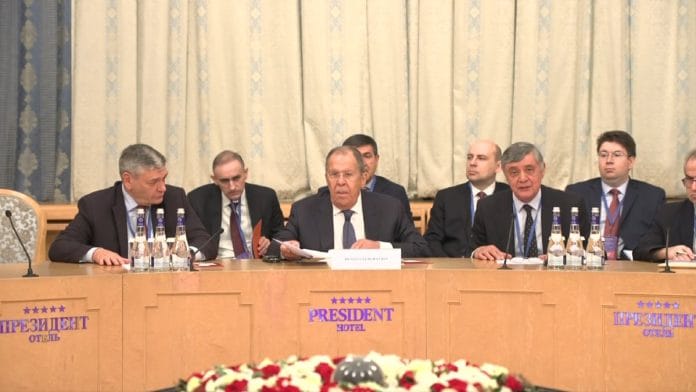

The eighth edition of the Moscow Format Consultations on Afghanistan concluded in the Russian capital on Monday, with representatives from Afghanistan, India, Iran, Kazakhstan, China, Kyrgyzstan, Pakistan, Russia, Tajikistan and Uzbekistan participating, while Egypt and Belarus attended as guests.
A joint statement did not see the light of day, perhaps the first time in the format’s history that a consensus could not be reached due to Pakistan-Afghanistan tensions. Russia regretted the outcome, but maintained nonetheless that the format would work and continue to exist even without one.
Across its previous iterations, joint statements have been useful in providing a sense of the participating countries’ position on Afghanistan. Even as they carry symbolic weight, they do not necessarily amount to a regional consensus in practice. So even if a final document had been adopted, the question that would still have arisen is whether the format is making full use of itself, given that it remains the broadest regional track on Afghanistan currently?
What is the Moscow Format?
Launched in 2017 by Russia, India, China, Iran, Pakistan, and Afghanistan, with the Central Asian Republics (CARs) joining soon after, the Moscow Format has since become a regular forum to deliberate on Afghanistan’s stability and progress. The Taliban were absent from the first iteration, but sent a delegation to the second one in 2018, when in attendance were members of Afghanistan’s High Peace Council, a government-established body participating as an independent national institution to facilitate intra-Afghan dialogue.
After a hiatus of nearly three years, the third iteration was held in October 2021, a couple of months after the Taliban had swept to power. The Taliban sent a delegation that year but were not invited in 2022. Even so, from 2021 to 2024, the statements called on the Taliban to form an inclusive government by ensuring the fundamental rights of all ethnic groups, including minorities, women and children. For instance, the 2023 statement, called the Kazan Declaration, said, “Regretfully…there had been no progress in forming a truly inclusive government.”
By the seventh iteration in October 2025, the joint statement had conveniently dropped any such reference. It wasn’t a coincidence that Moscow had granted formal recognition to the Taliban government that very year in July, and the Taliban participated in the format for the first time as a full member.
Had a consensus document been adopted this year, chances are it would have been silent on inclusive governance. This issue doesn’t appear to rank among the participants’ priorities; instead, it has been subsumed by larger interests like counter-terrorism, trade, and connectivity, for which the appeasement of the Taliban serves to secure a practical modus vivendi. One reason the drafters, not least Moscow, may have changed the wording is that Russia sees the Taliban as a willing partner against the Islamic State – Khorasan Province (ISKP) and does not want to risk antagonising them; ISKP is an enemy of the Taliban and claimed responsibility for the March 2024 Crocus City Hall attack.
One thread, though, has remained consistent: allusions to disapproval of US actions in Afghanistan. This is couched in how the forces behind the 20-year military presence in Afghanistan should bear the responsibility for its post-conflict reconstruction. Recent editions have, in fact, called attempts by countries to deploy their military infrastructure in Afghanistan “unacceptable”, a line that gained significance after US President Donald Trump spoke of regaining control of the Bagram air base in Afghanistan. The statements have also abidingly opposed the politicisation of humanitarian aid. All of this is widely read as aimed at Washington.
Also read: Taliban’s welcome is justified by pragmatism. It’s also full of moral fault lines
Between values and interests, Afghans suffer
Russia and China have moved to fill the vacuum left by the US withdrawal from Afghanistan.
But neither makes values a core tenet of its foreign policy, nor do they have the means to impose them like Washington. Until recently, both at least endorsed calls for inclusivity.
Washington’s values-based approach, which makes engagement and aid conditional on the Taliban’s improvement on the human rights front, has left Afghans worse off, given that Washington has been the largest international aid donor, even after its withdrawal. But Moscow and Beijing’s purely interest-led engagement, which leaves little room to raise the Taliban’s rights record, is equally flawed. Afghanistan needs a synthesis of both these approaches.
Without that, the Moscow Format risks becoming a talk-shop, regurgitating platitudes and taking shots at rival countries. Since it is a Russia-led platform, one can expect some degree of West-bashing like Russia congratulating the Taliban on the “5th anniversary of Afghanistan’s liberation from NATO’s military presence”; however, this agenda should not overshadow the forum.
Russia’s special envoy for Afghanistan described the format as a platform for “coordinating regional cooperation”, and not for resolving bilateral disagreements. Yet the latter appears to be hijacking it.
Pakistan issued its own statement on the format. Among other things, it said terrorism remains at the core of Afghanistan’s problems, that 4,700 innocent Pakistanis have lost their lives due to terrorism emanating from Afghanistan and that the Taliban regime is complicit. On the other hand, the Taliban objected to linking terrorism to Afghanistan (even as this had featured in past statements), which prevented the adoption of a joint statement. Taliban’s Foreign Minister Amir Khan Muttaqi said Afghanistan-Pakistan tensions can be resolved through dialogue and diplomacy, but Pakistan only deploys military language.
With Afghanistan having receded from the global agenda and forums for discussing the country’s state of affairs few and far between, the inability to overcome bilateral feuds augurs ill.
It is against this backdrop that a declaration adopted at the conclusion of the fifth Cambridge Afghanistan Series Conference, organised by the UK-based Mosaic Global Foundation in the famed halls of the University of Cambridge, is a welcome step.
Titled ‘Cambridge Declaration on Democratic Cooperation and Convergence for Afghanistan’, it has charted out eight principles agreed upon by the participants — including a spectrum of Afghan opposition figures, civil society activists, former government leaders and academicians – and offers perhaps the broadest, most inclusive roadmap any initiative has produced thus far. This includes calls for full rights and representation for women, minorities and every community along with an Afghanistan-led political process for the country’s future. These are the very commitments that have begun fading from the Moscow Format’s statements.
While this declaration is unlikely to change anything on its own, any format on Afghanistan would do well to take a leaf out of its book. Engagement with the Taliban is a practical approach. Normalising their reprehensible policies under the garb of a ‘necessary evil’, however, cannot remain the way forward, even five years into Taliban rule.
Bantirani Patro is a staff writer at ThePrint. She tweets @bantirani_patro. Views are personal.
(Edited by Prashant Dixit)
Cold heartless world. Afghanistan. Nepal after the earthquake. It is for the Taliban to do a better, more enlightened, humane job of governing the country.