




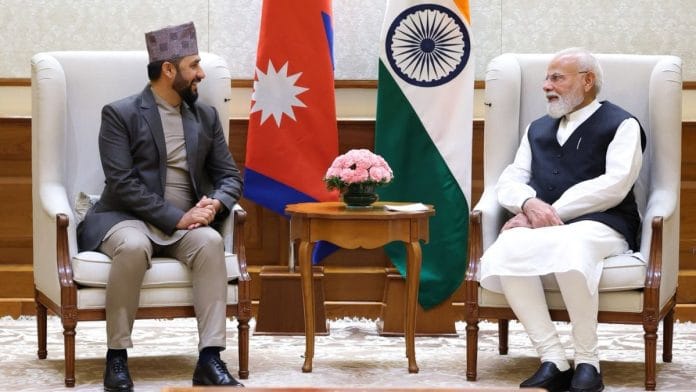

The successful high-level visit of Nepal’s ruling Rastriya Swatantra Party Chairman, Rabi Lamichhane, to Delhi was followed by Foreign Minister Shishir Khanal’s visit on 5 June. The two visits showcased the meticulous political and diplomatic work between the two countries to prepare the ground for Nepal Prime Minister Balendra Shah’s much-anticipated first foreign visit since becoming the world’s youngest Prime Minister in March.
While Lamichhane’s visit to Delhi at the invitation of the ruling Bhartiya Janata Party (BJP) prepared the political ground, Khanal’s visit was the first ministerial-level visit from Kathmandu, a much-needed diplomatic boost in bilateral ties, and a marker of preparation for Shah’s potential first visit to India.
Keeping aside the political and diplomatic signalling these two visits generated, there was another landmark achievement made in bilateral ties—the completion of the processes for the India-Nepal Mutual Legal Assistance Agreement in Criminal Matters (MLAA). This was announced in a media release made by India’s Ministry of External Affairs (MEA) on Khanal’s visit.
But what significant value does the MLAA update hold?
MLAA is a critical security framework
At the heart of the MLAA stands the open border between India and Nepal. The two sides share a 1,751 km-long open border. Often referred to as a lifeline to Nepal due to its landlocked nature, the open border facilitates visa and passport-free movement for the people of the two countries—a reflection of a closer people-to-people bond between the two neighbours.
Simultaneously, the border puts security establishments on high alert because non-state actors often use it to create instability and security threats.
Over the years, the security agencies on both sides have worked to establish a rules-based mechanism for coordinating and capturing non-state actors and wanted elements. While matters about extradition are governed by the Extradition Treaty, originally signed in 1953 with subsequent revisions to it, the MLAA is a unique security arrangement that will “benefit the people of India and Nepal by providing an institutional legal framework to enhance the effectiveness of investigation, prosecution and judicial proceedings relating to cross-border crimes.”
The agreement has been a work in progress for more than two decades. A draft MLAA agreement was transmitted on 22 June 1999, a period when Nepal was undergoing a Maoist Insurgency and the Monarchy was still the most prominent institution in Nepal’s politics, security and administrative spheres. The agreement was mainly discussed at Home Secretary-level meetings beginning in 2002, followed by the finalisation of its text in 2005 in Delhi by the Home Secretaries of the two sides.
The agreement was finally signed in February 2025.
What could have been the reasons for the delay? A possibility is a political transition in Nepal from a constitutional monarchy to a full-fledged democracy in 2008, followed by frequent changes in government and leadership thereafter.
Now the remaining task is to implement the agreement, and given Nepal’s political stability and bilateral intent, it awaits the completion of the final step—its implementation.
The need for such an agreement was clearly recognised during the Maoist-led civil war in Nepal from 1996 to 2006. It is noted in several accounts that members of Nepal’s Communist Party (Maoist) escaped into India through the open border to avoid arrests and legal actions in Nepal. Even the Nepal Maoists’ top leadership, including Pushpa Kamal Dahal alias Prachanda, had reportedly “slipped between India and Nepal to escape the authorities.”
Prachanda later became the prime minister after agreeing to the arms surrender, peace proposal, and integration with the country’s mainstream political system.
Had the agreement been signed and implemented then, Nepal could have raised such matters of escape under the MLAA arrangements. However, in practice, the MLAA addresses key security and strategic problems arising from an open border, including dense cross-border criminal exposure, such as smuggling, trafficking, terrorists, criminals, cyber-enabled frauds, fugitives, and those wanted for financial misdeeds.
The agreement benefits the security agencies in addressing such matters in a more structured manner under the legal ambit.
Also read: How the Chinese are viewing the meeting between Xi Jinping and Kim Jong Un
Nepal’s MLAA moment with China
Nepal signed a similar treaty with China in 2019. While China had been pressing Nepal to sign an MLAA for more than four decades, it was finally agreed upon during Chinese President Xi Jinping’s high-level visit to Nepal in October 2019. In the joint statement released by the two sides, they also noted their satisfaction with “signing the Treaty on Mutual Legal Assistance in Criminal Matters.”
However, signed, the Chinese side still awaits an Extradition Treaty with Nepal—something it has been insisting on for a long time, while the Nepalese side has kept it under wraps.
During the 2019 visit, Xi had “expressed hope for an early conclusion of the Treaty on Extradition” with Nepal. As of 2026, the extradition treaty remains under discussion, and the MLAA awaits ratification of the agreement.
Also, when Prachanda visited China in 2024 as a PM, the two sides had agreed to “expedite the ratification of the China-Nepal Treaty on Mutual Legal Assistance in Criminal Matters.” The progress has still not been made.
While China has been keen on strengthening such a mechanism with Nepal, the latter has its own obligations when framing, signing, and implementing such mechanisms, mainly due to the thousands of Tibetan exiles who arrived in Nepal by crossing the mountainous Himalayan terrain to escape the Communist regime.
Between the 1960s and the 1990s, thousands of Tibetans crossed into Nepal and then used the open border to enter India to be with the Tibetan government in exile in Dharamshala, while many stayed in Nepal due to its religious significance.
Interestingly, since the 1990s, the number of Tibetans crossing into Nepal has decreased sharply. Also, since 2008, the activities of the Tibetan exiles in Nepal have been very controlled. However, China still has its fears that movements like ‘Free Tibet’ in Nepal could ignite a first in Tibet or vice versa.
Therefore, ensuring a mechanism of legal assistance on criminal matters and an extradition treaty could further tighten the grip on Tibetans living in Nepal.
The Chinese concerns over Tibet are so visible that in every official joint release, sections on Tibet appear very prominently. The 2024 joint statement read, “The Nepali side reiterated that Xizang (Chinese name for Tibet) is an internal affair of China, and that it will never allow any separatist activities against China on its soil.”
Therefore, China, in many ways, sees Tibetan exiles as a potential security threat to peace and stability in Tibet, and when countries like the US express their support for Tibetan exiles, it worries Beijing. And that is where a mechanism like MLAA and extradition could empower China and also put the future of Tibetan exiles in a delicate sphere of interpretation—who is a separatist and who is not in the eyes of China.
To conclude, for Nepal, these instruments are less about abstract international law than about managing differences in interpretation between the two countries. While an open border warrants regular interactions on criminal matters, a legal framework provides a roadmap for the future.
At the same time, an MLAA might empower the Chinese state to further control the activities of the Tibetans, but for Kathmandu, this could also serve as a mechanism to have a more textually disciplined framework that will take away the vagueness of who is described as a wanted and a separatist by Beijing or the other way round.
Rishi Gupta is a Commentator on Global Strategic Affairs. Views are personal.
(Edited by Saptak Datta)