






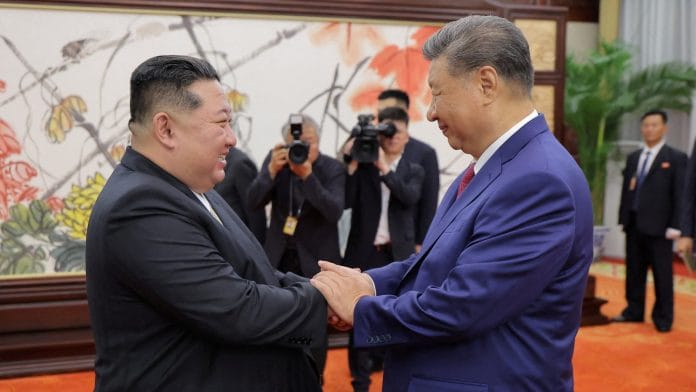


In 30 hours, Chinese President Xi Jinping participated in 11 events in North Korea” was a repeated description of Xi’s visit to Pyongyang on 8 June and 9 June across the Chinese internet. Official and state media accounts laid out the itinerary in detailed and celebratory terms, tracing the visit from a grand welcoming ceremony at the airport to a China-DPRK Friendship Tower visit and a formal farewell on departure. North Korean supreme leader Kim Jong Un’s close personal attention to the visit was constantly highlighted.
Across state media coverage, the visit is rendered as a carefully structured sequence of diplomatic rituals. Military bands, cavalry units, and coordinated receptions are presented as elements of an orchestrated display of bilateral friendship, while mass participation in Pyongyang is foregrounded as part of the ceremonial landscape. Particular emphasis is placed on visual imagery, especially children in festive dress waving flags, which has circulated widely across Chinese state-affiliated media platforms.
This year marks the 65th anniversary of the Treaty of Friendship, Cooperation and Mutual Assistance between China and North Korea. Against this backdrop, Chinese discourse places strong emphasis on continuity. As Tang Xiao, an expert from the Institute of Asia-Pacific Studies of the China Institute of International Studies, notes, the visit is framed as a reaffirmation of a long-standing friendship forged in past struggles and sustained across generations. This layer of discourse is characterised by a deliberate emphasis on symbolism, protocol, and affective political messaging.
Xi’s first visit to North Korea in seven years is treated as politically and strategically weighted. One Chinese commentary argues that the length of the gap itself signals that this was far from a routine diplomatic exchange. References to “issues of common concern” are interpreted as extending beyond bilateral relations to a wider regional and international agenda.
Why Pyongyang, why now?
A strand of Chinese discourse, drawn from online platforms such as Weibo alongside policy and think tank commentary, situates the visit within a broader trajectory of post-pandemic consolidation and advancement of ties. A Weibo post presents the visit as the culmination of a series of high-level exchanges that have steadily restored and strengthened China–North Korea relations since the pandemic. It argues that the trip represents a natural progression of growing party-to-party, diplomatic, and governmental engagement between the two countries.
Across Chinese discourse, three interrelated logics recur in explaining the timing and purpose of the visit: The first is a shift towards periphery-centred diplomacy, with China portrayed as prioritising its immediate neighbourhood and shaping conditions rather than just reacting to them. Engagement with North Korea is framed as part of a broader effort to stabilise the near periphery.
The second centres on stability as the organising principle of Northeast Asian geopolitics, constructed across the bilateral relationship, the Korean Peninsula, and the wider regional environment. The third reflects an evolving diplomatic posture, moving from defensive bottom-line management towards proactive regional engagement and strategic flexibility.
Within policy-oriented commentary, these themes are articulated through a language of strategic communication and coordination. Zhan Debin, director of the Center for Korean Peninsula Studies at Shanghai University of International Business and Economics, said that China and North Korea, while pursuing different development paths, benefit from strengthened exchanges across party, state and military channels, both to enhance mutual trust and to support regional stability.
Zheng Jiyong, president of the China Association for Korean History Studies, emphasised that deeper coordination and regular communication could improve predictability in Northeast Asia and reinforce regional economic linkages. Zhang Huizhi, deputy director of the Northeast Asia Research Center at Jilin University, similarly argued that pragmatic cooperation in economic and social fields would support broader regional cooperation and contribute to stability and prosperity in Northeast Asia.
Also read: What do Chinese make of Su-57, RELOS & India-Russia defence ties? Marriage of necessity
Signalling and regional positioning
Within online discourse and select policy commentary, the visit is also interpreted through a signalling lens. A Weibo post contemplated that the visit could be a mechanism for strengthening political trust while simultaneously reinforcing China’s role in shaping the Northeast Asian security environment. Closer coordination between Beijing and Pyongyang is described as contributing to a recalibration of regional strategic balance, particularly in relation to US and Japanese influence, while also creating conditions conducive to renewed diplomatic engagement on the Korean Peninsula.
In this context, Xu Liping, a researcher at the Institute of Asia-Pacific and Global Strategy Studies, the Chinese Academy of Social Sciences, believes that in a volatile international environment, the visit contributes to stabilising China’s external periphery and strengthening the broader regional environment.
Chinese coverage introduces a notable reframing of North Korea itself. Rather than foregrounding nuclear tensions or sanctions, Kim Jong is depicted as pursuing economic modernisation under constrained conditions. North Korea is discussed through a developmental lens that draws implicit parallels with China’s own reform-era trajectory, reinforcing an implicit sense of normalisation.
This shift partially displaces the dominant security-centric framing of North Korea. Attention moves towards the coexistence of economic adjustment and political control, with Xi’s visit implicitly read as an endorsement of a development-oriented pathway and a form of mainstreaming within regional discourse. Chinese reporting seems to situate China–North Korea relations within narratives of continuity, stability, and economic engagement, while signalling China’s preference to be recognised as a central actor in shaping the strategic architecture of Northeast Asia.
Sana Hashmi, PhD, is a fellow at the Taiwan-Asia Exchange Foundation. She tweets @sanahashmi1. Views are personal.
(Edited by Saptak Datta)