




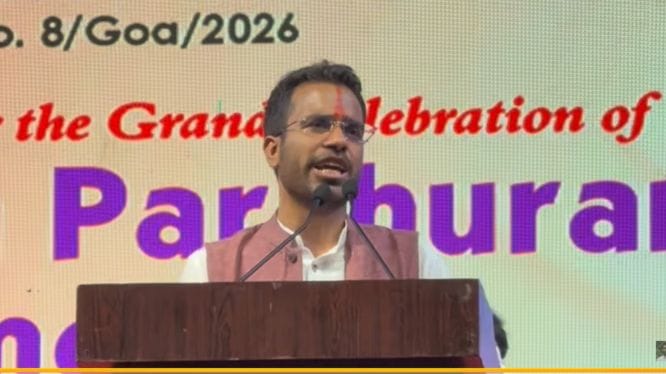

At a Parshuram Jayanti celebration on 18 April in Goa, a man, who describes himself as “half-YouTuber, half-journalist”, went up on stage and bit off more than he could chew.
Gautam Khattar, a rabid YouTuber on the “spiritual beat”, best known for making controversial and communal claims, was invited to speak at the event in Vasco. In one part of his speech, he declared that women should not be granted 33 per cent reservation in Parliament. His evidence is that women parliamentarians have never raised issues related to women on the floors of both houses, which is a claim so breathlessly false that it barely deserves rebuttal. But no matter. It wasn’t even the most offensive thing he said that afternoon.
Khattar then turned his attention to St Francis Xavier and labelled him a “terrorist and a cruel ruler”. “Goencho Saib” is considered the patron saint of Goa, and is a figure revered across faiths for nearly five centuries. Khattar had this to say about him: “Now his body has decayed, worms have eaten it; neither his soul remains nor his body. Even his bones were eaten and turned to dust. Yet, I don’t know what kind of festival is held every year, where lakhs of followers of Sanatan Dharma go and fold their hands in reverence toward someone who spent his whole life converting them, who turned lakhs of Sanatan followers into Christians.”
In an account by journalist Devika Sequeira, a woman walked onto the stage and handed him a handwritten note, perhaps asking him to stop. Khattar waved it away, perhaps emboldened by parts of the crowd that had begun chanting “Jai Shri Ram”. He then asked whether any legislators were present and thanked them for not interrupting.
There were actually three BJP legislators on stage throughout this. The most prominent of those was minister Mauvin Godinho, whose portfolio spans transport, industries, trade & commerce, panchayati raj, protocol & hospitality and legislative affairs. The others were Vasco MLA Krishna “Daji” Salkar, and Mormugao MLA Sankalp Amonkar. No one stopped the speaker, though by some accounts, Salkar might have tried to send messages to the organisers.
Godinho went a step further and actually praised “Kattarji” from the same podium afterward. He called the speech a necessary corrective to wrongs perpetuated by the Congress, and only offered a limp public statement days later, after Chief Minister Pramod Sawant publicly checked him. Godinho’s defence was that he had tried to intervene but feared creating a law-and-order situation, as though one wasn’t already underway at the microphone.
The remarks have since snowballed into one of the biggest communal controversies Goa has seen in years. Protests have erupted across the state, from Margao to Vasco to Anjuna. Candlelight vigils have been held, and several organisations have demanded Godinho’s removal from the cabinet. Khattar’s brother Madhav, who had reportedly scripted the speech and coordinated the logistics — including a payment of Rs 51,000 for the appearance — was arrested in Haridwar. Khattar himself was eventually detained in Kullu, Himachal Pradesh, after a multi-state search and brought to Goa.
Propagation of hate
All across India, the propagation of hate is a profitable business. Every once in a while, though, its consequences become all too real.
Khattar’s case will take its own course, but what’s riled most Goans is Godinho’s role on that stage. The trajectory of Godinho’s career tells you something about the shape-shifting demands of Goan politics. Once a Rajiv Gandhi insider and Youth Congress president, he crossed over to the BJP in 2016 under Manohar Parrikar’s patronage. In the years since, he has reinvented himself with considerable enthusiasm, aligning closely with the ruling party’s central ideology.
During a 2023 Independence Day speech, Godinho had said he was “first a Hindu before my ancestors were converted”. On another occasion, he described himself as “more Hindu than Catholic”. Part of this is Godinho playing to a specific gallery — a Goa of mutable demographics and migrant vote banks. As Kaustubh Naik, a doctoral scholar at the University of Pennsylvania, puts it: “Godinho is so confident because he probably believes his support base is non-Goans. He knows his votes don’t come from the Catholic community.”
But which community put you in office becomes irrelevant once you’re there. Many Goans are less interested in Godinho’s political arithmetic than his constitutional responsibility. Father Maverick Fernandes, Director of the Council for Social Justice and Peace, told me, “He has taken an oath to the Constitution. When you witness such things, you leave from there and make a statement to the press. But he remained there.”
The event at which Godinho remained was a celebration of Parshuram. The myth of Lord Parshuram as the creator of Goa has gained traction in recent years. According to legend, Parshuram, labelled Gomantbhoomi Janak, is supposed to have shot a divine arrow from the Sahyadri mountains into the Arabian Sea, commanding the waters to recede, thereby creating the Konkan coast. The most visible marker of this is the Yog Setu in Panjim, which leads you to a towering statue of Parshuram, overlooking the casino ships bobbing on the Mandovi.
But as Naik has argued in a detailed recent piece on the myth’s origins, the association of Parshuram with Goa is a modern phenomenon, crystallised in the late 19th and early 20th centuries. Versions of the same myth exist all along the Konkan coast. In each retelling, Parshuram settles a different set of Brahmins — the Chitpavans in Maharashtra, the Kerala Brahmins further south — in the land reclaimed from the sea. The Goa government, Naik writes, “is actively upholding a narrative that Saraswat Brahmins were the original settlers of the land”. “According to the myth, the land simply did not exist prior to the striking of Parshuram’s arrows, and it was first populated exclusively by the Brahmins themselves. Where does that leave the rest of the people? Where does that put the Gaudas, Velips, Kunbis and other labouring communities that are believed to be the original settlers of this land?”
It is, at its core, a caste origin story. But it is now being pitted against a figure whose hold on the popular imagination runs far deeper than any political project can dislodge. Saint Francis Xavier’s feast, exposition, and novenas in Old Goa draw lakhs of followers every year, and a significant number of them are non-Christian Goans. A veteran journalist based in the state told me that “reverence in India works in such a way that people feel that they can’t afford to miss out on blessings”, whether the deity is Hindu, Muslim, or Christian.
This isn’t the first time St Francis Xavier is at the centre of a controversy. In 2024, former Goa RSS chief Subhash Velingkar suggested that his remains undergo a DNA test, leading to a situation similar to the present one. Velingkar should have remembered former CM Manohar Parrikar’s abortive attempts to remove the public holiday on the feast of SFX around 2002.
Fernandes recalled overhearing a conversation between two Hindu men during a ferry boat ride from that era. “One of them said: ‘This guy will not remain the CM for too long’,” he told me. “And sure enough, in the month of February, he was no longer CM. It was like a prediction come true.”
Parrikar did go on to lead the government again in June that year. But that small anecdote illustrates that the neat communal categorisation that defines politics elsewhere in India, doesn’t work in Goa. Unlike major states in north and central India, Goa has been able to resist communal polarisation thanks to its unique social fabric.
Also read: Wanted—A Bengali face. Why the BJP’s reliance on the central leadership has its limits
Goa’s demographic wall
Cyril Fernandes, President of the Catholic Association of Goa, pointed me to the Lairai Zatra, an intense annual festival dedicated to Lairai Devi, which brings Hindus, Christians, and Muslims together. The cult of the Saptamatrukas, or seven mother goddesses, takes on a different local colour in Goa. “One day, the people will gather for the Lairai Zatra,” he said. “The next day, they will bring offerings of oil to Milagres Saibinn, because the deities are considered to be sisters.”
This is why the polarisation playbook runs up against a demographic wall here. Christians and Muslims together make up nearly a third of the state’s population. In a state Assembly where victory margins are often razor thin, no party can form a government without significant minority support.
Still, it runs deeper than demographics. Take the beef issue, for instance. Gau rakshak groups have been active in Goa since at least 2010, raiding traders and pressuring the state-run Goa Meat Complex. In 2017, new central regulations disrupted beef supply almost overnight, an existential situation for a state where the meat is consumed by nearly half the population and where the tourism economy depends on it.
Parrikar, who was CM at the time, ensured legal supply resumed within days, making it clear that anybody interfering with documented imports would face the law. Despite ideological pressures within the BJP, this fine balancing act is essential for every Goa leader, including Pramod Sawant.
There are parallels to this project in several other arenas, such as the murmurs over conversions, the calls for the reconstruction of temples destroyed during the Portuguese era, and the efforts to rally sentiment around Chhatrapati Shivaji Maharaj (sometimes, in illegal ways). Naik told me that these attempts keep failing because “there is a sedimentation of quasi-regional identity that trumps polarisation”. After all, he points out, “there has never been a moment in Goan history where one community has dominated.” It is this accumulated weight of cohabitation, shared commerce, and intertwined daily life, that the communal template cannot parse.
All of this matters especially because Goa goes to the polls next year. Across India, BJP governments are expected to amp up communal rhetoric in every poll-bound state, most recently witnessed in West Bengal and Assam. In Goa, that strategy has not found purchase.
And yet, something seems to have shifted. Cyril Fernandes told me that minority communities have never been made to feel isolated. “But now, after this incident, we feel we might have been overconfident and lethargic, thinking that these things never happen here,” he said. For the first time, Fernandes and his colleagues are considering demanding a minority commission and bringing the state’s Christians, Muslims, Parsis, and Sikhs together in a coalition.
Parrikar had wanted to form such a commission in 2012, but the idea went into hibernation. The Khattar incident might have awoken it. As Fernandes told me, “No one can defeat the communal harmony of Goa, it is in our blood. We will not allow other forces to destroy it.”
The defiance holds — for now. But it no longer feels easy, and it may not always remain inherited.
This article is part of the Goa Life series, which explores the new and the old of Goan culture.
Karanjeet Kaur is a journalist, former editor of Arré, and a partner at TWO Design. She tweets @Kaju_Katri. Views are personal.
(Edited by Aamaan Alam Khan)
One sided narrative by the blogger
How is telling a truth about some murderer and killer and educating people about the false narrative propagated by church wrong.
So many frauds like Teresa , Xavier etc whose only aim was to convert have been shown as doing miracles which is utter fraud on Hindus.
Problem is if truth comes out, half penny journalist like you masquerading as intellectual will lose their jobs.