






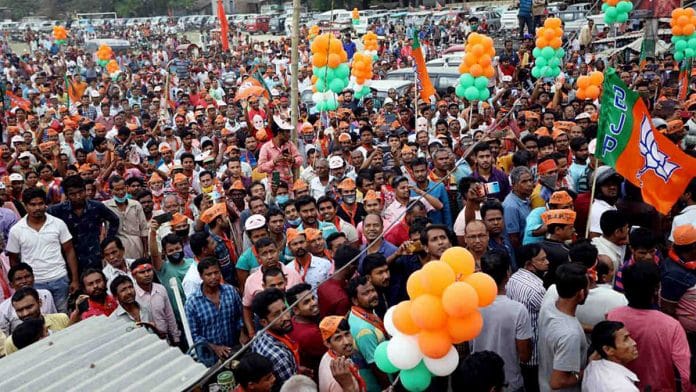


The BJP in its current avatar was born in 1980, but the process of formation of its precursor, the Bharatiya Jana Sangh, was begun by Syama Prasad Mookerjee more than seven decades ago in Kolkata. Why, then, has it taken so long for the party to become a significant player in the state of its founder? Moreover, what are the chances that the Bengal BJP will not only retain its newfound popularity but also grow further? To answer these questions, it is necessary to take a quick look at some key trends in Bengal’s political journey.
The first general elections of 1951-1952 provide a clear picture of the political alignments in the state across the ideological spectrum. In the assembly elections, while the Jana Sangh and the Hindu Mahasabha received about 6 and 4 per cent votes respectively, the leftist parties received about 29 per cent, and the Congress received 42 per cent. Thus, the left-of-centre Congress had the largest vote share, followed by the Left, while the Right lagged, even at a time when the state was torn apart by communal politics. Remarkably, over 22 per cent of votes went to independent candidates, indicating a large space available to be occupied by the existing political groups.
The Left parties, particularly the Communist party, expanded on the back of mass movements related to labour issues, civil liberties, and agrarian reforms, which were based on an ideological grand narrative guided by the international socialist and communist movements. Needless to point out, the Congress had the legacy of the freedom struggle. The programme of the Right-wing parties, on the contrary, remained confined to the protection of Hindu interests without developing it into a framework that could challenge the Leftist and Congress narratives.
As Bengal moved through the Muslim League’s gory Direct Action Day of 16 August 1946, the Noakhali riots, the Partition, and an influx of millions of Hindu Bengali refugees, the Mahasabha failed to respond effectively due to the absence of a narrative framework, combined with a lack of inspiring leadership. They were not able to cultivate the most obvious constituency of Bengali Hindu refugees. The lack of its influence was visible in the 1946 elections, where the party received less than 2 per cent of the votes. West Bengal’s first Congress chief minister, Prafulla Ghosh, defeated the Hindu Mahasabha and got elected to the Assembly in November 1947.
Why did the Hindutva parties fail to grow in Bengal?
Among the serious organisational setbacks that the Hindutva parties suffered after Independence was Mookerjee’s resignation in 1948 from the Mahasabha and the impact of the government crackdown following MK Gandhi’s assassination. The Mahasabha suffered not only organisationally but a loss of image on account of the charge of complicity in the assassination. The third factor was Mookerjee’s death before he could organise the Jana Sangh as a political force in the province. Other similar parties, such as the Ram Rajya Parishad, could not make any impact due to a lack of any connection to Bengal’s ethos.
Whatever potential the Jana Sangh had was decimated with Mookerjee’s sudden death in June 1953. There was neither a strong organisation nor a Bengali leader of Mookerjee’s stature to carry its flag forward. With this, the Congress and the Left parties expanded their footprints to occupy the state’s political space.
The Jana Sangh, and later the BJP, could never cross even one per cent vote share until the 1991 elections, when the BJP received 11 per cent votes on the back of the Ram Janambhoomi movement. The next time the party crossed the 10 per cent mark in Assembly elections was in 2016, thereafter reaching a high of more than 40 per cent vote share in 2019, dropping slightly to 38 per cent in the 2021 Assembly elections and increasing marginally to 39 per cent in the 2024 Lok Sabha elections.
This remarkable feat was achieved by the BJP not on the back of organisational prowess or power of ideological narratives. With a skeletal organisation and almost no core voter base, the BJP rode on the back of Prime Minister Narendra Modi’s nationwide popularity and the state’s internal political dynamics, which resulted in an en masse vote transfer from the erstwhile Left party supporters.
The Trinamool Congress, on the other hand, has built a formidable organisation with nearly complete control over both urban and rural politics and the state’s administrative machinery, complemented by several cash transfer schemes for women, students, unemployed youth, the elderly, and healthcare benefits, which have resulted in a dedicated vote bank. Based on this carrot and stick approach, the TMC has not only succeeded in taking over but in growing the core voter base of the Congress in the state, which has never dipped below 35 per cent except twice in the 1970s.
A striking characteristic of Bengal’s political culture is that anti-incumbency appears to be a less important factor than in other states. Historically, power has not changed hands as frequently in Bengal as in other states. Barring a small window of instability between 1967 and 1972, the Congress was in power for 25 years in Bengal, the Left Front for 34 years, but now the question is whether the TMC can extend its tenure to 20 years.
Also Read: How Mamata Banerjee turned Bengali identity into a potent electoral weapon
What BJP needs now
Systemic corruption exposed in teachers’ employment, the public distribution system, lack of employment opportunities, the judiciary’s rejection of laws introduced to benefit certain segments as unconstitutional, arrest of ministers and leaders by investigative agencies, and widespread instances of extortion by political workers have had little visible impact on the results of elections.
The Bengal BJP, unfortunately, hasn’t paid enough attention to strengthening its organisation following the windfall of votes in 2019, nor has it been able to develop a narrative grounded in the social-cultural-political tradition and current realities of the province to retain the transferred votes. Rather than nurturing potential constituencies such as teachers, women, youth, government employees, etc., around the above issues, the BJP continues to highlight the issue of illegal migrants from Bangladesh and the threat of radical Islam.
The party also faces a lack of clarity regarding its Hindutva ideology and its application in a state with a significant Muslim population, nearly a third of the total.
Additionally, the party has shown disproportionate reliance on the central leadership and the brand image of leaders like Modi, Amit Shah, and Yogi Adityanath to convince the state electorate. Ironically, at the same time, the BJP has not been able to market the benefits yielded by central government schemes. The absence of a local band of senior leaders who would speak and work as one, or a second rung of fresh talents who could connect with the youth, has acted as a brake on the party’s ability to grow its vote share after 2019.
The BJP’s failure to develop a regional grand narrative and to evolve as a conservative Bengali political party as opposed to a weak offshoot of a powerful national political party has strengthened the TMC’s narrative of the BJP being a party of bohiragotos (outsiders). While the Bengal Congress, too, was a part of a national party, it had strong leaders in the initial decades after Independence who could stand up to national leadership. Once the provincial Congress lost that influence, it lost ground to the TMC. Notably, Bengali communist leaders have had tremendous clout in both CPI and CPI(M).
Despite all these weaknesses, the BJP stands a better chance to improve its electoral performance than ever before. The most important factors contributing to this are the cleaning of the electoral rolls through the Special Intensive Revision (SIR), unprecedented security arrangements to ensure free and fair voting, and the revamping of the state’s administrative machinery by the Election Commission.
Although its extent is still unclear, an anticipated higher extent of Hindu vote consolidation riding on the back of years of silent ground-level work by the RSS is also expected to go in favour of the BJP. The party’s election campaign, which is better organised than previous elections, might also yield better results.
Even if the BJP manages to pull off a victory, it will still have to cover a lot of ground to address the weaknesses in its organisational and narrative structure. However, in the event of another electoral defeat, it is doubtful if the party will be able to retain the transferred vote share, which belonged to other political groups.
Chandrachur Ghose is an author, columnist, and public speaker. He is a Fellow of the Sir Jadunath Sarkar Fellowship for Indian History at the Foundation for Indian Historical and Cultural Research (FIHCR). He posts on X @ chandrachurg. Views are personal.
(Edited by Insha Jalil Waziri)