







New Delhi: Days after Iran and the US entered a fragile de-escalation and Tehran declared that the Strait of Hormuz is ‘completely open’ for all commerical vessels, transit through the critical waterway remains tightly controlled by the Islamic Revolutionary Guard Corps (IRGC). On the other end, the US continues to enforce a blockade on Iranian vessels.
The developments over the past several weeks have once again shifted focus to critical chokepoints like the Strait of Hormuz and how emerging economies, including India, are dependent on these chokepoints for energy and other needs.
As India’s trade-to-GDP ratio increased, from below 20 percent in the 1980s to about 45 percent in 2024, so did the significance of the four chokepoints for the Indian economy. Maritime trade now constitutes nearly 95 percent of India’s trade by volume and 70 percent by value. This makes India vulnerable to disruptions at the chokepoints.
India has, therefore, been looking forward to other transnational corridors, including the proposed India-Middle East-Europe Economic Corridor (IMEC), the International North-South Transport Corridor (INSTC), the India-Myanmar-Thailand Trilateral Highway (IMT-TH), and the Chennai-Vladivostok Maritime Corridor—all in different stages of conceptualisation or operationalisation.
The INSTC has been partially operational since 2022, with limited cargo movement across segments. While announced as operational in late 2024, the Chennai-Vladivostok Maritime Corridor remains commercially underutilised. In contrast, IMEC, announced in 2023, has yet to be operationalised, and the IMT-TH remains incomplete despite being conceived in 2002.
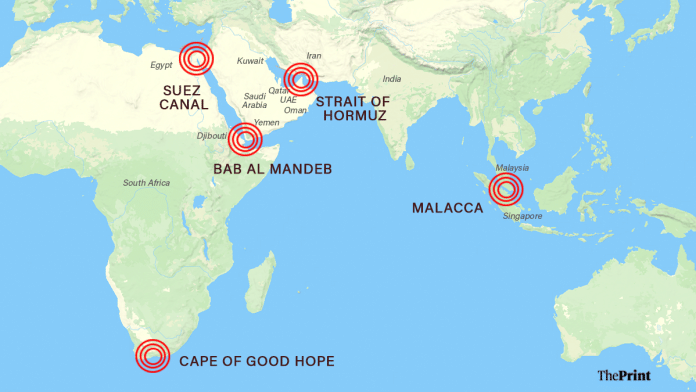
Against the backdrop of this continued disruption, which has significantly impacted global trade and energy supplies, ThePrint looks at how much India’s economy relies on four major chokepoints—the Suez Canal, Bab al-Mandab, Strait of Hormuz, and the Malacca Strait—and what the country is doing to reduce its dependence on them.
Also Read: How Iran choked Strait of Hormuz & why it’s not easy to break the blockade
The chokepoints
Suez-Bab al-Mandab
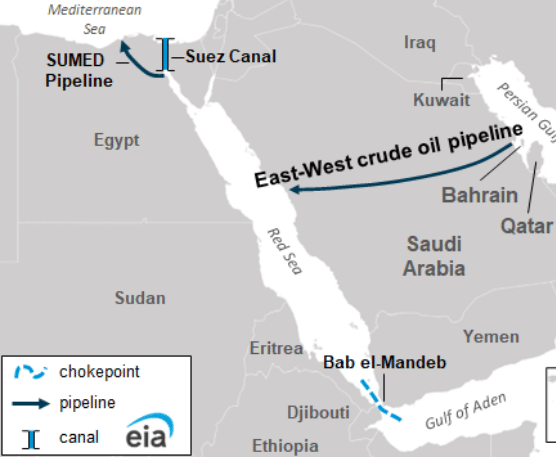
According to a 2024 ICRA report, the Suez Canal accounts for 35 percent of India’s total foreign trade. This includes exports of textiles, apparel, pharmaceuticals, and machinery to the European Union and the United States.
The Suez Canal, along with Egypt’s SUMED pipeline and Bab al-Mandab, is a strategic maritime route for India’s trade with Europe, the United States, and Russia.
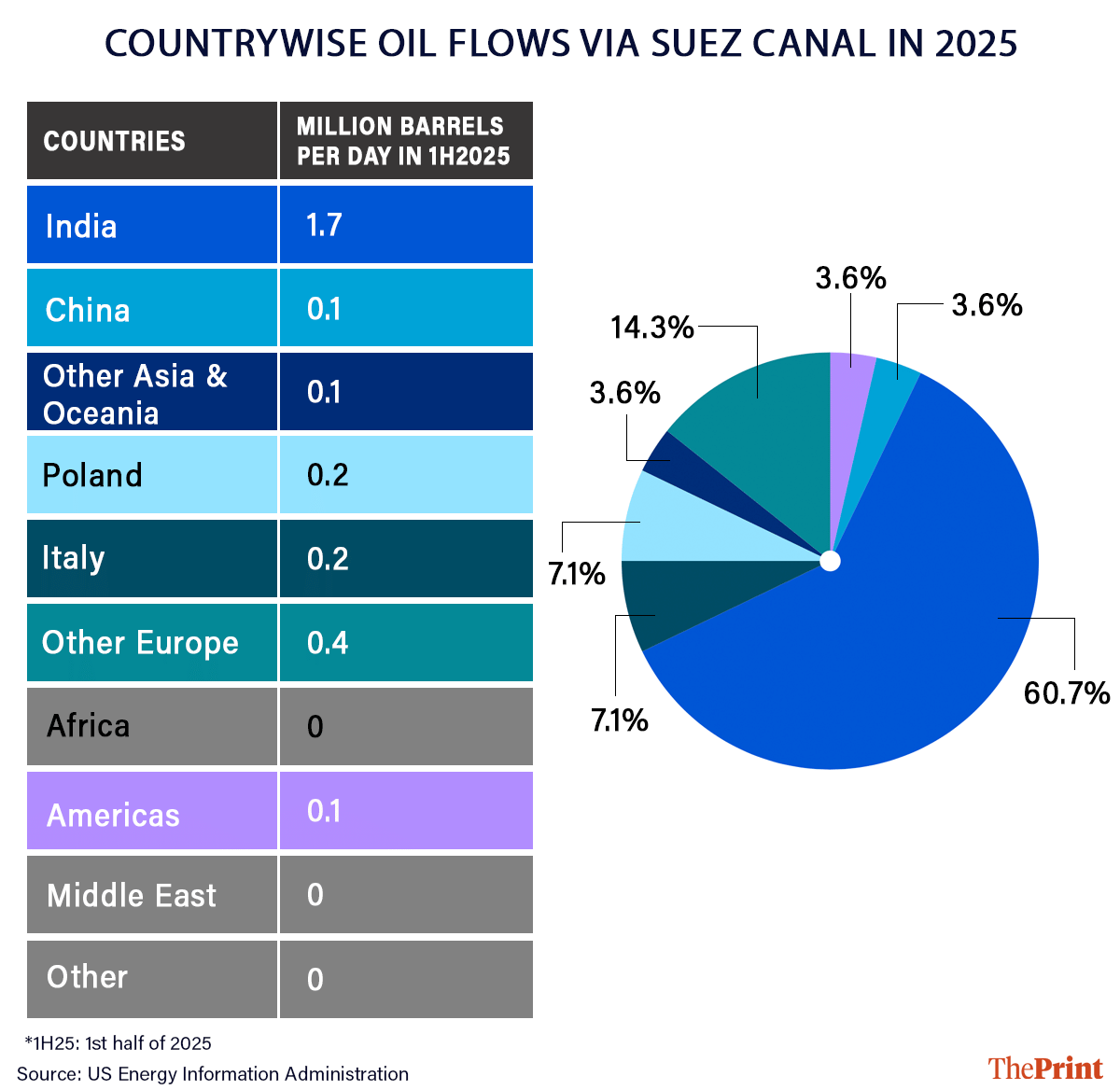
The Suez-Bab al-Mandab corridor accounted for approximately 8.7 percent of global oil consumption and 11.4 percent of global maritime oil flows (9.1 mbpd) in the first half of 2025, according to US Energy Information Administration (EIA) data.
Of this, India accounted for roughly 59 percent of the Suez Canal’s oil flows in 2025, compared to about 11.5 percent in 2020. These figures reflect a growing redirection of oil flows toward India. A significant portion comes from Russia, which has become one of India’s largest suppliers, as the European Union seeks to reduce its energy dependency on Moscow due to Russia’s invasion of Ukraine.
Currently, India’s dependence on the Suez Canal remains restricted not only for crude oil imports but also as a transit point for its refined petroleum exports to Europe, as the EU distances itself from Russia.
Previous closures of the Suez-Bab al-Mandab corridor severely affected global trade, but India was somewhat spared because global trade constituted a small part of its economy.
Now, the picture is different.
When the Houthis in Yemen started targeting commercial shipping vessels in the Bab al-Mandab Strait in 2024, it adversely affected India’s trade. Ships had to be rerouted around the Cape of Good Hope, adding 6,500 km to their journey and leading to a fivefold spike in shipping and insurance costs.
Due to attacks by the Houthis, global crude oil flows through the strait reportedly fell from 9.3 million barrels per day (mbpd) in 2023 to 4.1 mbpd in 2024.
Meanwhile, oil exports via the Cape of Good Hope reportedly surged between 2023 and 2024—from 6.2 mbpd to 9.3 mbpd.
Still, significant volumes of Russian oil ended up transiting the Suez and reaching India, due to Houthi guarantees to Moscow.
Strait of Hormuz
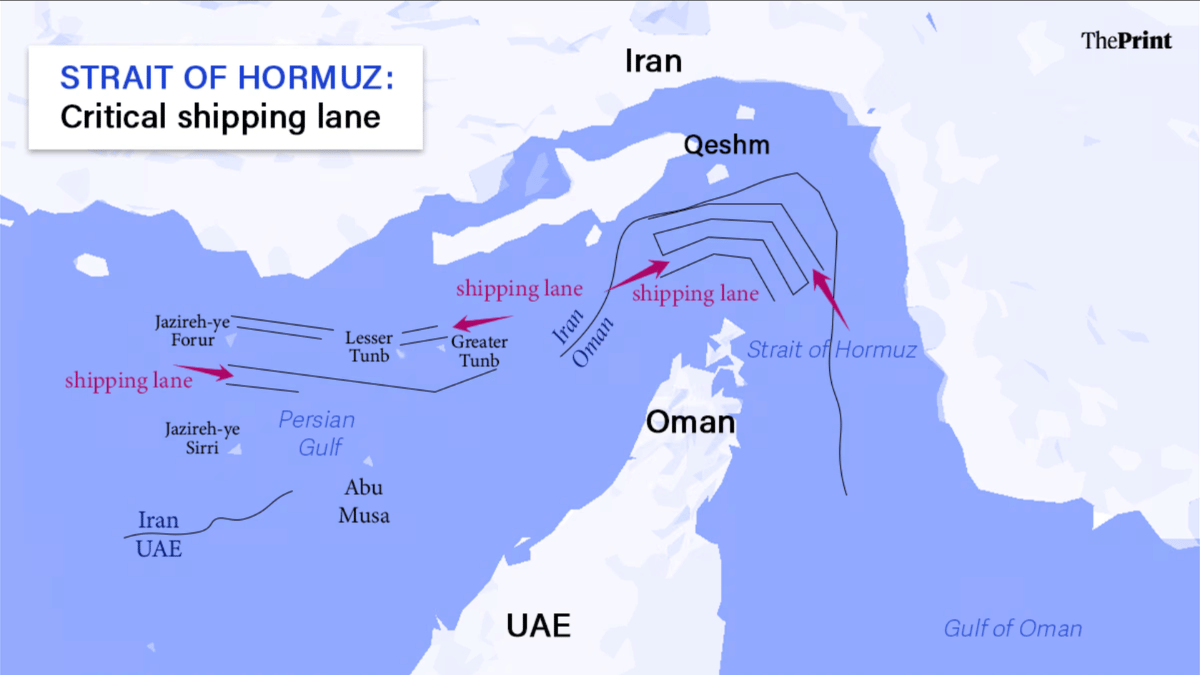
According to EIA, the Strait of Hormuz accounted for 20 percent of global oil consumption and 26.2 percent of global maritime oil flows (20.9 mbpd) in the first half of 2025. It also facilitated one-fifth of global LNG flows in 2025.
Iran’s blockade revealed that major disruptions in the Strait of Hormuz can cause global economic ramifications, which alternatives, such as Saudi Aramco’s East-West pipeline and the UAE’s Abu Dhabi pipeline, can currently only partially offset.
Hormuz is a critical energy corridor for major Asian importers, particularly China and India.
Based on flow estimates derived from EIA production and destination datasets, China accounted for approximately 36.7 percent of oil flows through the strait in the first half of 2025, while India accounted for nearly 13.6 percent.
For LNG, similar derivations indicate that China received nearly 23.7 percent of the LNG volumes associated with the Hormuz-linked supply chain in the first half of 2025, while India accounted for approximately 19.3 percent.
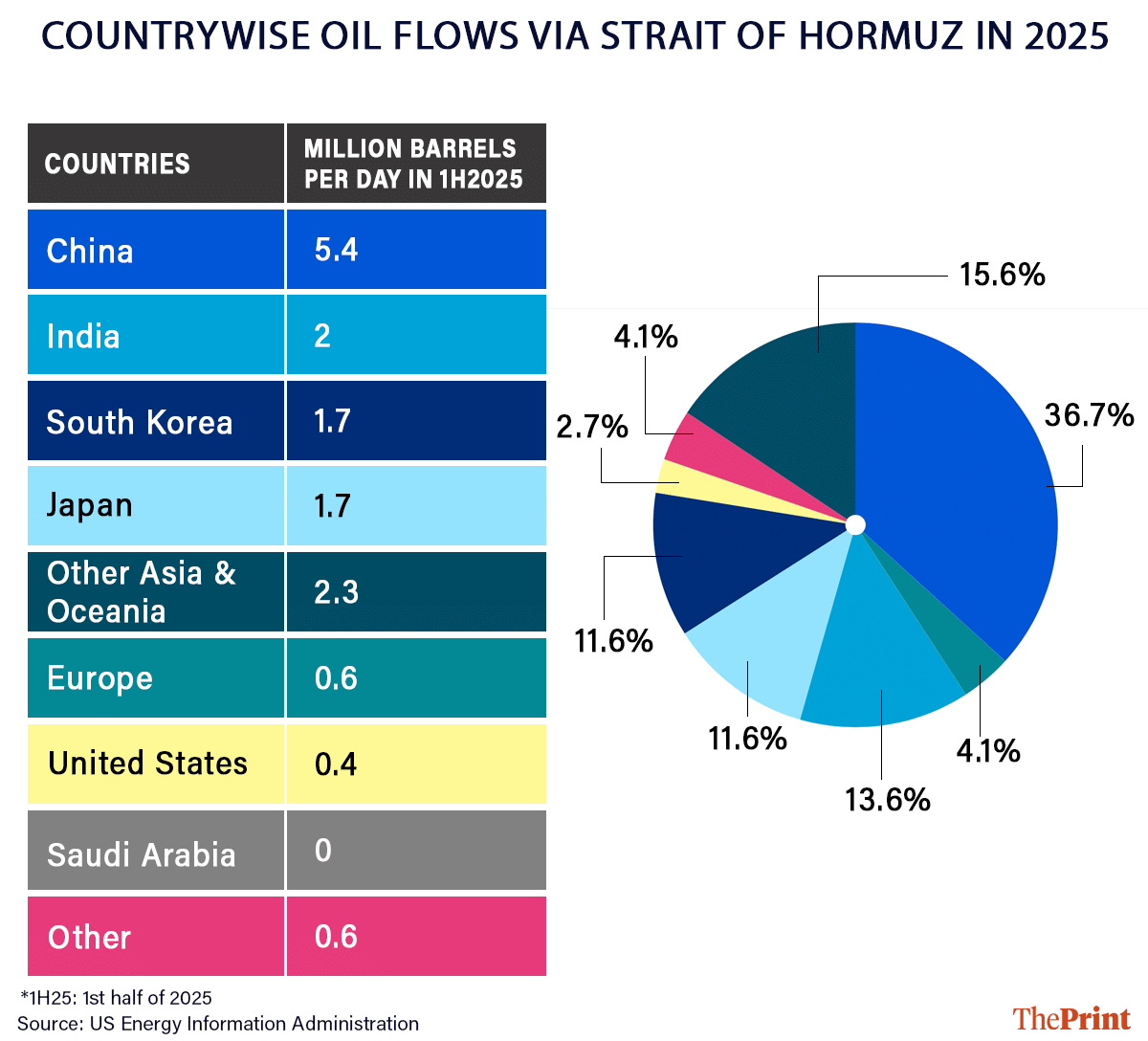
While Saudi Arabia and the UAE are the two main oil suppliers to India and China, Qatar and the UAE are the key LNG suppliers.
India reportedly relies on Hormuz for 40 percent of its crude oil, 50 percent of its LNG, and 90 percent of its LPG imports. Disruptions in Hormuz will inevitably affect not only India and China but also other importers such as Singapore.
Malacca Strait
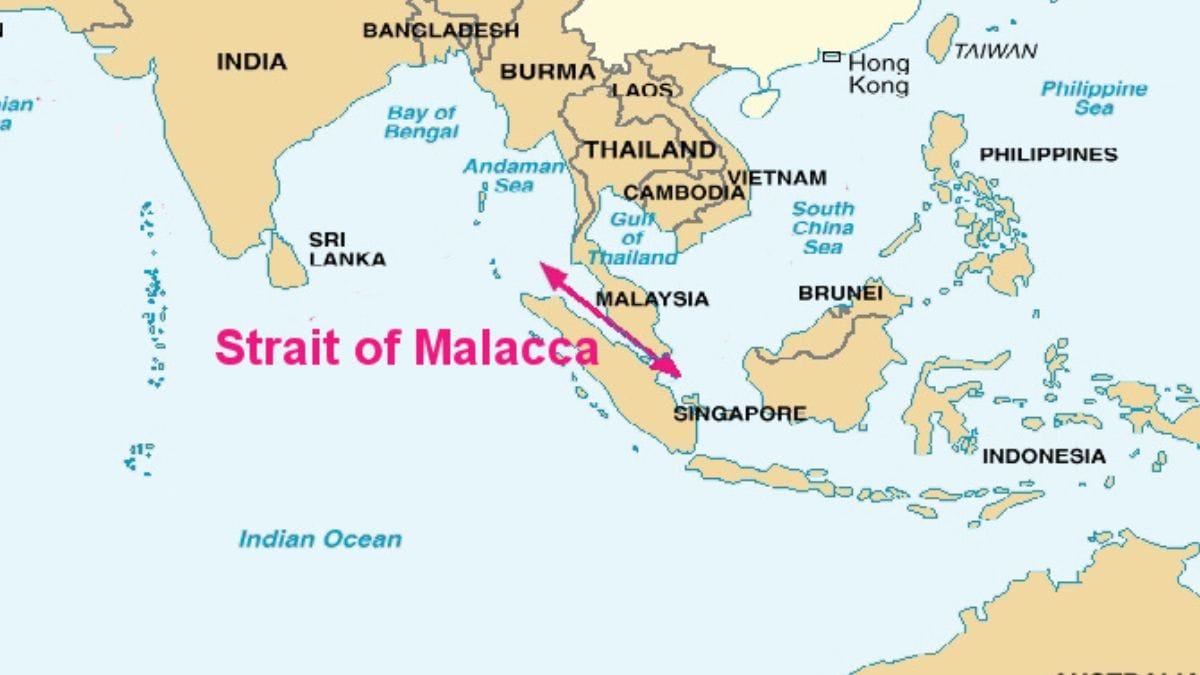
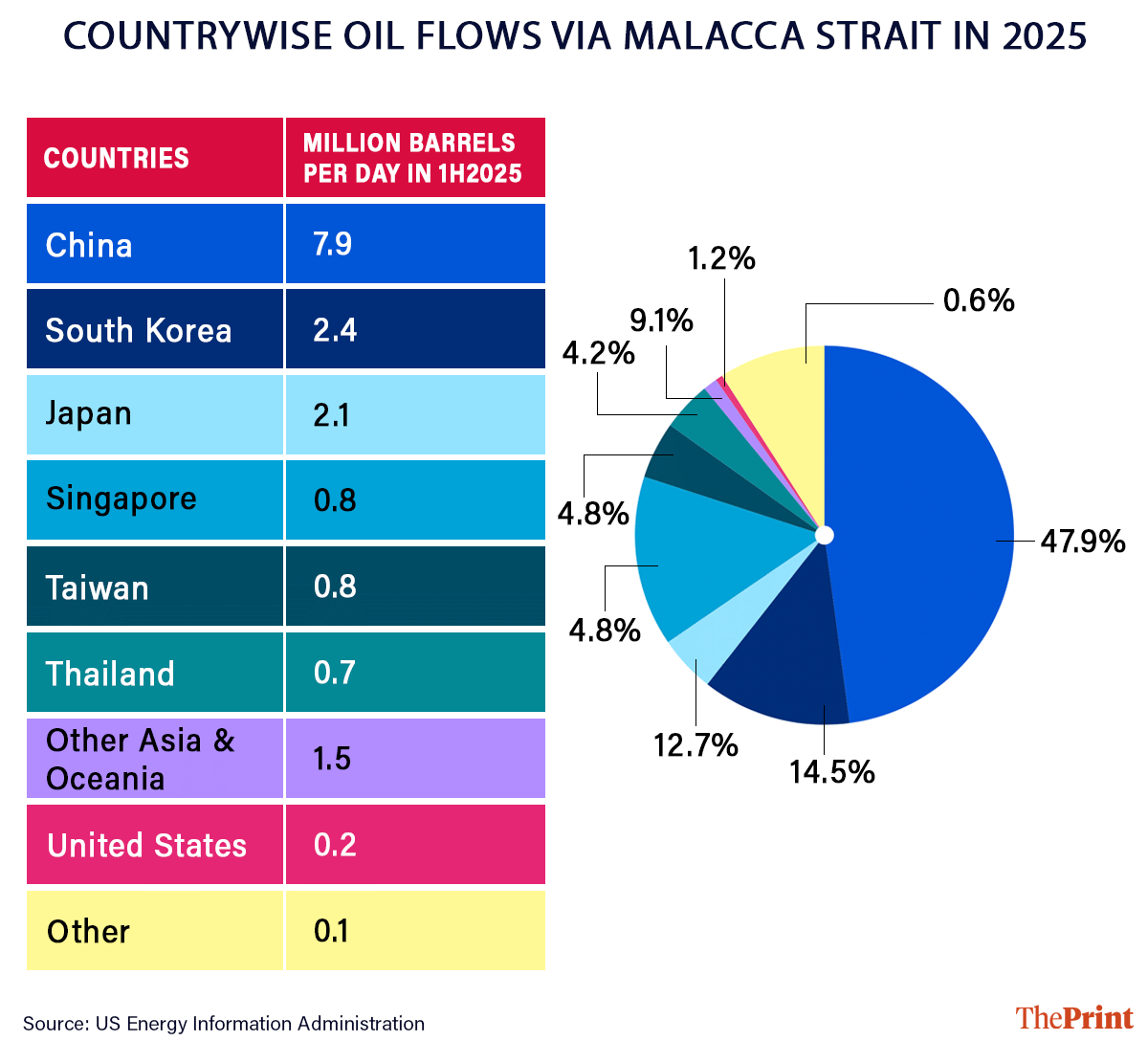
The Malacca Strait, Asia’s most important maritime chokepoint, accounted for 22.2 percent of global oil consumption and 29.1 percent of global maritime oil flows (23.3 mbpd) in the first half of 2025, according to the EIA data.
The Malacca Strait is crucial to China, which accounted for 47.9 percent of oil flows through the strait in the first half of 2025, followed by South Korea (14.5 percent), Japan (12.7 percent), and Singapore (4.8 percent).
Compared to China, India is not as reliant on the Malacca Strait for oil, but its imports of industrial goods, electronics, and active pharmaceutical ingredients from China and ASEAN, along with imports of coal from Indonesia and Australia, rely on passage through the strait.
Beijing’s dependence on the Malacca Strait has, however, been reducing, thanks to its Belt and Road Initiative (BRI). China has also developed multiple trade and energy corridors through Pakistan and Myanmar, along with oil and gas pipelines from Russia and Kazakhstan, as well as port development projects in Hambantota, Sri Lanka; Gwadar, Pakistan; and Kyaukpyu in Myanmar.
Also Read: What Iran’s Hormuz play means for Malacca freedoms — and why India should be speaking up
The alternatives
International North-South Transport Corridor
The International North-South Transport Corridor (INSTC) was initiated in 2000 as a 7,200–7,500 km multimodal transport network linking India with Russia and Europe via Iran and Central Asia. It aims to reduce logistical costs and transit time between India and Eurasia by providing an alternative to the Suez Canal route, cutting delivery times from approximately 45–60 days to 23 days under the best of conditions.
As part of a trial run in 2022, a consignment was sent from the port of Astrakhan in southern Russia to Mumbai’s Nhava Shera port via Iran’s Bandar Abbas port.
In 2024, 26.9 million tons of cargo are estimated to have passed through the INSTC, the majority of which consisted of Russian exports—coal, oil products, and minerals to India, and foodgrains to Iran.
For all its potential, however, the INSTC remains hostage to the region’s geopolitical tensions.
India-Myanmar-Thailand Trilateral Highway
While the India-Myanmar-Thailand Trilateral Highway (IMT-TH) was conceived in 2002, major construction started only in 2012. The IMT-TH could provide a transnational trade route to Southeast Asia, bypassing the Strait of Malacca.
The precursor to the IMT-TH was the 160 km Indo–Myanmar Friendship Highway from Tamu to Kalay, constructed by India’s Border Roads Organisation (BRO) between 2001 and 2002. The subsequent 1,360 km IMT-TH land corridor furthers India’s ‘Act East Policy’ by connecting the country’s Northeast from Moreh (in Manipur) to Tamu and onward to Yangon in Myanmar, and further to Mae Sot and Bangkok in Thailand.
More than a decade later, however, the IMT-TH remains incomplete, especially the portions in Myanmar, owing to the country’s ongoing conflict since the 2021 military coup.
While large stretches of the route are motorable, they have not yet been developed into dedicated freight corridors—for example, the Mandalay-Yangon segment—despite several sections being under phased construction and upgradation.
Chennai-Vladivostok Eastern Maritime Corridor
The Chennai-Vladivostok Eastern Maritime Corridor is part of India’s efforts to expand maritime connectivity in the Indo-Pacific. Operational since 2024, the route connects Chennai in India to Vladivostok in Russia’s Far East, reducing transit time from around 35-40 days via the Suez Canal to approximately 24 days.
The corridor spans roughly 5,600 nautical miles, passing through the Strait of Malacca and onward to Vladivostok. It is expected to serve as an alternative trade route for commodities such as crude oil, coal, fertilisers, machinery, and textiles.
However, logistical challenges and Western sanctions on Russia’s shipping and financial systems have limited the corridor’s ability to scale to its full potential.
India-Middle East-Europe Corridor
The India-Middle East–Europe Corridor (IMEC) aims to reduce India’s dependence on traditional maritime chokepoints such as the Suez Canal and the Strait of Hormuz.
It seeks to link sea routes from India’s western coast to a high-speed rail and road network connecting the United Arab Emirates and Saudi Arabia to Israel’s port of Haifa, and further onward by sea to the Greek port of Piraeus.
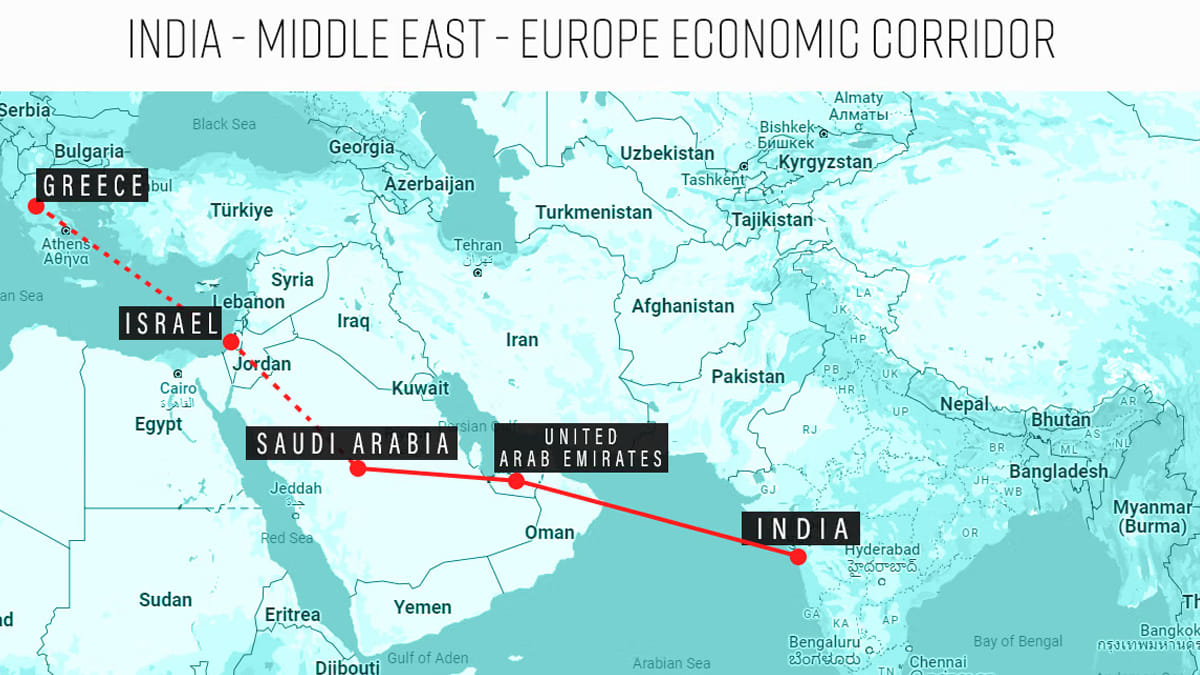
IMEC was announced on the sidelines of the G20 Summit held in India in 2023 and is widely viewed as a potential alternative to China’s Belt and Road Initiative (BRI). However, for IMEC to emerge as a fully viable corridor, several geopolitical challenges must be addressed, including the US-Israel war with Iran, and Israeli military action in Lebanon.
Another factor influencing the project is China’s infrastructure footprint in the region, including its investments in logistics and rail-linked infrastructure in the UAE, as well as its significant ownership stake in Greece’s Piraeus port.
Rahul Saikia is an alum of ThePrint School of Journalism, currently interning with ThePrint.
(Edited by Madhurita Goswami)
Also Read: When geography is a weapon: How Iran is using 7 islands to keep a chokehold on Strait of Hormuz