





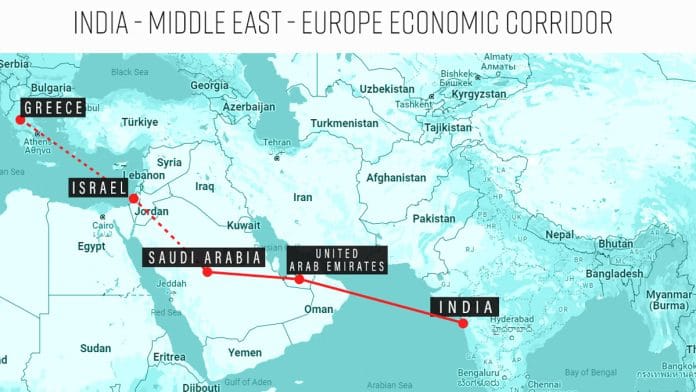


New Delhi: The weaponisation of trade routes, especially in West Asia, has led to countries searching for alternatives, bringing the proposed India-Middle East-Europe Economic Corridor (IMEC) back into focus. The US, which is furthest from the corridor but a member of the original agreement, has started discussions around the IMEC domestically.
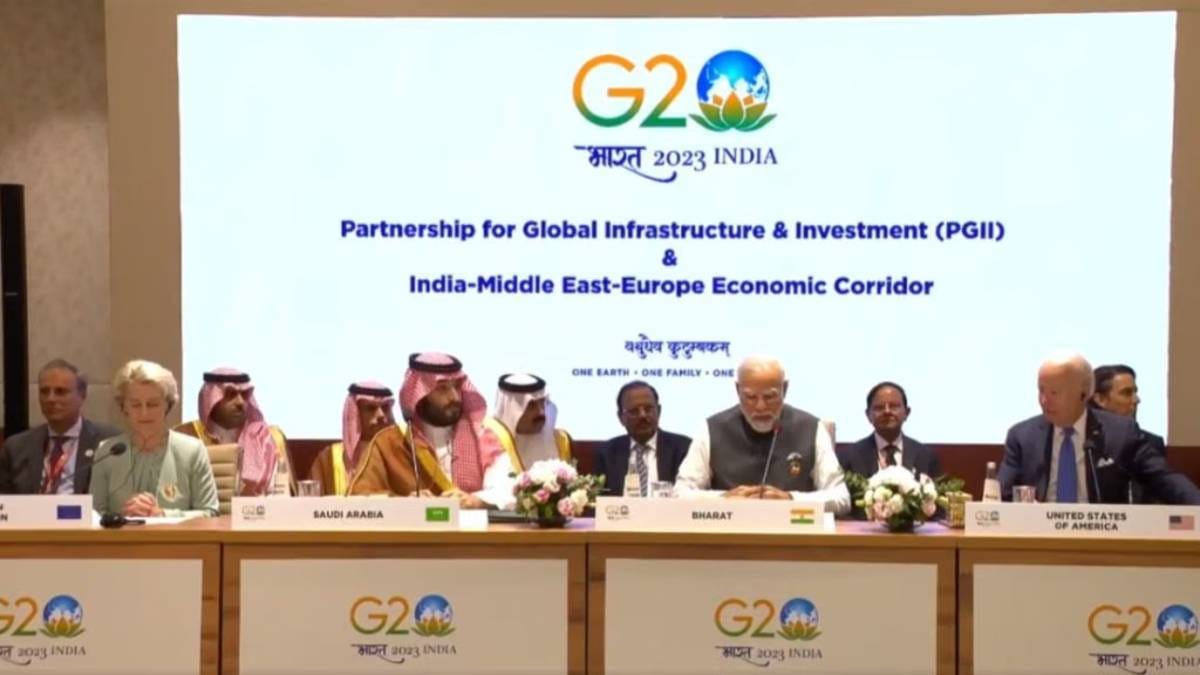
The corridor was launched with much fanfare on the margins of the G20 leaders’ summit in New Delhi in September 2023. The original memorandum of understanding (MoU) was signed by seven countries and one bloc: India, the UAE, the US, Saudi Arabia, France, Italy, Germany and the European Union (EU).
This week, Deputy Assistant Secretary in the US Department of State Dane Johnston discussed the IMEC and Washington’s intentions with think tank Atlantic Council’s Allison Minor. Pointing to the situation in West Asia, where Iran has effectively closed the Strait of Hormuz, disrupting trade and supply chains, Johnston highlighted the need for alternative routes such as the IMEC.
“When we talk about the IMEC, let’s just start with the early administration, when President (Donald) Trump called it ‘one of the greatest trade routes in history’. That is a good person for you to take your direction from on your priorities,” said Johnston.
He added, “The economic potential of the IMEC is unmatched. It is also a way to advance our political and security interests. I think now more than ever we have seen the risks of a single point of failure when it comes to our trade routes and movement of goods and what that represents.”
Johnston made it clear that for the US, its “core interest” is the “economic opportunity”. As part of moving forward with the idea, he highlighted that there are sherpas from various governments liaisoning with one another to identify already existing projects and “loop it under” the larger IMEC vision.
The proposed corridor, at the time of its launch, envisioned a new transport route connecting India to Europe via the Middle East, as a potential alternative to existing sea routes such as the Suez Canal or around the Cape of Good Hope.
The project, however, at a physical level hinged on the potential opening of diplomatic ties between Saudi Arabia and Israel, allowing for the route to bypass the Suez Canal controlled by Egypt. Within weeks of the announcement of IMEC, however, Hamas launched an attack on Israel on 7 October, 2023, leading to a two-year conflict in the region.
Israel’s retaliation to the Hamas attacks left around 70,000 Palestinians dead and pushed back normalisation of ties under the nascent Abraham Accords with other countries in the region. The region has since been mired in another conflict that began with US and Israel’s strikes against Iran in June 2025 and then at the end of February this year.
“IMEC was envisioned by the US through its optimistic reading of the signs of regional geopolitics at play in West Asia at the time. By focusing on trade and economic linkages, and on the other hand, potential political normalisation between Saudi Arabia and Israel, the vision was to engender further strengthening of ties among the stakeholders of IMEC,” Bashir Ali Abbas, senior research associate at New Delhi-based think tank Council for Strategic and Defense Research (CSDR), told ThePrint.
Abbas’ view is reinforced by then US National Security Adviser Jake Sullivan proclaiming at the end of September 2023 that the “Middle East region has been quieter today than it has been in two decades”, to attendees at a festival hosted by The Atlantic.
A week later, Hamas launched its attacks, providing insight into how the then Joe Biden administration in the US had deeply misread the situation in the region.
Also Read: From East to West, India is making a big push for transnational transport corridors. Here’s why
India-UAE ‘foundational leg’
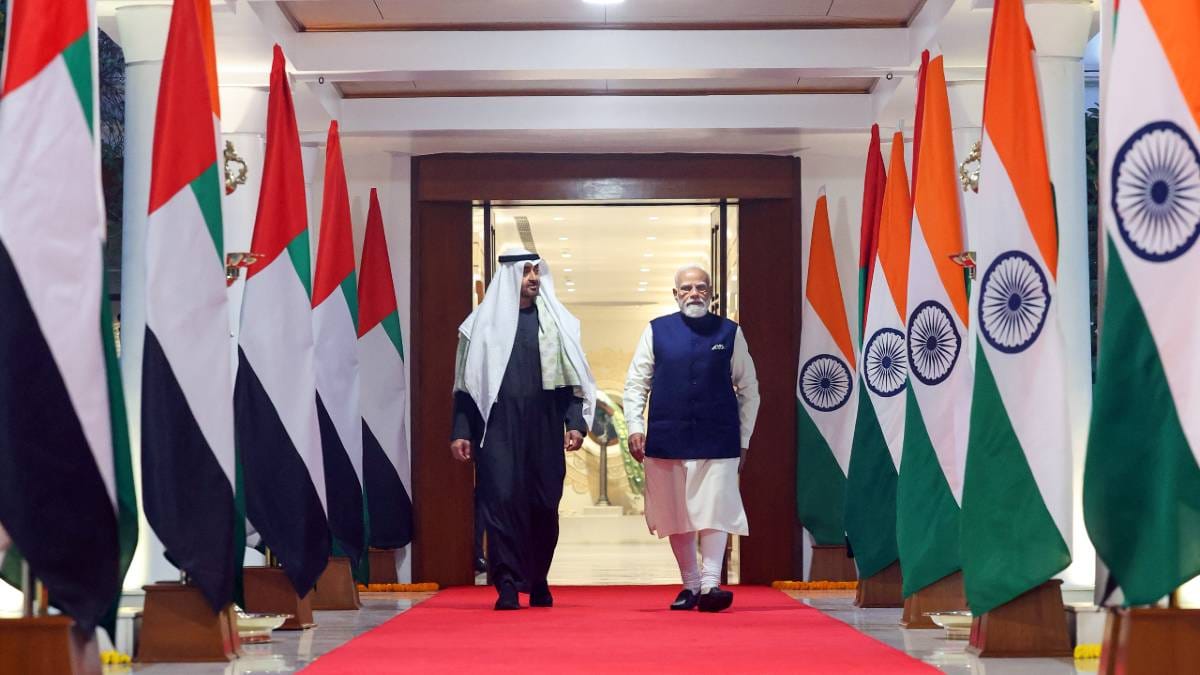
For India, work on the project continues, with a focus on strengthening its economic partnership with the UAE, as this is the “foundational leg” of the project. One of the lesser identified works being undertaken is digital infrastructure. New Delhi and Abu Dhabi have moved to build digital infrastructure to facilitate trade access that could eventually be extended across the corridor.
The sense in New Delhi is that work on easing trade between India and Europe, via the Middle East, never ceased, with the focus remaining on strengthening the “foundational leg” of the project with Abu Dhabi.
“Work has continued in strengthening the corridor between India and the United Arab Emirates. A number of steps have been taken between the two governments to ensure easier trade,” a person familiar with the matter told ThePrint.
The two countries have focused on both physical and digital applications to ease trade.
In 2024, India and the UAE announced the Intergovernmental Framework Agreement (IGFA) for the operation of IMEC. As part of bilateral efforts to ease trade, the two countries soft-launched the Virtual Trade Corridor (VTC) in September that year, based on the Master Application for International Trade and Regulatory Interface (MAITRI), a middleware software platform developed by the Indian public-sector undertaking Rites in collaboration with the Centre for Development of Advanced Computing.
The VTC aims to integrate the customs, logistics and regulatory processes between India and the UAE into a single, digital system to aid in seamless trade between the two countries, thereby reducing existing trade barriers.
“The project (IMEC) is seen in a positive light in the UAE. They are fundamentally considering the geopolitical realities and are very keen in strengthening the overall digital and physical infrastructure with India. This works very well bilaterally, especially if you create the infrastructure and digital ecosystem. It would not be too hard to extend it to the rest of the IMEC,” Kabir Taneja, executive director at Observer Research Foundation (ORF) Middle East, explained to ThePrint.
“The India-UAE link is foundational. When the situation is better, the foundational infrastructure can be easily extended. The digital infrastructure has been prioritised for two reasons. It is the kind of infrastructure that will provide dividends in the future and can also be easily constructed because it does not rely on second or third countries,” he added.
The approach promises high dividends and low risk, Taneja added, pointing out that the prioritisation is also because building a digital ecosystem is “doable”.
However, harmonisation remains challenging especially as countries within the proposed IMEC have witnessed deteriorating diplomatic ties in the last few months, particularly the UAE and Saudi Arabia.
The two countries were the main backers of the current internationally recognised government in Yemen. Their coalition, however, fractured this January, when Riyadh accused Abu Dhabi of aiding in the abrupt departure of the leader of the Southern Transitional Council (STC), Aidarus Al-Zoubaidi, from Yemen to the UAE.
The STC was a constituent of the Riyadh-backed Presidential Leadership Council (PLC). Under Al-Zoubaidi, STC made a bid to separate southern Yemen from the rest of the country.
Also Read: India-UAE shipping leg of IMEC to be operationalised in ‘first 100 days’ of Modi govt
‘Keeping the idea alive’
India and the UAE have instead focused on retooling the project bilaterally, while creating an ecosystem through repeated success of proofs of concept that could be expanded at scale as the corridor takes further shape.
“It will be very difficult to create a geopolitical construct interlinking different countries because of the current geopolitical realities. However, streamlining regulatory paperwork, digital infrastructure and real-time information-sharing can be added into the larger corridor,” said Taneja.
Adding, “The important part is to keep showing proofs of concept and keeping the idea alive. By doing so, it also keeps the interest alive within countries part of the project. The digital infrastructure is the best format for that.”
As part of efforts to double trade between India and the UAE to $200 billion by 2032, the two governments have taken a raft of decisions to promote exports and imports. DP World, the Emirati logistics provider, launched “Bharat Mart” in Dubai in 2024 during PM Narendra Modi’s visit to the UAE. The two governments have also sought to connect Micro, Small and Medium Sector Enterprises (MSMEs) in both countries to boost trade.
“They directed their teams to work towards connecting MSMEs on both sides. In this context, they called for the expeditious implementation of key initiatives, such as Bharat Mart, the ‘Virtual Trade Corridor’ and the ‘Bharat-Africa Setu’ to promote MSME products across the Middle East, West Asia, Africa and the Eurasia region,” stated a joint statement issued by the two countries following the visit of UAE President Sheikh Mohamed bin Zayed Al Nahyan to India this January.
The various India-UAE initiatives, while promoting bilateral trade, also works as a blueprint for how the IMEC could play out going forward, the person familiar with the matter explained. Such moves by the two nations would reduce the potential timeframe of expansion to Europe.
Taneja highlighted that the IMEC is “more about seamless integration of law, regulation and policy” rather than just physical infrastructure. “Movement of containers seamlessly to Europe, for example, requires streamlined customs regulations and forms. This is predominantly regulatory in nature. By making paperwork consistent and linear, till a container from India is shipped to Europe, would aid in the ease of trade,” he explained.
Johnston, in his remarks at the Atlantic Council, also said “the digital aspect of IMEC is one of the things that makes it really unique”.
“We have some of the best emerging technologies here in the US. We are looking to deploy all of our private sector partners on that,” he added.
The US Deputy Assistant Secretary further highlighted the importance of “facilitating trade harmonisation”, a view similar to the one in New Delhi. The focus of the US and multiple governments currently is to aid in quicker movement of goods.
(Edited by Nida Fatima Siddiqui)
Also Read: For IMEC to have any real impact, fix the finance first. Only then it can counter China’s BRI