





Well-known musician Chongtham Vikram Singh went down three flights of stairs of an apartment building in Kilokri to dispose of the household rubbish last Sunday, a little before midnight. The ground floors of the dense urban village – located a few minutes from where the Yamuna bifurcates Delhi – are full of dhabas and cloud kitchens that keep no particular hours. The upper floors are residential apartments.
That night, a group of delivery executives and workers at nearby eateries had been shouting and drinking. Singh objected to the ruckus. A few days later, his friends and family received his body in a coffin at Imphal airport’s cargo bay.
The 55-year-old Manipuri artist, teacher, and guitarist of the rock band Phoenix had lived in Delhi for nearly two decades. When Singh asked the drunk men to bring it down a few notches, they followed him home and beat him outside his own front door. Singh’s family rushed him to Holy Family Hospital – along the way, he told his son Yaiphaba that he recognised the men and had once before made the same request. He died soon after due to haemorrhagic shock.
Seven men have been arrested in connection with Singh’s murder, and a 15-year-old boy has been detained. It remains to be seen if there was a racial motive to the killing. What requires no clarification, however, is that Singh challenged the men over what is considered an Indian birthright: the entitlement to make noise.
Ganesh Chaturthi to wedding season
We are a boisterous, rackety people; we tell each other fondly, indulgently, as if talking about errant children having a meltdown in a mall. It’s a national characteristic – like our famed hostility toward women – that we’re simply supposed to accept. The real problem is the killjoys who choose to object to the cacophony that’s simply a part of Indian life.
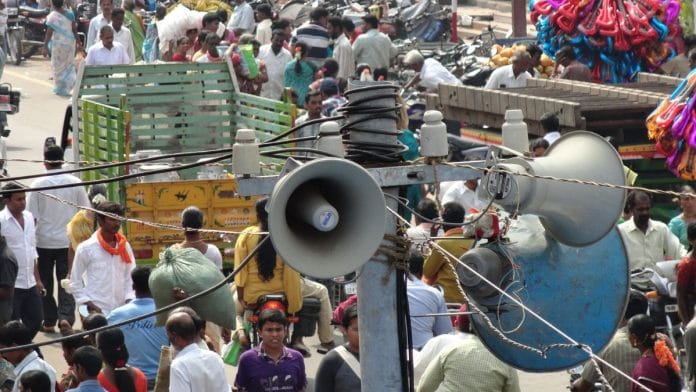
In our already noisy cities, where the soundtrack of incessant honking is only punctuated by the din of rampant construction, clamour also follows a schedule. The festive season stretches between August and December, with high-voltage events like Ganesh Chaturthi, Navratri, Kanwar Yatra and even Christmas.
Several of these are accompanied by truck-mounted boomboxes, blasting right through the 90-decibel limit imposed in most areas. Between November and February, as the wedding season takes off, the mantle of rambunctiousness passes to the baraats that wind through residential areas at all hours of the night. And then there are the year-round cricket calendar’s fireworks.
But this fondness does an excellent job of obscuring what the noise is for. Turning up the volume isn’t merely an irritant – it’s also how we stake a claim to public space. It’s how dominance is asserted. It’s how we announce who a place belongs to and dare anyone to say otherwise.
In the last few weeks, several Pune residents have rallied against noise pollution. The city police has recorded 15,000 noise-related complaints this year. Last weekend, responding to a call from Punekars Against Loudspeakers Forum, more than a thousand citizens gathered to protest against DJs and other sound systems.
A resident of the city’s Model Colony told the Times of India that during last year’s Ganeshotsav, they could barely hear each other on the seventh floor of a high-rise apartment.
“I had to get new windows installed at a cost of Rs 5.5 lakh to keep some of the sound out,” he said. Another resident of the very posh Boat Club Road recorded sound levels of 120 dB inside her first-floor house, even though the pandals responsible were almost a kilometre away.
Last year, Varsha Kadam lost her father, attempting to shield the ailing man from the DJ system installed near her house. Her pleas to lower the volume or shift the DJ stand and consider her elderly father – who was on oxygen support – fell on deaf ears. Kadam told a publication that every time they raised the issue, they were accused of being “against religion”.
The bodies keep piling up on both sides of this argument. In Pune, last week, two men collapsed and died during the visarjan processions. In Hyderabad, a 19-year-old student died of a suspected heart attack during another procession – his family claims it was because of the deafening DJ systems and firecrackers. If the noise doesn’t kill you, accusations of being against religion will. In March 2025, a man was beaten to death for asking that the sound systems during Holi be lowered so children could study for their board exams.
Also read: India’s coastal roads cannot be widened forever. It’s time to expand vertically
Noise, a claim to power
This loud claiming of public space is documented in history – as are its devastating consequences. Days after the Babri Masjid was demolished in December 1992, the Shiv Sena and other right-wing outfits took over Mumbai’s streets with ghantanaad, or the synchronised ringing of temple bells, and maha-aartis. The Srikrishna Commission’s report – instituted to investigate the Mumbai riots – had noted a sudden rise in attendance at Friday namaaz in mosques, which right-wing groups interpreted as evidence of an intent to seek revenge.
The Tuesday Ganpati aartis and Saturday Hanuman aartis were staged in areas where different communities had coexisted peacefully for years. At one of the maha-aartis in Grant Road, participants complained that the Azaan from a nearby mosque was interfering with their prayers. Even though the Azaan was stopped by the police, a crowd later attacked Muslim establishments in the area. The commission found that the maha-aartis were the staging grounds for the deadly riots that followed.
Indian courts have made it clear that these instances violate Article 21 of the Indian Constitution. In 2000, the Supreme Court, hearing the case Church Of God (Full Gospel) In. vs K.K.R. Majestic Colony Welfare, held that in a civilised society, activities carried out in the name of religion that disturb “old, infirm persons, students or children having their sleep in the early hours or during daytime” cannot be permitted.
Five years later, the courts barred the use of loudspeakers between 10 pm and 6 am, though state governments may relax the rules for up to 15 days a year.
But the rules, experience tells us, are often relaxed for much more than 15 days a year. In our raucous cities, decibel limits, silence zones, a bar on amplified sounds during certain hours all exist in the rulebooks – in excellent condition, sparingly used. But the appetite to listen? Drowned out by the 3 am bass thump of the mobile DJ.
Karanjeet Kaur is a journalist, former editor of Arré, and a partner at TWO Design. She tweets @Kaju_Katri. Views are personal.
(Edited by Saptak Datta)
Lundbhakts have destroyed out peace in every sense of the word.
Despite clear ban on use of loudspeakers in the public place, the law enforcers hardly notice the violation unless somebody complains. In India, every is a big shot connected to some politicians and officers or events have backing of politicians, so no big action is taken. Like traffic rules violations, this violation is blatantly done.
Ms. Kaur rants and rails against loud DJs in aartis, weddings and Hindu festivals – and quite rightly so. The loudspeaker has become a curse for our society. Everyone agrees on that.
But kindly note that she leaves out the Islamic call to prayer 5 times a day over the loudspeaker from all mosques.
Hindu festivals occur on certain days of a month/year. But the Islamic call to prayer is a daily affair – 5 times per day.
And yet, Ms. Kaur did not find it prudent to include it in her list of accusations and fulminations.
What does that tell us about Ms. Kaur?
The most telling aspect isn’t just what this cantankerous and cacophonous blogger chose to write, but the massive, convenient blind spot in what she deliberately left out.
Deliberately, singling out seasonal festivals and temple bells while granting complete immunity to daily, year-round loudspeaker disruptions isn’t civic concern.
Temple aartis, baraats, cricket fireworks are noise but the amplified azaan blaring five times a day, 365 days a year across residential neighborhoods is What??? Music to your ruptured years??