



The ancient relationship between India and China, which transformed the history of Asia, is remembered in dramatically different ways across the border. While India boasts of its status as the homeland of Buddhism, China valorises heroic monks like Xuanzang, who travelled the Silk Road to fetch scriptures.
Indians also went the other way, at great personal danger to themselves. And they carried not just religion, but astronomy, commerce, and mathematics. Memorials to these Indians can still be found around Xi’an, the central-northwestern part of China, where Indian tourists still go to see the world-famous Terracotta Army — often without even knowing that distant ancestors are buried nearby.
Indians had been travelling to China for centuries before Xuanzang. And while China’s historical memory (like India’s) prefers the rosy picture of holy men travelling between unified empires, many Indian travellers found careers during times of political strife and division, sought after for magical assistance to kings rather than lectures on dharma and ethics. Some also came to sticky ends.
Monks, magic and murder
Historian Alexander Coburn Soper writes, in “Literary Evidence for Early Buddhist Art in China”, of a monk called Dharmakshema from North India. Early in his life, according to Chinese materials, his brother killed a king’s favourite elephant, and his entire family was at risk of execution. Dharmakshema then travelled via Kashmir through Central Asia and studied Chinese in the court of the Northern Liang (a regional fifth-century dynasty). By this point, he was already famous for his magical prowess, as “The Great Master of Spells”.
Then, in 429, his royal patron was defeated by a neighbouring nomadic coalition, and Dharmakshema was blamed for not intervening. His position only worsened when, having heard of his miracles, another nomadic ruler threatened to invade the Liang unless the magician was handed over. The Liang king refused, fearing his rival would turn those spells against him. When Dharmakshema, apparently seeking to escape this mess, requested permission to return West, the enraged king had him murdered on the road in 433.
The only evidence of Dharmakshema’s existence comes from Chinese court sources. Other Indians are better memorialised, because they better fit the image of the holy man — influential, but ultimately harmless to the narrative of national pride. The famous fourth-century translator Kumarajiva, whose father was a Kashmiri Brahmin, belonged to the royal family of Kucha, a Silk Road kingdom.
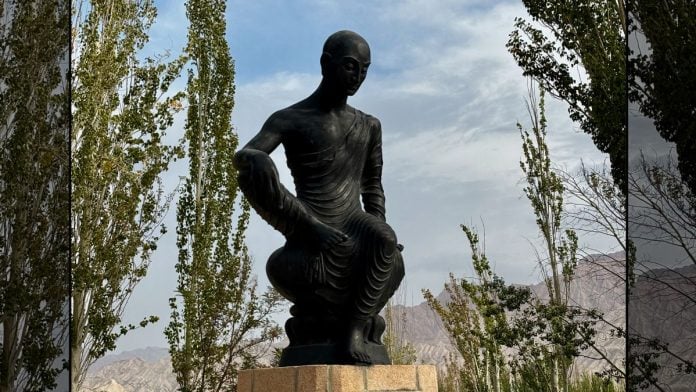
Tourists can still see a bronze statue of Kumarajiva at the Kizil cave monasteries, a few hours’ drive from Kucha. Kumarajiva himself is buried at Caotang, 35 kilometres south of Xi’an, where he spent much of his career. A small stupa is believed to contain his actual tongue. According to local legend, it survived cremation because Kumarajiva promised it would only burn if his translations contained errors.
Also read: Hyderabad is losing its heritage buildings. Two colonial-era railway stations down
Brahmins of Xi’an
Often missing from these conversations, partly owing to insufficient archaeology, are ‘secular’ Indian people, who did not travel for any sort of religious purpose. Sometimes we have only the most intriguing hints of them. In 313 CE, for example, a Central Asian merchant wrote a desperate message to his trading partners back home in Samarkand reporting war and famine in Luoyang, the then-capital of China.
“When the caravan departed from Guzang,” he wrote, “Wakhush[akk] the . . . was there, and when they reached Luoyang, bo[th the . . .] and the Indians and the Sogdians there had all died of starvation.”
Another Indian buried in China left a more concrete trace: his body and tomb survived nearly 1,500 years. His name was Li Dan. He lived in Xi’an when it was the capital of another regional dynasty, the Northern Zhou, in the sixth century CE. Li Dan’s carved stone coffin was discovered in September 2005, with the report published the next year. He was buried alongside his Chinese wife, who had a golden coin of the eastern Roman emperor Justinian — perhaps best known for building Hagia Sophia — in her mouth.
Li Dan’s epitaph claimed he was a Brahmin from “Jibin”, probably Kashmir, and arrived in China as a teenager. A 2025 genomic study, which made international headlines, confirmed these claims through Li Dan’s DNA. He had lived in Xi’an for 40 years, raising a half-Chinese family. He seems to have been reasonably well-off and received a posthumous distinction from the court, though we have no idea what he did for a living. He was survived by at least one son, Panti.
Chinese historian Li Yusheng noted the “exotic” deities and fire-altar carved on the stone coffin, some of which are recognisably Chinese, while others are impossible to identify. Perhaps they were garbled memories from Li Dan’s distant Indian childhood, or ideas borrowed from a long life in a foreign land that became his home. Once on exhibit at the Xi’an Museum, Li Dan’s tomb is now in storage there.
Also read: Dancing Girl’s return ends controversy, but questions for National Museum remain
Fortunes of an astronomer
The most colourful surviving story of an Indian in China must be that of Gautama Zhuan (712–776), a court astronomer who worked for the Tang Dynasty. The Tang had unified China, transformed Xi’an into a sprawling capital, and extended their power deep into Central Asia. During their reign from the seventh to the 10th centuries, Indian astrological and mathematical texts were renowned for the accuracy of their calculations of planetary positions.
Zhuan’s great-grandfather, a North Indian called Gautama Ajita, had moved to China some decades after Li Dan. Unlike Li Dan, this family rose to high status: they thrived in China for generations, marrying into Chinese bureaucratic families, translating Indian texts, and holding important court positions.
In his paper “Gautama Zhuan: An Indian Astronomer at the Tang Court”, historian Tansen Sen traced out the family’s roots. Zhuan’s career was one of great highs and lows. Having been excluded from a calendrical reform led by a distinguished Chinese monk, he once submitted a proposal claiming the new methodology was plagiarised from an Indian source.
“On examination, the new method was found to be 70–80 per cent accurate in comparison to the Indian source’s 10–20 per cent. Zhuan was unceremoniously banished. When he was eventually restored during the devastating An Lushan Rebellion, he predicted in 761 that the uprising would collapse within a hundred days and received great rewards. But the rebellion dragged on, and he was dismissed from office again.
On examination, the new method was found to be 70-80 per cent accurate in comparison to the Indian source’s 10 per cent. Zhuan was unceremoniously banished. According to Sen, when he was eventually restored, he predicted an imminent rebellion in 761 and received great rewards. But the rebellion failed to materialise, and he was dismissed from office again.
Then, in 763, Tibetans invaded China, and the emperor decided that Zhuan’s prediction was, in fact, correct. He was restored and promoted to the Director of the Bureau of Astronomy. In 765, he received the title of “Grand Master of Imperial Entertainments with Silver Seal and Blue Ribbon”. The rest of his career, thankfully, passed without incident.
Survived by six children, Zhuan seems to have rested in peace until his tomb was rediscovered in Xi’an in 1977. Despite enquiries with museum staff in the city, I have been unable to find where it is now. Perhaps future discoveries of this lost Indian diaspora will be better remembered.
Anirudh Kanisetti is a public historian. He is the author of ‘Lords of Earth and Sea: A History of the Chola Empire’ and the award-winning ‘Lords of the Deccan’. He hosts the Echoes of India and Yuddha podcasts. He tweets @AKanisetti and is on Instagram @anirbuddha.
This article is a part of the ‘Thinking Medieval‘ series that takes a deep dive into India’s medieval culture, politics, and history.
(Edited by Saptak Datta)