


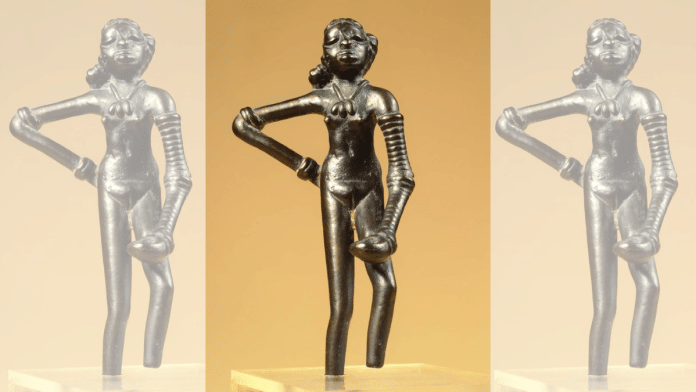
Dancing Girl, a bronze statuette excavated by Ernest Mackay from Mohenjo Daro in 1926-27, is regarded not only as one of the most exquisite examples of ancient lost-wax technique dated to the third millennium BCE, but also as the most controversial figurine.
Her recent removal and reinstallation at the National Museum in New Delhi has become another controversy surrounding this merely 11cm tall bronze statuette of a young girl adorned with jewellery and a stylish hairdo, albeit without any clothes. Due to her nakedness, her identity has repeatedly been constructed, interpreted, contested and appropriated by successive generations.
In the last few years, she has been making headlines for being continuously censored, from expos to school textbooks. Many attempts were made to cover her up, quite literally. The recent controversy regarding her removal suggested a permanent attempt to cover up (conceal) the Dancing Girl. The paranoia spread quickly. From former MPs to art historians and political commentators, all feared the Dancing Girl’s temporary, if not permanent, removal from the public domain. Recent media reports suggest that even if the National Museum decides to remove an AA antiquity from the showcase, it needs public approval. The truth is it does not.
Dancing Girl’s protection and permanent display at the Museum gallery are eminent; however, it’s important to understand that there are two sides to every story and in this case, the recent controversy.
Museums housing hundreds of classified, significant, and one-of-a-kind objects routinely remove them from display for many reasons, spanning from conservation to routine checks. In this case, it was for a “mock gallery” created within the premises of the current National Museum, a few meters away from the Harappan Gallery, on the instructions of the Ministry of Culture. What further stirred the pot was the two-month-long absence of the Dancing Girl, which required explanation and institutional accountability, not a blame game and politics.
What is the Dancing Girl controversy?
On 7 September 2026, the Dancing Girl figurine was removed from the Harappan Gallery at the National Museum. The removal from the showcase was not merely a routine procedure; it was shifted to a mock gallery for the upcoming Yuge Yugeen Bharat Museum. The mock showcase was created in the Jewellery Gallery of the National Museum, which is a vaulted gallery with precious Nizam jewels and Taxila antiquities. It is by far the most secure section of the entire museum. This prototype gallery housed the Dancing Girl, among other significant antiquities and was visited by the secretary and other officials of the Ministry of Culture. This was meant to replicate the gallery designed for the first phase of the YYBM in the coming year, under a section titled “Early Ideas of Adornment.”
By 17 October 2026, former Lok Sabha MP R Senthil visited the National Museum during his tour of Harappan sites in India. The National Museum was meant to be the last stop in his tour, since it houses almost all significant Harappan artefacts, pottery and burials. Currently, chalcolithic Sinauli chariots are on display in the gallery along with the Mandi hoard. The absence of the Dancing Girl from its usual abode immediately upon entering the gallery disappointed Senthil, who subsequently wrote to the Union culture minister Gajendra Singh Shekhawat, the cultural secretary and the director general of the museum, seeking an explanation and demanding its immediate restoration in the gallery. Soon, everyone was in uproar, and the Dancing Girl was declared “missing”.
For over two months, the artefact was not installed, which indicated an institutional lag. On 4 November, ThePrint published a report highlighting the removal and the continued absence from the display. The controversy attracted wider attention because the Dancing Girl is one of the museum’s most recognisable archaeological objects. Subsequently, on 11 November, the figurine returned to the gallery in a new bulletproof independent showcase instead of its original place.
According to another ThePrint report, the in-charge of the gallery claimed that access to the artefact was denied and that its restoration was not consulted.
Given the nature of the public uproar, the museum authority including additional director-general Meenakshi Jolly and senior conservators, curators and security personnel, restored the Dancing Girl in an updated showcase, enabling the public to access a 360 view of the figurine. In all of this, the assistant curator, who is travelling with the sacred Buddhist relics in the north-east, questioned the committee’s authority, which comprises senior-ranked nodal officers.
According to sources, the gallery in-charge was asked multiple times to restore the Dancing Girl between 1 October and 4 November. The faulty showcase, where the Dancing Girl was originally placed, and an absent key was reported by the in-charge, which further caused a delay in returning the statuette to the gallery. Now, if, after adequate media attention, the museum, under the gaze of gazetted officers, restored the Dancing Girl back in the Harappan Gallery, it shouldn’t be a further cause of distress.
The core issue was its removal and delayed reinstallation. Now that it’s resolved, why cause unnecessary drama? Gallery and its objects belong to the people of the country who demanded answers and got back what was needed. In this, if an on-duty in-charge travelling with another AA category object was not consulted it should be part of the institutional working, not treated as an institutional failure.
Also Read: The past controversies of Mohenjo-Daro Dancing Girl. Her nudity has always been an issue
The Flip-Side
The movement of national masterworks, or AA category objects, whether the 4,500-year-old Harappan bronze or the Sacred Relics of the Lord Buddha, is strictly governed by statutory frameworks laid by the institution and the Ministry, grounded in the Antiquities and Art Treasures Act, 1972, and international ethical codes established by the International Council of Museums (ICOM).
Across the globe, museums routinely rotate or temporarily relocate artefacts for preventive conservation, gallery redesigns, scholarly documentation, and state-sanctioned exhibitions. Conservators and museum curators manage these movements under strict environmental controls, with administrative approvals and security escorts. This is standard curatorial stewardship, not permanent or unauthorised removal. For incoming or outgoing loans, objects are insured, institutional MOUs are signed, and at times, specialised fine art handling agencies are also involved. If objects are fragile or heavy, fine art handling agencies are engaged to move them within the museum.
Similar international and domestic diplomatic protocols govern the temporary movement of sacred artefacts—such as the Piprahwa/Kapilavastu or Devni Mori Buddha Relics—for government-sanctioned exhibitions (e.g., state-level exhibitions in Sri Lanka, Mongolia, and Thailand). These temporary loans fulfil vital cultural, educational, and spiritual mandates, extending public access beyond the walls of central institutions. Currently, the Holy Relic Exposition in Arunachal Pradesh showcases four fragments of bone relics from the second excavation of the Piprahwa Stupa; objects retrieved from there are also considered AA category due to their spiritual and historical significance.
Under the directive of the Ministry of Culture, the National Museum established this “mock gallery” using selected original artefacts to facilitate detailed curatorial research, finalise spatial layouts, and calibrate scenography, mounting standards, and tailored conservation protocols for the final North Block galleries. Such full-scale prototyping and physical mock-ups represent an established international museological best practice during major institutional redevelopments. Leading global institutions—including the Metropolitan Museum of Art (New York) during its Michael C Rockefeller Wing renovation, the British Museum (London) for its gallery redisplays, and the Musée du Louvre (Paris)—regularly utilise off-display mock-up rooms with original collections to test microclimates, seismic and custom mounts, lux levels, and spatial sight-lines prior to permanent installation.
As per established national and international museological standards—such as the ICOM Code of Ethics for Museums—the lifecycle of an antiquity is divided into distinct disciplinary phases, whereby field archaeology governs the initial in-situ recovery, stratigraphic recording, and provenance documentation at an excavation site, while formal accessioning into a museum repository transitions institutional custodianship to the specialised domains of conservation science, museology, and art history.
Once housed within a museum, the primary mandate shifts from archaeological discovery to long-term preservation, physical security, and public interpretation: conservation scientists (archaeological chemists) assume responsibility for metallurgical integrity, micro-climate stability, and safe physical handling; museologists govern collections management, risk mitigation, custom mount-making, and secure vitrine protocols; and art historians oversee visual authentication, stylistic verification, and historical contextualisation.
Consequently, while archaeological scholarship remains valuable for contextual research, the physical handling, condition auditing, and intra-museum relocation of an accessioned antiquity fall squarely within the core statutory competency of conservation scientists, museologists, and art historians.
Also Read: The Indus Valley Civilisation declined. Its crops survived and adapted
Best Way Forward
While the state of the present museum, especially the Harappan gallery, is a cause for concern, the upcoming Yuge Yugeen Bharat Museum is projected to be bigger and better.
If you have recently visited the Harappan gallery, you may come across old, badly lit and dirty showcases. In fact, zip-lock bags may still be lying gathering dust in the Mandi hoard showcase.
The orientation and flow of the exhibition is more like a hay-bailey-maze. These issues should be the core focus for the museum authorities and particularly the gallery in-charge.
Till India opens the doors to the new museum, the focus should be on rectifying issues, learning from past mistakes and moving forward. Indians deserve a clean and maintained museum which includes the controversial but much-loved Dancing Girl.
Disha Ahluwalia is an archaeologist. She tweets @ahluwaliadisha. Views are personal.
(Edited by Insha Jalil Waziri)