



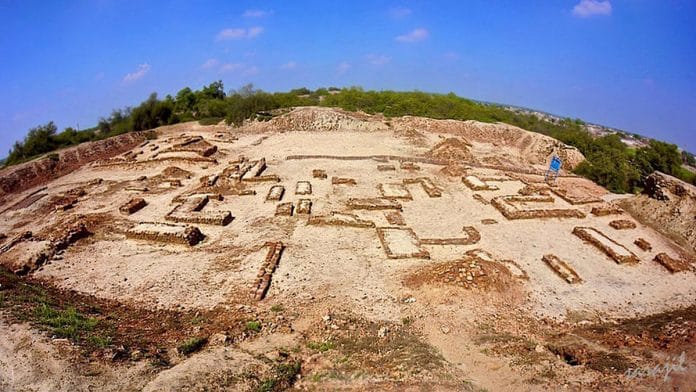
A recent study published archaeobotanical data from Jognakhera, a site in Haryana’s Kurukshetra district, highlights the continuity of the Indus or Harappan crop package following the Meghalayan stage drought.
The findings suggest that during the post-urban phase, communities at Jognakhera, located within the Ghaggar-Hakra River system, continued to cultivate winter and summer crops. This indicates the persistence of a diverse cropping system rather than abandoning existing agricultural strategies. Significantly, the evidence points to the continuity of established agricultural practices despite climate changes associated with the 4.2-kilo year event.
Although this is a regional case study on archaeobotanical remains recovered from excavations at Jognakhera, it raises two crucial points. First, agricultural practices appear to have persisted beyond the decline of the Harappan Civilisation, with evidence of continued occupation at the site extending into the Painted Grey Ware period (circa 1200 BCE to 600 BCE). Second, millets, which are considered drought-resistant crops, did not necessarily replace the existing crop package or become dominant in the post-Harappan period. Instead, the evidence suggests that communities continued to cultivate winter and summer crops despite changing climatic conditions over the centuries.
While it is a study done on only one of many such sites, it is important to ask if changes in the pottery and other markers of culture meant that farming changed along with the people. Did climatic changes make the ancient people of Punjab and Haryana adopt millets, like their Gujarati counterparts and ditch wheat and rice? What does this scientific study on botanical remains of excavated layers tell us about the subsistence pattern of the people of northern India all those millennia ago?
Archaeology
Toward the end of the third millennium BCE, roughly 2000 BCE, many of the Harappan cultural traits were undergoing transition across the entire civilisation. Evidence also suggests that Harappan sites located in the lower Ghaggar-Hakra basin, in present-day Rajasthan, were abandoned, indicating a probable eastward movement.
But this cannot be generalised to the entire Indus and Ghaggar River systems. For instance, in present-day Punjab (including Pakistan’s Punjab) and Haryana, the sites show continuous occupation until post-urban phases, as seen at Harappa. Apart from this, the intensity of post-urban or Late Harappan sites increases compared to the Indus or the lower Ghaggar-Hakra basin. Sites such as Ropar, Sanghol, Bhagwanpura, Madina, etc., reveal a transition from Late Harappan to succeeding cultures including the Painted Grey Ware tradition, which marks the onset of the Iron Age in northern India.
The transition from the urban phase, i.e. Mature Harappan (c.2600-1900 BCE) to the post-urban phase, i.e. Late Harappan (c.1900-1500 BCE) has frequently been examined from the purview of climatic changes and hydrological transformation. The 4.2 ka event, which is thought to have disrupted southwestern monsoon, eventually disrupting monsoon dependent farming and eventually pushed people to migrate.
Moreover, the disruption in monsoons pushed people to resort to drought-resistant crops, i.e., millets, thus forever changing the crop rotation practices. Contrary to this, researchers are now starting to assess the real impact of the 4.2 ka event in India and ask if the impact was homogeneous or varied from region to region. Alongside climatic fluctuations, changes in the hydrology, particularly with the Ghaggar-Hakra-Drishatvati River systems, have also been considered another significant factor in understanding the distribution and organisation of the Harappan (both Mature and Late) settlement.
Also Read: Inequality reduced as Mohenjo-daro urbanised, says UK study. It ignores Harappan villages
Archaeobotany
Against this background, the site of Jognakhera was excavated by archaeologists Madhava Acharya and RS Dahiya under the direction of Deputy Director DS Malik of the Department of Archaeology and Museums in Haryana. This excavation was conducted under the Archaeological Survey of India’s Saraswati Heritage Project. The excavation yielded a twofold cultural sequence–Post-Harappan or Bara culture and Painted Grey Ware. The Bara culture, named the type site, is represented by a distinct pottery tradition that is spread across the upper Ghaggar basin. Sites like Sanghol, Kotla Nihang Khan, Bara, and Ropar in Punjab are significant Bara sites that are datable to c.1900 BCE.
Though this culture requires a separate discussion, at the site of Jognakhera, micro-botanical analysis was done along with direct dating of the grains to reconstruct farming practices. The main crops found at the site including wheat, rice, maize, sugarcane, mustard seeds, sunflower and fruits included muskmelon. Legumes contributed 42.8 per cent of the total assemblage, which includes both winter (62 per cent) and summer crops (37 per cent). However, millet accounted for only 0.2 per cent.
The study, therefore, suggests that climatic stress did not disrupt monsoon-dependent farming in the post-Harappan period, nor did it significantly disrupt subsistence in this region. According to Anil Pokharia, one of India’s leading archaeobotanists, millets have been part of the crop package since the advent of agriculture, but the concentration varies.
In Haryana and Punjab, at sites such as Banawali, Kunal, and Sanghol, millet accounts for 3 per cent of the farming during the Mature Harappan period, with the exception of Rohira, where millet was around 20 per cent of the total crop package. During the Late Harappan period, it is roughly 2 to 6 per cent. In Gujarat, however, millets dominate the crop package, as there are examples of finger millets at Rojdi that accounted for 68 per cent during the Mature Harappan period. At Oriyo Timbo, during the Late Harappan period, it is around 60-70 per cent, whereas at Kanmer, pearl millet is 36 per cent.
Certainly, there is no uniformity in the agricultural practises which seems to be driven by the landscape, ecology and water.
Interestingly, thousands of years later, a similarity can be seen in the agricultural practices in northern and western India. Gujarat, an arid state, continues to cultivate millets such as sorghum, pear and finger millet, more than Punjab and Haryana. Having said that, it’s important to also understand that there were micro-zones within one river basin. If this Indus crop package continued in Punjab and Haryana, in the lower Ghaggar basin in Rajasthan, similar analysis on post-Harappan and Painted Grey Ware sites could throw some new light on s the ubsistence patterns of the communities who were settled in a significantly more arid zone than those at Jognakhera, Bara, Balu, Sanghol and Ropar.
Persistence and continuity
Here emerges a picture of resilience and continuity rather than abrupt decline and disappearance.
Climate stress affected communities, but there were variations in the degree of effect. Indus farming strategies continued in this region and the communities didn’t resort to millets as suggested by experts such as Dorian Fuller.
More so, the study also begs us to remember that change in material culture does not signify change in population and practises. Pottery types were discontinued, but the crop package persisted; in other words, agricultural strategies outlasted changes in the material culture.
Disha Ahluwalia is an archaeologist and junior research fellow at the Indian Council Of Historical Research. She tweets @ahluwaliadisha. Views are personal.
(Edited by Insha Jalil Waziri)