



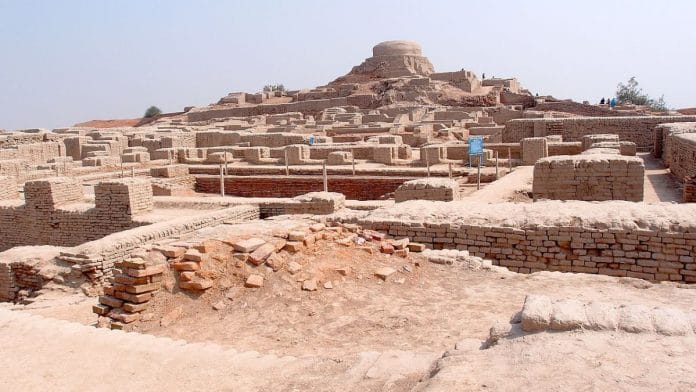
A recent paper examines the relationship between urbanisation and inequality at Mohenjo–daro. Using archaeological data from residential buildings excavated at the site, authors Adam S Green, Iqtedar Alam, and Cameron Petrie calculated the Gini coefficient of the areas as a quantitative proxy for economic inequality.
Titled ‘Inequality declined in the Bronze Age city of Mohenjo-daro’, the study was published in Antiquity. It proposes that inequality declined in the Harappan city of Mohenjo-daro with the rise of urbanisation roughly 5,000 years ago, thus breaking away from the correlation between urbanisation and inequality.
The paper brings a fresh perspective through statistical analysis, opening up an age-old debate about the nature of Harappan society, particularly the correlation between social and economic disparities and the rise of cities. More importantly, it brings into focus the relationship between statistical interpretation and archaeological understanding, which stems from rigorous fieldwork, material evidence, and spatial context.
Rather than accepting the findings as a straightforward description of Harappan society, it is important to examine what the analysis actually demonstrates, how it relates to archaeological interpretations, and its limitations.
The statistical study
The study looks at one of the largest Harappan cities, Mohenjo-daro, located in the Sindh province of present-day Pakistan. From excavated data, the size of residential buildings was used as a proxy for household wealth and economic disparities, if any existed. Around 309 residential buildings were used to calculate the Gini coefficient, a statistical measure of economic inequality that describes how evenly income or wealth is distributed across a population. The overall Gini coefficient of ancient Mohenjo-daro is estimated to be 0.44. It’s a lower figure than what is found in sites known to exhibit qualitative evidence for stratification, such as the ancient Greek site of Knossos, with a Gini coefficient of 0.86.
The study examines changes in the structures from early to later phases in the DK South area, where the sequence provides a comparatively clearer chronological framework. Here, the Gini coefficient decreased from 0.39 in the early urban phase of c. 2,500 BCE to 0.23 by c. 2,100 BCE. The author interprets this decline as evidence for decreasing inequality. At Mohenjo-daro, residential disparity declined as more structures were built in alignment with the city’s streets. According to the authors, this co-occurrence suggests that measures aimed at improving civic amenities accompanied those that ensured a more equitable distribution of the residential area—even if we do not know exactly what those measures were. Perhaps the same governance that made possible the city’s large non-residential buildings and its drainage system constrained the unequal distribution of residential space.
The study then questions whether it is reasonable to propose that a Gini coefficient of 0.44 is egalitarian. According to the authors, including Green, who is one of the main propounders of egalitarian urbanism, the Gini coefficient of Mohenjo-daro is double that of some early societies considered to be egalitarian by archaeologists. This includes neolithic or early farming settlements, where disparity rarely goes above 0.2.
At Mohenjo-daro, the decline in ‘residential inequality’ could be connected to its collective form of governance, as suggested by the city’s buildings and layout. The authors do acknowledge that the theory is not statistically robust, given the small number of chronological data points and the unusually large size of some residences. They also stress that residential area is only an indirect measure of inequality, as wealth and status could be measured with other forms of material culture. They highlight the need for more research combining residential data and material inequality.
Also read: Kalibangan was hiding in plain sight. It deserves more than a footnote to Harappan history
The archaeological perspective
As I sat down with Green in August, we discussed the absence of palaces, tombs, temples, and aggrandising art in Mohenjo-daro, which has been noted in another publication by the researcher. For over 100 years, he said, archaeologists have not been able to find evidence of social stratification at the site. Some of these archaeologists, including Jonathan Mark Kenoyer, point toward other indicators of wealth such as craft specialisation; access to exotic material; seals and ornaments; presence of specialised technologies; and control over procurement, production, trade, and consumption. Thus, inequality may be visible in material reality without being expressed dramatically through residential architecture.
According to Massimo Vidale, elite residential complexes did exist in the form of large architectural complexes found at Mohenjo-daro. He suggests that multiple competing or overlapping elite groups existed, which makes Mohenjo-daro potentially a heterarchical rather than simple egalitarian society. Robin Coningham and Mark Manuel challenged the assumption that social hierarchy everywhere would resemble Mesopotamian or Egyptian societies. He highlighted a need to move away from Eurocentric thought and accommodate South Asian perspectives while understanding Bronze Age societies.
The absence of royal tombs, palaces, and temples can account for an egalitarian society, but the presence of social differentiations, including at sites such as Dholavira and Rakhigarhi, does not necessarily require a centralised power. Moreover, in an area stretching over 1.32 million square kilometres, there are only five major cities. The rest of the social and spatial organisation, spanning over 4,000 sites, includes rural and semi-rural civilisations, towns, and ports. These sites require an in-depth understanding of the Harappan world, which cannot be accomplished with study conducted at one site. On this, Green stresses the importance of documenting structures during excavations. While this is important advice, we may also have to account for the limited excavations done at these sites. A majority of these cities are still not fully excavated in order to infer holistically about these aspects of Harappan society.
The archaeological enquiry here is not only limited to social equality that may have existed at Mohenjo-daro, but also concerns how the transformation from inequality to equality took place, especially from the Early Harappan phase to the urban phase. Since the Early Harappan phase is still unknown at the site, we may have to look for answers about authority, wealth, and social status through material reality.
In the context of this larger debate, Green’s attempt to quantify residential inequality is a significant attempt that should be understood with caution and tested with further archaeological endeavours. As a field archaeologist, I must point out that the stratification in Harappan cities, particularly in the buildings, is apparent at Dholavira and Rakhigarhi. It is clear that the features in the Harappan citadel are different from those found in the lower and middle towns. It would be fascinating to see similar studies conducted at these sites.
Disha Ahluwalia is an archaeologist and junior research fellow at the Indian Council Of Historical Research. She tweets @ahluwaliadisha. Views are personal.
(Edited by Prasanna Bachchhav)
This is another stereotypical exercise in retrofitting modern socio-political obsessions onto ancient antiquity. And don’t forget the loud-mouthed scream of Whataboutism!
When physical evidence proves an ancient Indian city was far more egalitarian than contemporary Egypt or Mesopotamia, the default response is: ‘But what about the hidden inequality in the villages?’
You simply cannot appreciate or tolerate an indigenous civilization that prospered on civic responsibility rather than class exploitation.
Instead of marveling at a 5,000+ year-old indigenous civilization that prioritized civic sanitation, public infrastructure, and shared prosperity over grand royal palaces and gold-filled tombs, you desperately hunt for hidden exploitation.
Kahan se aate hain yeh log?”