


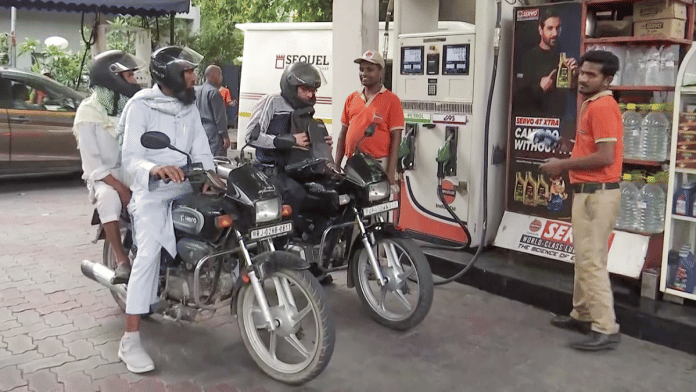
New Delhi/Bengaluru: The Karnataka government and three public-sector oil marketing companies (OMCs) on Friday clashed over allegations of excessive ethanol blending in petrol, after state minister Rizwan Arshad said tests had found ethanol content as high as 31.2 percent in fuel sold at some petrol pumps, well above the prescribed E20 (20 percent ethanol mixed with 80 percent petrol) level.
Hours after Arshad’s allegations, Indian Oil Corporation (IOCL), Bharat Petroleum Corporation Limited (BPCL) and Hindustan Petroleum Corporation Limited (HPCL) issued a joint statement rejecting the findings and questioning the testing process followed by the Karnataka government.
The state government had collected 63 petrol samples from seven districts, including Bengaluru, Kolar, Chikkaballapura, Bengaluru Rural, Ramanagara, Mangaluru and Tumakuru. These were tested at the Shriram Research Institute in Bengaluru. Arshad said the results showed ethanol content of 31.2 percent in an IOCL sample and 30.5 percent in an HPCL sample. Other samples recorded levels between 25.5 percent and 27 percent.
Arshad, who holds the Food and Civil Supplies and Consumer Affairs portfolio in the Karnataka government, reiterated earlier statements from automobile manufacturers and insurance companies who opposed the E20 blending. He said that the consumers were set to lose at least Rs 62,000 crore, attributing the estimates to automobile makers and insurance companies.
Addressed a press conference today and shared laboratory findings exposing excessive ethanol blending in petrol supplied across Karnataka. Tests conducted at NABL-accredited and ISO-certified laboratories found ethanol levels exceeding 20%, with certain IOCL and HPCL samples… pic.twitter.com/dhckW4s6GI
— Rizwan Arshad (@ArshadRizwan) November 6, 2026
“Even if you say 10 per cent reduction in mileage because of the ethanol mix petrol, if we consider an average of April 2025 to April 2026 where 46 million tonnes of fuel has been sold, then the loss to consumers is as much as Rs 62,000 crore per year. This, considering the average price of petrol is between Rs 100 to Rs 110 per litre,” Arshad said.
He added that if the average servicing cost is Rs 2,000 to Rs 3,000 due to E20 issues for 35 crore vehicles in the country, then it is likely that consumers pay Rs 39,000 to Rs 40,000 crore annually.
He said the state government demands that the Centre publicly clarify the “actual ethanol blend” being supplied to consumers.
The Karnataka government has also demanded mandatory blend displays to be put up at fuel stations across the country to allow consumers to choose between the range of blends available.
OMCs dispute Karnataka findings
In their statement, the three oil companies said the allegations were not supported by testing conducted under the prescribed procedures.
They said the sampling exercise conducted by Karnataka in October did not involve representatives of the oil companies. They also claimed they had not received the retained samples, complete details of the petrol pumps inspected or the laboratory reports, despite seeking these from the state government.
The OMCs said the procedure requires six one-litre samples to be collected during inspections. Two samples are given to the petrol pump dealer, two are retained by the oil company or department, and two are sent for testing to an authorised laboratory.
The statement also questioned the findings of the third-party laboratory, saying the reports did not contain sufficient details to independently verify the ethanol content.
The OMCs said samples collected during an earlier inspection exercise in September had been sent to their designated laboratories and tested.
“E20 petrol supplied by the three OMCs across the country, including Karnataka, conforms to IS 17021, the Bureau of Indian Standards specification for ethanol-blended motor gasoline,” the statement said.
Companies cite 893 samples
To support their position, the three oil marketing companies conducted a separate quality-monitoring exercise with the Centre for High Technology (CHT), under the Ministry of Petroleum and Natural Gas.
According to the statement, 893 samples collected from oil company depots and retail outlets across 27 states and Union Territories were tested. All were found to have ethanol content within the prescribed range of 19–21 percent.
Of these, 56 samples were collected in Karnataka from different locations and outlets operated by all three companies. These recorded ethanol content between 19 and 20 percent, with an average of 19.30 percent.
The companies also disputed Karnataka’s estimates of the financial burden on consumers due to higher ethanol blending. The state has estimated annual mileage-related losses of around Rs 62,000 crore and vehicle repair expenses of Rs 39,000 crore, taking the total estimated burden to around Rs 1.01 lakh crore.
Citing a Petroleum Ministry assessment published in August 2025, they said vehicles designed for E20 fuel could experience mileage reductions of around 1–2 percent, while some other vehicles could see reductions of 3–6 percent, depending on their category and calibration.
The statement also said ethanol blending at refineries and depots was carried out through automated and controlled systems. They rejected suggestions that they had a commercial incentive to blend beyond the prescribed limit, saying additional ethanol procurement would increase their costs.
India’s ethanol-blending programme is aimed at reducing dependence on imported crude oil, saving foreign exchange and supporting farmers. The OMCs said the programme had generated foreign-exchange savings of more than Rs 1.97 lakh crore since the 2014-15 ethanol supply year.
The three companies have asked the Karnataka government to share the complete sampling records and laboratory reports. They have also sought access to the retained samples for independent testing in the presence of state government and OMC representatives.
OMCs said they remained willing to cooperate with the state government in conducting joint sampling and testing, adding that any violation established through the prescribed procedure would be dealt with under applicable guidelines.
(Edited by Chingkheinganbi Mayengbam)
Also Read: Ethanol industry backs govt’s procurement tender, but seeks higher prices and more flexibility