




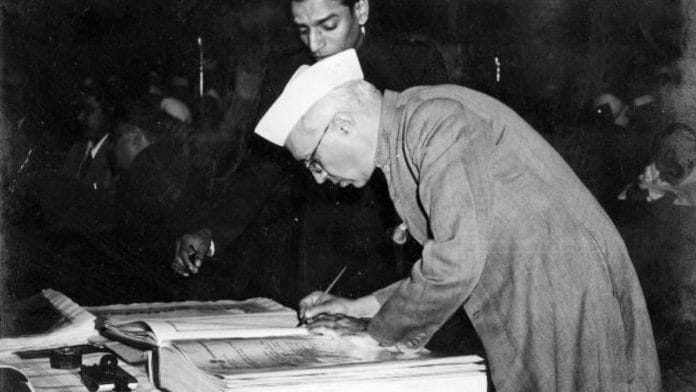

There is a photograph of Jawaharlal Nehru that almost everyone in India has seen, even if they couldn’t tell you where or when it was taken — the patrician profile, the rosebud pinned to the achkan, the faint air of a man who has just finished a sentence more elegant than the one you were expecting.
Nehru is the statesman of the midnight speech, the disciple of Gandhi, the architect of non-alignment. He is a figure so thoroughly absorbed into the national psyche that it is difficult to see him as a thinker rather than a monument. Yet, maybe photographs fail to capture the most interesting aspects of Nehru. Before he was a Prime Minister, he was something stranger and more vulnerable. He was a prisoner with a fountain pen, trying to work out, on paper, how you talk an ancient civilisation into changing its mind.
The setting matters. While Karl Popper sat in Christchurch, New Zealand, a refugee from Vienna, teaching at a provincial college, and wrote The Open Society and Its Enemies, his furious wartime defense of doubt against dogma, Nehru was writing his own book under guard. He drafted The Discovery of India between 1942 and 1945 in Ahmadnagar Fort, a basalt prison in Maharashtra where the British had deposited him and eleven other Congress leaders after the Quit India resolution.
The book was published in 1946. Two men, two confinements, two attempts to think their way out of the catastrophes of the twentieth century. One of them was a philosopher with the luxury of an academic readership, the other a politician who would shortly have to govern four hundred million people.
Evidence over faith
It was in The Discovery of India that Nehru gave lasting currency to a phrase that has clung to him ever since, the scientific temper. It is easy to misread the phrase as a slogan about laboratories and engineers. It was nothing of the kind. For Nehru, science was not an industry; it was a disposition, almost a form of etiquette.
Nehru’s famous formulation has the cadence of a creed: the search for truth, the refusal to accept anything without testing, the willingness to abandon a previous conclusion when the evidence turns against you, the reliance on observed fact rather than on the theory you walked in with. All of this, he insisted, was necessary not merely for the application of science but for life itself. It is, in its way, a remarkably Popperian sentence.
Popper thought a society stayed open only so long as its citizens kept testing and challenging it. Nehru thought the same thing about the mind. He had decided that India’s long political subjugation had a cognitive root — the fatalism of caste, the deference to religious orthodoxy, the patience with feudal authority were all, in the end, failures of nerve in the face of inherited belief. Independence from Britain was the easy part. The harder emancipation was internal.
What gives this its edge is the company Nehru was keeping, intellectually, when he refused it. He loved Gandhi, loved him with the complicated devotion of a brilliant son toward a difficult father, and he rejected almost everything Gandhi believed about modernity.
Gandhi distrusted the machine. He saw in the spinning wheel and the self-sufficient village not a quaint relic but a moral summit, a way of life that kept the soul intact against the grinding logic of industry. Nehru looked at the same Indian village and saw something he could not romanticise: hunger, disease, a landscape that brutalised the people living in it.
Where Gandhi saw a sanctuary, Nehru saw a trap, and he concluded that only the Promethean fire of technology—his phrases tended to run hot—offered a mathematically plausible escape from famine. This was not a small disagreement dressed up as a large one. It placed Nehru, consciously, in the lineage of the Enlightenment and Idealist rationalists. He did not want to recover a pure past. He wanted to engineer a verifiable future.
Also read: Jawaharlal Nehru opposed idea of SC being final arbiter of compensation: A Ranganathan
The philosopher and the Prime Minister
And here the critique must turn, because this is where the philosopher and the Prime Minister begin to come apart. It is one thing to praise doubt in a prison cell. It is another to institutionalise it from the seat of power.
Popper’s open society was meant to be a glorious mess, a decentralised brawl of competing hypotheses in which no one held the monopoly on truth. Nehruvian science, by contrast, became magnificent and monolithic. He inaugurated dams and steel plants and national laboratories and christened them, in a phrase first used of the Bhakra-Nangal project in 1954, the ‘temples of modern India’—and notice how quickly the metaphor betrays the method.
A temple is not a place where you test hypotheses. It is a place where you are told things. In his desperate haste to modernise a country freshly partitioned and economically gutted, Nehru built a vast state apparatus that concentrated scientific authority in the hands of a small technocratic elite.
The clearest case is the Atomic Energy Commission, run by the formidable Homi Bhabha, which operated with a degree of insulation from parliamentary scrutiny that would have made Popper wince. Rather than a citizenry empowered to question its own reality, India got an enlightenment delivered downward, by edict, with the state installed as the supreme custodian of reason.
There is a real risk in such an arrangement: simply swapping one priesthood for another, replacing the dogma of tradition with the dogma of the scientific establishment, while the ordinary citizen remains, as before, a recipient rather than a participant.
Also read: Is Vijay’s TVK ideologically bankrupt?
The danger of science without humanism
Nehru was not, for all that, a naïve technophile. He had read his Russell, corresponded with him, and absorbed the older man’s central anxiety that science cut loose from humanism is merely an efficient way to organise slaughter, a fear that did not feel abstract in the years just after Hiroshima.
Nehru was caught in the postcolonial version of that bind. India needed nuclear physics and aerospace engineering to be taken seriously as a modern state; those same technologies sat uneasily beside the country’s carefully maintained Gandhian, pacifist self-image. You can read his foreign policy as the scientific temper applied to geopolitics. Non-alignment was, at bottom, a refusal of preconceived theory.
The Cold War offered India two ready-made dogmas; American capitalism, Soviet communism, and Nehru declined to accept either without testing it against the observable facts of each particular crisis. Whether it always worked is a separate question. But the intellectual posture was consistent.
Also read: From Kolkata to Quad, Marco Rubio’s India visit sparks anxiety and mockery in China
Rationalism by government order
The final irony is almost too neat for a historian to be trusted with, and yet it is true. In 1976, twelve years after Nehru’s death, and during the Emergency, when civil liberties across India had been suspended, his daughter Indira Gandhi’s government passed the 42nd Amendment to the Constitution. Tucked into it, as Article 51A(h), was a new fundamental duty: every citizen of India was now constitutionally obliged ‘to develop the scientific temper, humanism and the spirit of inquiry and reform.”
A state of emergency had decreed that the people must be sceptics. One imagines Popper, who spent a career warning that truth cannot be administered from above, receiving the news with a dry laugh. It is the perfect monument to the contradiction at the heart of the whole project: rationalism arriving by government order.
But it would be a cheap ending to leave Nehru there, impaled on his own paradox, and it would also be wrong. The temptation is to score him against Popper and Russell and find him wanting, too top-heavy, too institutional, too sure. The fairer measure is the one the comparison itself suggests.
Also read: UPI isn’t a payment system anymore. It’s India’s GDP tracker
Testing theories in a newborn republic
Popper and Russell got to test their pristine theories in lecture halls and academic journals, where a flawed argument costs you a rebuttal. Nehru tested his theories against a newborn republic fractured by caste, raw from partition, drained by two centuries of colonial extraction, where a flawed argument cost you a famine.
Nehru’s attempt to apply his theories in practice turned out arrogant in places and overcentralised in others; the criticism is earned. But it was the arrogance of urgency, not of indifference. He was a genuine peer of the century’s great rationalists, wrestling with the same questions about truth, authority, and human freedom, with the crucial difference that he had to answer them in office, on a deadline, with the lives of millions as the variable.
He did not succeed in reasoning a wholly rational society into existence. Nobody could have. What he did, in the dogmatic dark of the mid-twentieth century, was govern an enormous and improbable country on the wager that evidence was a better compass than faith. He then wrote a book explaining his conviction, in a prison, while waiting to be released into the much harder task of testing it against reality.
Popper and Russell taught the twentieth century how to doubt. Nehru did something rarer and lonelier: he stood at the head of a fragile, unmade nation and asked an entire people to learn it with him, not as a theory to admire, but as a country to live in.
Pranav Sharma is a historian of science who lives and writes from New Delhi, India and Paro, Bhutan. Views are personal.
(Edited by Janaki Pande)
The article’s framing points to a real historiographical problem in how India’s pre-independence scientific achievements get written out of the narrative.
It gives Nehru credit for institutionalizing science at the state level, which is fair to an extent,but conflating that with inventing scientific thinking in India, is historically false….because it conveniently erases the actual Indian scientists who came before him.
For example,
A) Maharaja Sawai Jai Singh II and the Jantar Mantar observatories
B) Prafulla Chandra Ray or the Father of Indian Chemistry
C) Jagadish Chandra Bose and his pioneering work on radio waves
D) Satyendra Nath Bose and Meghnad Saha’s theoretical physics contributions
The blogger does not acknowledge any of those earlier scientific figures. By completely erasing these predecessors, this ode to Nehru, presents him as if scientific thinking had to be imported wholesale from the West through him, when in reality there was:
1) An 18th-century astronomical tradition
2) A 19th-century Indian chemistry school and research tradition
3) Early 20th-century physicists doing Nobel-caliber work
Blog celebrates Nehru for doing with state power what earlier Indians had already done with their own intellect and resources. I am sorry but this brown-washing builds a narrative where Nehru becomes the hero of Indian science, when the actual heroes were the scientists who did the thinking and the building without needing to be Prime Minister first.
A consistently relishing read. I should mention that the case for elitist centralisation perpetuated by Pandit Nehru may be overstated. Pandit Nehru had Vigyan Mandirs established to bring the scientific method and knowledge to the ground level.
It was a deeply held conviction. Scientific temper. AEC. ISRO. Which allow Indians to sleep peacefully at night. IITs coupled with IIMs. A statesman for eternity, the majesty of the Himalayas he and his daughter loved so deeply.