



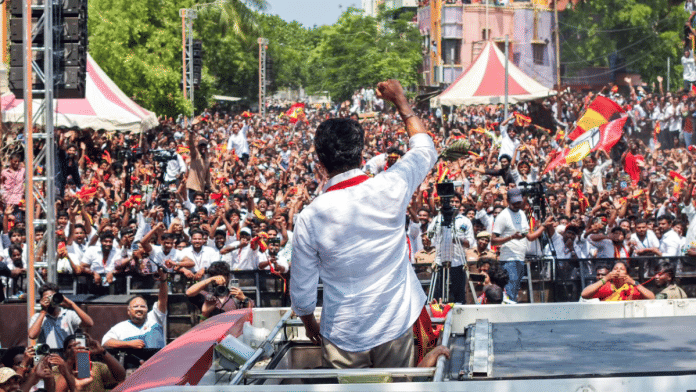
Fans and followers frequently characterise him as a lion. But what kind of political animal is Vijay really? The TVK’s victory in Tamil Nadu has lent a new salience to this question, the subject of debate in print and television, not to speak of the definitive decrees on social media.
Is Vijay ideologically ambivalent, or worse, bankrupt, as his detractors claim? Does he lack a clear, cohesive governance policy? Is his administration already compromised by political and administrative naivete?
The TVK is frequently portrayed as a non-Dravidian alternative to the two traditional majors, the DMK and AIADMK. At the same time, there are some who claim he is not very different from them and speak of the TVK as if it were a third Dravidian force. This begs the challenging question: What exactly is Dravidianism or a Dravidian party?
Political ideologies and movements are far from easy to precisely define. They may seem like mere descriptors, but terms such as fascism, wokeism and liberalism have what some philosophers call “emotive meaning”. In essence, their meanings are also dependent on subjective feelings and value judgements. Dravidianism is no different — a contested label rather than a clear-cut analytical tool in many explanatory contexts.
As a result, it seems more worthwhile to examine where the TVK and the two majors differ on specific issues or policies, rather than look at it through the prism of a Dravidian/non-Dravidian binary.
It only requires a cursory glance to list a few of the policies on which the three are aligned. They have strongly opposed:
- The NEET for medical admissions in Tamil Nadu, which they regard as undermining equitable access to education
- The Centre’s three-language policy, which they see as a covert way of promoting Hindi
- The one-nation one-election idea, which they argue is a threat to federalism and state autonomy
- The 50 per cent cap on reservations, which they regard as constrictive of social justice, given the State’s caste structure
- The delimitation exercise, which they fear will reduce Tamil Nadu’s political representation in Parliament and penalise it for successful family planning
Add a shared love for freebies—a number of them grossly unproductive—and this makes up a fair amount in common.
A shared cultural and linguistic nationalism binds these parties together on these and other singular issues. At the same time, there are significant differences at the broader, more transcendent level.
Where DMK, AIADMK & TVK differ
The DMK may regard itself as the true custodian of the Dravidian ideology, having emerged from the fiercely rationalist social movement, the Dravida Kazhagam. But original principles have a way of being diluted in the journey toward political power. For instance, at the personal level, DMK founder CN Annadurai may have shared his mentor Periyar’s radical atheism. But the political credo he adopted, “Ondre Kulam, Oruvane Devan (one humanity, one almighty)” was both a call for unity as well as a rejection of hardline rationalism.
The AIADMK has all but given up any pretence of rationalism, with a number of its leaders, including former chief minister Jayalalithaa, making no attempt at hiding their faith. Unlike earlier, a few DMK ministers too are now transparent about their religious beliefs, and the party itself officially makes a distinction between personal faith and the public use of religion to divide and discriminate.
Even so, the party’s relationship with Hinduism is complex, and sometimes marked by provocative and polarising rhetoric. Udhayanidhi Stalin’s condemnation of Sanatan Dharma is a case in point. One may or may not accept that Stalin was singling out caste hierarchy rather than ‘insulting Hinduism’, as his rivals made out. But surely the former deputy chief minister must have known that his remarks would stoke a controversy, which would not be defused by simply referring to the purported semantic ambiguity of the Sanskrit term.
As a practising Christian, Vijay has made a deliberate and strategic attempt to strike a posture of religious inclusivity, making publicised visits to temples and mosques and projecting himself as the face for all communities. His declaration that “Every religion is my religion” echoes the Gandhian sarva dharma sama bhava (equal respect for all religions), which embodies not only the idea of the equality of faiths but their spiritual harmony.
Vijay’s religious ecumenicalism is evidently comfortable with atheism as well. One of his first ports of call following the victory was to the Dravida Kazhagam’s headquarters, where Vijay met K Veeramani, who regards himself as the primary torchbearer for Periyar’s radical atheism, anti-Brahminism, and the ideals of social justice. The newly elected chief minister called on MK Stalin only a day later.
Also read: Skip the lies about Delhi Gymkhana Club being a secret power centre and answer 5 questions
What is Vijay’s ideology?
If we look beyond religion, does Vijay totally lack a larger ideological vision, as his critics say? This is not fair, given that he has some clear red lines. One of them he has drawn is against Right–wing communalism. The BJP, he has suggested, is his ideological enemy. In contrast, the DMK, which he described as an “evil force”, is but a mere political foe.
It is arguable that what Vijay really stands for is a syncretic pluralism, a big tent, catch-em-all approach to politics—an attitude regarded by some as ideologically ambivalent, particularly in rigid puritanical quarters. His appointment of two Brahmins as ministers is one reflection of this. The TVK dismissed the subsequent outrage as owing to a traditional and outdated anti-Brahminism.
It is probably this very pragmatic centrism that has drawn Vijay toward the Congress, the other umbrella organisation that traditionally traded in a restrictive ideology for one that accommodated a mix of ideologies, castes, and interests. It is no accident that he regards the late Congress chief minister K Kamaraj as one of his ideological mentors. Vijay described the Congress as a “natural ally” well before his victory, after which he surprised many by quickly onboarding it.
At the time, there was a feeling that this was a strategic mistake and that the wiser course would have been to encourage a break in an already fragile AIADMK to drum up the shortfall in numbers. As it turned out, Vijay did not have to do this. He managed to wean away the VCK and the IUML to join his government, and got the lone MLA from AMMK to externally support him in defiance of party leadership. Once again, it is a pragmatic centrism founded on coalition and compromise, and favouring wide appeal over (real or imagined) rigid doctrinal purity, that has got him where he is.
To some extent, this exposes the charge of political naivete. The post-election developments have left the DMK smarting as its allies abandoned it. As for the AIADMK, it is in something of a limbo, with the fate of a section of rebellious but now repentant MLAs, charged with defection, in the hands of the Assembly Speaker. Worse, three of its MLAs have resigned and signed up with the TVK, leaving it open to charges of horse-trading. That this is not the first time it has happened in Tamil Nadu is not really a good defence.
Administrative naivete is altogether another thing. While it is too early to properly assess the truth of this charge, any government manned by so many inexperienced ministers is bound to face serious challenges. The best course would be to rely heavily on the advice of senior government officials in the days going forward.
It is not clear if Vijay will allow this, but if he does, it would be in keeping with an approach that does not disfavour being procedural and pragmatically post-ideological.
Mukund Padmanabhan is a professor of philosophy at Krea University and former Editor of The Hindu. Views are personal.
(Edited by Prasanna Bachchhav)
Vijay doesn’t know anything other than freebies and theatrics.