




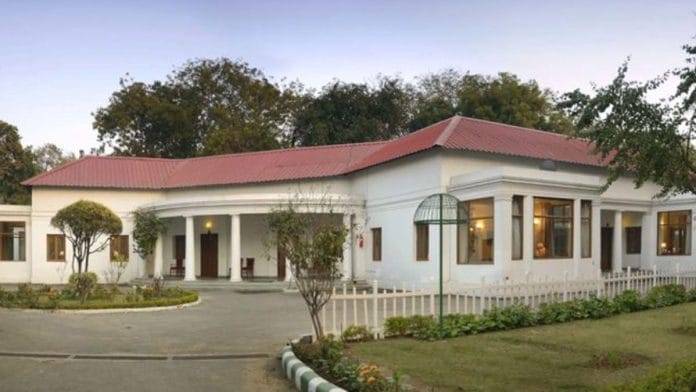

The controversy surrounding the Delhi Gymkhana Club reminds me of how differently people define elites — and how our objections to clubs often reflect our own resentments and prejudices.
Take my own example. I am not a member of any of the so-called Raj-era elite clubs. My reasons are hereditary.
My father always refused to join any club with roots in the Raj. Most of India’s great historic clubs were founded by the British Raj for itself. They were places where the white rulers of India entertained one another, and where the only Indians allowed were waiters and cleaners.
Until Independence, these clubs refused not just membership but also physical entry to Indians.
One version of the famous Jamsetji Tata story is that he was refused entry — despite being a knight of the realm — to the Royal Bombay Yacht Club. Other versions name different establishments, but the point remains the same: Jamsetji was so angry that he vowed to build the greatest hotel in India. And he built one just next door to the club — the Taj.
The Taj hired white foreigners, but they worked for Indian owners. And there was no colour bar, though at one stage the Taj did put up a sign that read: “No dogs and South Africans allowed.” (The ban on South Africans was a response to that country’s apartheid policy.) Today, the Taj is famous around the world. The Royal Bombay Yacht Club is mostly forgotten.
My father found this colour-based discrimination deeply offensive and, even when brown people were allowed in after Independence, he refused to join any of these clubs. He professed contempt for the new members who rushed to occupy the dining tables and tennis courts vacated by the Brits — places where our ancestors had once been allowed entry only as servants.
Over time, my father moderated his views to the extent that if someone he liked invited him to one of these Raj-era clubs, he would do his whole flag-waving routine in private but accept the invitation out of courtesy. But such occasions were rare.
I inherited his prejudice. I am not a member of any such club and haven’t visited any of them in Mumbai, Bangalore or Chennai in years. In Delhi, I have accepted the odd dinner invitation at the Golf Club, but have not entered the Delhi Gymkhana Club for at least five years, if not more.
My views are mostly shaped by my father’s legacy, but I also endorse his prejudice against clubs where membership committees interview you to decide whether you are socially acceptable enough to be allowed in. Socially acceptable? Don’t make me throw up.
So am I delighted by the Delhi Gymkhana’s troubles? Actually, no. I am deeply indifferent to the club’s fate. I never go there, and its eventual fate makes no difference to my life.
But the episode does make me wonder about the state of India today, and about the gap between appearance and reality.
On the rare occasions I have been to the Delhi Gymkhana, it has struck me as the last hangout of people who were once relatively important. It is packed with retired Army officers, superannuated bureaucrats and people whose families once had money but can no longer afford the extortionate prices at five-star hotel bars. It has never struck me as the home of the Deep State, the secret centre of power or a playground for the rich.
And yet, if you follow the commentary on social media, the Gymkhana is the beating heart of India’s wealthy and powerful elite. This characterisation is so far removed from reality as to be laughable. So is the suggestion that it is a Congress hangout where Rahul Gandhi parks his helicopter and Sonia Gandhi runs a pizza counter.
In fact, I suspect that if the Gymkhana were an assembly constituency, the BJP would win as many middle-class votes there as it does in the rest of Delhi. As things stand, the club is now run by a government-appointed committee, making it effectively an extended arm of the BJP machine.
This is the reality that social media seeks to obscure.
Misconceptions about Delhi Gymkhana Club
People who have never been to Delhi treat the Gymkhana as the haunt of something they have been told is called the Khan Market gang. This too is a misconception.
Khan Market was where wealthy Delhi people shopped ten years ago, before luxury malls opened. Almost everyone who pulled out fistfuls of cash there was probably a Modi supporter. They were not part of some powerful liberal establishment.
Even the subtext behind the term — “English-speaking people we Sanghis should hate“ — is misconceived. It’s hard to hear anything but Hindi or Punjabi in the shops at Khan Market.
So let’s skip the social media lies and ask ourselves a few questions.
First: is the Delhi Gymkhana a hangover from the Raj? Yes, it is. It opened in 1913 as the Imperial Delhi Gymkhana.
Should that matter? Well, it does to people like me, but that is no more than a personal prejudice. You can’t make prejudices the basis of public policy. If people like me dislike Raj-era clubs, we should simply refuse to join them. We have no right to ask others not to join, let alone demand that the clubs be shut down.
Second: why do RSS-BJP supporters get away with pretending this is the centre of a ruling elite?
Well, because many people are either ignorant or willing to believe convenient myths. The Gymkhana has never been more than a club for senior government employees. Exact figures are hard to come by, but roughly 80 per cent of the membership has usually consisted of civil servants and armed forces officers. Only about 20 per cent of the members work in the private sector, which is why it is so hard to get in.
As bureaucrats and Army officers retire, they spend more and more time at the club and end up determining its character.
Third: does the club pay market rent? No, of course it doesn’t. It was created for government officers who continue to earn less than their counterparts in the private sector and survive on relatively modest pensions after retirement. The club was one way of compensating for that salary gap.
Is this unfair? Maybe. But then, do ministers need to live in sprawling bungalows at taxpayers’ expense? Do they need huge motorcades? Should they be using private planes?
My view is that if you object to retired government servants having a club of their own, then you must also evict ministers from their bungalows and make them drive around in small cars without these huge convoys.
Why should politicians, most of whom have access (should they want it) to vast cash incomes, be allowed to live like kings while retired government servants are turfed out of their clubs? You can’t have one standard for the political class and another for everyone else.
Four: is this the end of the club?
I don’t think so. At least not yet. The club has been battling the government for a while now (which is why the committee running it is government-appointed) and the legal fight over the attempted takeover is likely to continue.
Five: why is there so much nonsense about the club being a bastion of the liberal establishment?
Because the BJP has always resorted to the same narrative in its appeal to middle-class supporters: India is run by a privileged, English-educated elite that has ignored the interests of Bharat. Though the BJP has electorally defeated these people, they supposedly still constitute a kind of deep state trying to sabotage the New India.
But this narrative is beginning to wear thin. The BJP has now been unchallenged in power for over a decade. Its members occupy the bungalows of Lutyens’ Delhi, and much of the media bows to their will.
Who is going to believe them when they warn about the threat posed by the ‘Lutyens elite’ when they themselves have become the Lutyens elite?
I have no idea why the government has decided to take over the Delhi Gymkhana. I doubt if it is only to distract supporters from the worrying headlines of the moment, as some have suggested. Other distractions are available that do not involve indicating to the armed forces and civil servants that only the political class deserves to keep its privileges.
No doubt we will get a better idea of the government’s motives with time. But I remain sceptical about how much longer the country will believe this nonsense about battling the liberal establishment.
As I read about the Delhi Gymkhana’s struggle to survive, I wondered what my club-hating father would have made of this battle. I suspect his reaction would have been much the same as mine.
As much as he loathed brown sahib clubs, he hated governmental dadagiri and overreach even more.
Vir Sanghvi is a print and television journalist and talk show host. He tweets @virsanghvi. Views are personal.
(Edited by Prashant Dixit)
I think Mr Sangvi has given a very candid and honest analysis… notwithstanding his personal bias he is very clear and logical. Wish more people would see what he can see.
As always the best article on this topic
You did not like the Raj legacy, yet you joined the Macaulay club, and carved out a distinguished career, in english language!
I know each chappa chappa of Delhi Gym, having spent so many nights there. Dinner was invariably in the room, so had very little interaction with the members. They seemed a little older than the people I see in CCI Bombay. So many trees, the ambience a five star hotel. would struggle to create.
Even after 12 years, the BJP continues to be sore winners.
Delhi Gym led me to Khan Market, in the quest for fresh fruit, toiletries, other essentials on long visits. Fell in love with it.
A friend took me for lunch to the Delhi Golf Club. Was enchanted by the peacocks.
I have followed Mr Sanghvi’s journalistic work for quite sometime. I have also interacted with him on some occasion though he may not remember me. The piece written by him and subsequently edited by someone else somehow looks a bit like a PR piece. Consider the following:
1) He establishes his father’s dislike and his own dislike against Raj era clubs to drive home a point that he is not bothered about this issue of Delhi Gymkhana club’s future. Yet he uses his piece to clearly spell out clearly that the future of club actually matters to him.
2) If the club is for retired bureaucrats and armed forces officers largely, then how come it is not elitist? He actually establishes that it is a Political class Vs Bureaucracy privilege issue. What about the general Public?
3) Why should the DGC not be taken over and converted into a public library with open spaces or a recreational center in the heart of Delhi where general public can buy a ticket and have a good evening? He does not mention the greater public good that can come out of it. He is bothered about ex bureaucrats enjoying a cheap drink the heart of Delhi. PATHETIC.
4) Why should a club subsidized by Govt own vast swathes of land in the heart of Delhi when a better use for greater public good can come of it by way of some good national project or office? Instead Mr Sanghvi focusses on bunglows and motorcades of ministers. RIDICULOUS.
I think Mr Sanghvi has clearly lost his sense of objective journalism somewhere in the late 1990s or early 2000s like many of his erstwhile colleagues.
Social media is full of trash but senior so called ex journalists should atleast write objectively whenever they get the chance now, DO NOT LOWER YOUR STANDARDS TO DEFEND A FEW TO ENJOY A CHEAP DRINK AT SOME RAJ ERA CLUB.