





It is a tough phase for Europe. Protests are raging in France and other countries on the one hand, while America is no longer the dependable ally it once was on the other. In this situation, could India become the European Union’s best bet for a mutually beneficial partnership?
‘Paris is burning’, ‘Another French Revolution in the offing’—these are some of the headlines describing the highly volatile situation on the streets of multiple cities in France. What began as a protest by students, parents and teachers demanding better schools, more funds for education and changes to the country’s university admission system has spun off into wider, uncontrollable protests over high fuel prices and inflation, with protesters accusing the government of fiscal profligacy. Police action against protesters, the closure of several Metro stations and tightening of security measures to maintain law and order have aggravated the unrest.
Elsewhere in Europe, too, cities are seeing similar violent protests by angry mobs, mostly youth, involving acts of vandalism, destruction of government property and looting of shops. Violent clashes between protesters and police have been reported from Milan, Italy. Reports of rampant political corruption have brought huge numbers of protesters onto the streets of Tirana in Albania. Low wages, soaring housing costs and inflation have mobilised thousands in Lisbon and Porto, Portugal. Economic strains and austerity measures in the wake of the fuel crisis have triggered protests in Brussels, Belgium. The high cost of living and lack of affordable homes have led to massive protests in Madrid, Spain. In Germany, meanwhile, thousands of students and youth have organised nationwide school strikes and street protests against the country’s new military service laws, aimed at addressing a shortage in the armed forces, which currently have about 1,86,400 active troops, against a target of 2,60,000 by 2035 to meet NATO requirements.
Also Read: US IT industry will touch rock bottom soon—that’s what happens when you lose Indian talent
A pressure cooker in Europe
There are three notable features of these protests. One is that they are spearheaded by students and youth, many of them unemployed or in the final years of their graduation, haunted by the spectre of mounting unemployment and the lack of avenues to earn a decent living. Secondly, the large-scale and cross-border nature of the protests in such a short span of time is astounding, to say the least, as though they have been planned with military precision. Third, and probably more importantly, the protests have largely been triggered by the economic policies of respective governments, especially in the wake of the Middle East conflict. Restricted oil supplies, government cost-cutting measures and disrupted supply chains have compounded economic woes.
Anti-immigration policies, strict measures against immigrants, property purchase rules and restrictions on admissions for foreign students are also touted as prominent reasons for the current protests. “How can French people do this to France?” asked French President Emmanuel Macron, insisting on a distinction between protesters with “legitimate demands” and “those who destroyed, smashed, and looted”. He blamed the violence on ultra-left groups and criminals.
Meanwhile, US President Donald Trump, in a post on Truth Social, blamed uncontrolled migration for the unrest, saying, “What’s happening in France is nothing less than out of control mass migration. This isn’t about schools, this is about Islam wanting to take over a once great Country!”
While welfare systems face a fund crunch due to the increased burden of immigration, several European countries, once eulogised as strong economies of the North in any North-South divide narrative, face a double whammy of high deficit financing and low productivity.
Europe’s export market is shrinking, with the WTO projecting a 0.1 per cent decline in Europe’s total exports for 2026. The EU’s trade balance has deteriorated sharply, swinging from a €51 billion surplus in Q1 2025 to a €22 billion deficit by Q2 2026, mainly due to falling export volumes and surging import values, partially driven by high energy costs.
The introduction of a 15 per cent import tariff on most European goods by the US, the EU’s largest export market, triggered a sharp decline in EU exports to the US, which fell by 26 per cent in Q2 2026 compared with Q1 2025.
And then, all of a sudden, Trump told the European members of NATO to fend for themselves by increasing their respective defence budgets and contributing more to NATO. Trump’s US-China G2 framework and purchase of Russian oil, coupled with the West Asia crisis, have crippled energy supplies to Europe. Already, the gross debt-to-GDP ratio reached 88.8 per cent in the euro area and 82.9 per cent across the broader European Union by the second quarter of 2026, according to Eurostat.
Also Read: US wants India to concede on trade and Russia. New Delhi should negotiate without fear
A win-win for India and the EU
It is about 110 years now since the First World War broke out and changed the geography and politics of Europe, heralding a new dimension of geopolitics and world order. Since then, Europe and the rest of the Western world have witnessed several watershed moments and premonitions of doom. Remaining united and steadfast, the US and Europe have withstood two World Wars, a Cold War and several major economic challenges.
But can Europe rely on the US anymore?
The US wants to knock down the emerging multipolarity, EU-Asian solidarity and South-South cooperation and create a unipolar world with a tripolar support system—where the three dominant powers would be the US, China and Russia. Europe is not one of them, which puts European unity and NATO at peril.
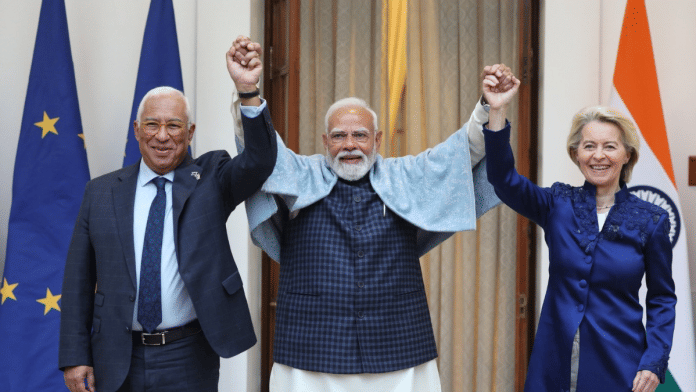
Europe needs to seriously consider partnering with India, a strong democratic economy in Asia. India and the EU have already taken steps in this direction, including concluding Free Trade Agreement (FTA) negotiations and signing a Security and Defence Partnership in January 2026. Now, putting the India-EU FTA on the fast-track could be a way forward and create a win-win situation.
Seshadri Chari is the former editor of ‘Organiser’. He tweets @seshadrichari. Views are personal.
(Edited by Asavari Singh)