





We often see political leaders on the ground during elections, connecting with voters, listening to their grievances, visiting their humble homes, and sharing a meal with them. But once the elections are over, many seem to disappear, only to return five years later, when the next election comes around.
But some leaders stand apart. Their commitment to serving people does not begin or end with an election. It comes from an innate sense of purpose , one that is not driven by political motives alone. As PM Narendra Modi mentioned while recalling Ashok Bhatt, the veteran BJP leader, while being a minister, was willing to help people even in the middle of the night. In the PM’s words, political life is about winning people’s trust through service, not merely winning elections. Such leaders leave a legacy behind that speaks volumes, be it PM Modi, who went on a bike to scout the post-disaster Bhuj in 2001, when he wasn’t even the CM. He then returned to Chobari, which was one of the worst-hit areas in the disaster, to celebrate the first Diwali as a CM.
APJ Abdul Kalam was known as the ‘People’s President’ for the very same reason — due to his accessibility, humility, and connection to the ordinary citizens of the country. When a leader works with this ethos, the adulation follows.
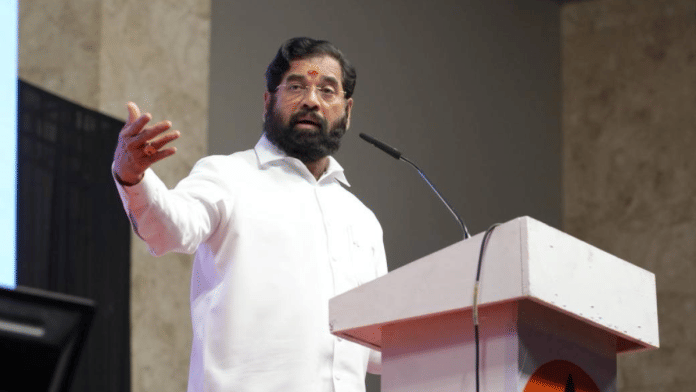
The same ethos can be seen in Maharashtra Deputy Chief Minister Eknath Shinde. Over the years, he has built and earned an image as a people’s leader, known for being accessible, responsive, and accountable. During his recent speech on the occasion of Vijayadashmi, as Shiv Sena completed 60 years, he mentioned that all the office bearers were directed not to attend the Dasara Melawa. The idea was that with the saffron flag on their shoulders, Shivsainiks would be seen on the farm. This shows that true leadership is about staying in touch with reality and being empathetic. The government is providing 12 types of waivers to farmers, along with immediate financial assistance of Rs 5,000, and ration kits are being distributed. To ensure a holistic, rather than merely superficial, solution, the panchnama of drought-affected farms is also underway.
Accessible to party workers and public
Long before politics, Shinde had shown this side of himself. During the 1989 Bombay riots, amid the violence, he reportedly drove an auto rickshaw from his chawl at night to take a woman and her child to the hospital. It was an act of kindness that came long before he held public office, proving that his instinct to help others was not motive-driven.
Decades later, that same instinct was visible in another incident. While returning from an official function, Shinde spotted an ambulance parked by the roadside in Mumbai, with a patient who was returning home after failing to find a hospital bed in the city. Shinde immediately stepped in, arranged for the man’s admission to a hospital in Thane, and provided an ambulance from his motorcade to take him there.
What makes him a people’s leader is that he does not have an ivory-tower mentality. In his own words, he wants to listen to the last person in the queue too. Even if every problem cannot be solved, he believes it is important to listen to people’s concerns. This was reflected in his approach during his tenure as the Chief Minister. At Varsha, the official residence of the Maharashtra CM, he said, “The doors of this house are open to everyone, 24×7. I know I am here because of the people. I am here to serve them, so I will never close my doors on them.”
People came from far-flung areas with their grievances, and he worked with a team of bureaucrats to resolve their issues. This approach to leadership also brings to mind Balasaheb Thackeray, who would read the newspaper every morning, mark civic issues, and call the concerned officials to follow up.
A leader at the top sets the tone for the entire organisation and administration. Shinde’s directive to Shiv Sena ministers to hold Janata Durbar at the party headquarters in Mumbai was an extension of this approach. The aim was to hear the grievances of ordinary citizens and work toward resolving them. His vision was that a party heading the government must remain accessible to its workers and the public.
His approach was not limited to accessibility but also accountability. We often see the gap in the policy as envisioned on paper and on the ground; it’s the feedback loop that fixes the gap. As Chief Minister, he directed district collectors to visit government hospitals, municipal hospitals, primary health centers, medical colleges, and allied hospitals in their respective jurisdictions and submit status reports. The directive linked listening to people’s concerns with checking the condition of the public health facilities they depend on.
In his own words, his motto is “24/7 government”. His government also pushed major infrastructure projects, including the Mumbai Coastal Road, Atal Setu, metro rail projects, Navi Mumbai International Airport, the Mumbai–Nagpur Samruddhi Mahamarg and Dharavi redevelopment.
Also read: What are the best and the worst things about being PM Modi
An inspiration for next generation
Now, as Deputy Chief Minister, Shinde is moving ahead with the same spirit and fervor; the same emphasis on public access and grievance redressal can be seen through his recent initiatives, including the medical assistance cell and public grievance hearings. The offices and responsibilities may have changed, but the essence guiding it remains the same.
In January 2026, Shinde launched Arogya Aplya Dari for preventive health check-ups. When floods hit Nepal in August 2026, he personally video-called over 80 Maharashtra residents stranded there, enquired about their situation, and assured them that efforts were underway to bring them home safely.
From welfare schemes to medical assistance and personally reaching out to people stranded during a crisis, accessibility has remained a recurring theme in Shinde’s approach to public service. This sense of responsibility is also reflected in the way Shiv Sena approached this year’s Vijayadashmi. The party dedicated its Dussehra rally to drought-hit farmers, many of whom are struggling with crop losses and financial uncertainty.
The message is simple: leadership must remain accessible, especially when people need support the most. A farmer facing hardship should not have to face it alone, particularly during a festival that brings families together in celebration. The next generation must learn from these leaders that the essence of true leadership lies in staying connected to the people and putting their needs first.
The author is the national secretary and spokesperson of the Shiv Sena. She tweets @ShainaNC. Views are personal.
(Edited by Aamaan Alam Khan)