




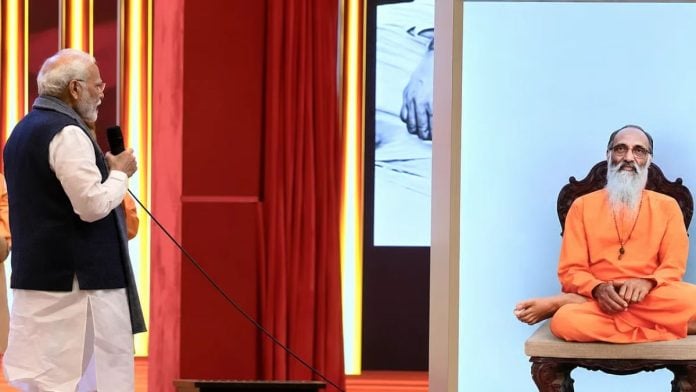

Prime Minister Narendra Modi’s interaction with the holographic avatar of the Late Swami Chinmayanand Saraswati brought to my mind Brazilian president Luiz Inacio Lula da Silva’s photo when he finally got a smartphone at 81. It was a desperate bid by the Leftist icon to connect with the online generation ahead of Sunday’s presidential runoff with Right-winger Flavio Bolsonaro.
Unlike Lula da Silva, PM Modi has been one of the most tech-savvy politicians in India. Yet, to make him talk to and get endorsement from someone who died 33 years ago—ostensibly to connect with the AI generation—looked more desperate than ‘cool’.
It reminded me of what popped up on my Facebook timeline the other day—a video clip from Season 9 of Koffee with Karan, a celebrity talk show hosted by filmmaker Karan Johar. In that clip, Karishma Kapoor is asking Salman Khan, “What’s the best and the worst thing about being Salman?” With a deadpan expression, the actor replies, “The best thing about being Salman is Salman. The worst thing about being Salman is also Salman.”
That got me thinking about the best and the worst things about being Prime Minister Narendra Modi. The answer to both is PM Modi. He is omnipotent, omniscient and omnipresent. He needs no advice from anyone because he knows the people’s pulse. He is India’s most popular leader with a titanium coating. Nobody in the Bharatiya Janata Party (BJP) or the larger Sangh Parivar can question any of his words or actions. He is bigger than his party. The BJP’s Union Ministers, Chief Ministers, MPs, MLAs, organisational office-bearers—everyone owes their position to him and their continuity is at his pleasure.
The Rashtriya Swayamsevak Sangh (RSS) can only praise him. There is no veritable challenger to him inside or outside the BJP. The Opposition doesn’t matter to him. They can cry hoarse about Chinese misadventures across the Line of Actual Control, the Manipur tragedy, or Chief Election Commissioner Gyanesh Kumar becoming a law unto himself. Who cares? PM Modi can simply ignore them because he wins elections; they don’t. He can keep setting loftier goals such as Viksit Bharat 2047 while common people wistfully listen to Nobel laureate and MIT economist Daron Acemoglu telling them how politicians have forgotten their key pacts with voters to “take care of the drains”— or basic infrastructure such as schools, colleges and hospitals.
One-way affair in world’s largest party
Well, what’s the worst thing about being PM Modi? The AI avatar of Swami Chinmayanand answered that in one sentence on Friday: “Shikhar par vyakti akela hota hai (a person is lonely at the top).” Having ‘no family’ is a big positive in politics because people think you can’t be corrupt—kiske liye zamaa karega or who will he amass any wealth for? Not living with the family becomes an automatic validation of living for the people and the country. Being “without a family”, therefore, makes PM Modi a saint in the public eye—among a section of them, at least.
It, however, also means having no near and dear ones to share fears and anxieties with. It becomes lonelier at the top once you start realising that you and those around you may have conflicting interests. The sooner you step away, the sooner they get a shot at fulfilling their ambitions.
Amid these personal dilemmas is this huge burden of expectations. The titanium-coated PM must use his shield to protect his party colleagues. CMs, ministers, MPs, MLAs are all having a blast, chanting ‘Jai Modi’ intermittently and leaving it to PM Modi to ensure their stay in power.
Madhya Pradesh CM Mohan Yadav and his family can, therefore, focus on amassing real estate. His Arunachal Pradesh counterpart, Pema Khandu, can chill even after the Supreme Court’s direction for a Central Bureau of Investigation inquiry into allegations of contracts worth Rs 1,270 crore given to firms linked with the CM’s wife and brother. Union Minister of State for Agriculture and Farmers’ Welfare Bhagirath Choudhary can get Rs 99.60 lakh subsidy for his own farm sanctioned by a board under his own ministry. When a controversy breaks out, he can just return the money and chill.
MP minister Vijay Shah can call Colonel Sofiya Qureshi a “sister” of terrorists and chill because the BJP government wouldn’t give sanction to prosecute him. There are instances galore of PM Modi having to expend his goodwill for his party colleagues. Dushyant Gautam’s appointment as Sikkim governor in complete disregard of the allegations by the grieving parents of a murdered Uttarakhand girl is the latest instance.
Also read: Why Nehru’s idea of scientific temper failed in India
Essentially, everyone is looking up to PM Modi for something or the other. It’s a one-way affair. Few are there to warn or help him when things start going wrong. When Gen Z protesters were on the streets in New Delhi, demanding Education Minister Dharmendra Pradhan’s resignation, where were the workers of the world’s biggest party, the BJP? A party that claims to have 18 crore members could have swamped every city, town and village with its workers and set a counter-narrative. Instead, PM Modi was left to fend for himself.
How is it that Rahul Gandhi, a “failed product” in PM Modi’s eyes, has been dominating the public discourse and dictating the agenda of the government, even virtually foiling its ambitious delimitation plan? Where is the world’s largest party? Let me say in words what the BJP may be telling the PM in deeds: ‘Ask not what your party can do for you, ask what more you can do for your party.’
Swami Chinmayanand, in his AI avatar, was so prescient.
DK Singh is Political Editor at ThePrint. He tweets @dksingh73. Views are personal.
(Edited by Ratan Priya)