




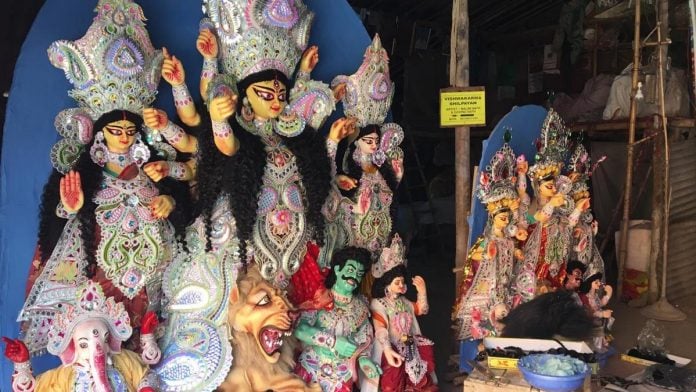

There are a million mutinies now in West Bengal around the goddess with 10 hands. Durga Puja 2026, if you happen to eavesdrop on the chatter inside Kolkata cafes or read opinion pieces in news outlets, is under saffron siege. Most people strongly believe the new BJP government in the state, under express orders of Chief Minister Suvendu Adhikari, is out to put a Hindutva spin on Bengal’s favourite festivity.
What began with a furore over Bageshwar Dham Chief Dhirendra Krishna Shastri’s comments about eating non-vegetarian foods during Durga Puja has become an all-out scare about the nature of the festival itself after Adhikari announced a strict set of rules and guidelines this year. But the fear that Durga Puja won’t survive under the BJP rule is unfounded.
The annual festival that celebrates divine feminine power defeating the forces of evil has survived the British, the Leftists and Mamata Banerjee.
It will survive the BJP reign also.
Saffron reign, Durga’s arrival
Murmurs of dissent among Bengalis began after the Vishva Hindu Parishad (VHP) issued guidelines in August, prodding Durga Puja organisers to turn back to traditional ways of conducting puja and make sure that non-vegetarian food is neither sold nor consumed inside or around puja pandals.
The organisation said it was not asking for a blanket ban on non-vegetarian food during the puja as West Bengal didn’t have a history of strictly vegetarian food during puja days.
The parishad also stressed the sanctity of the Durga idol and said it should be kept free from contact with non-vegetarian food.
“If non-vegetarian food must be sold, it should be done at a designated location outside the puja pandal, ensuring that food scraps do not find their way into the pandal’s vicinity,” Nirgunananda, a member of the VHP’s central advisory council, said.
Days after VHP issued its guidelines, Shastri delivered similar sermons to Bengalis to keep non-vegetarian food away from Durga idols. During a visit to West Bengal for a three-day Hanumant Katha in Howrah’s Liluah, Shastri asked Bengali Hindus to observe Navratri and do the rituals with utmost devotion and sincerity, whether they installed an idol or not.
If reactions to VHP’s exhortations about Durga Puja had been muted, Bengalis broke ranks across the political divide to take on Shastri. Such was the uproar over Shastri’s speech, whether on social media or on the streets, that West Bengal BJP president Shamik Bhattacharya had to stress that Bageshwar Dham Chief’s remarks were “his personal view” and were not endorsed by the BJP.
“We Bengalis eat puri on Ashtami and mutton on Navami,” Bhattacharya said.
The fear that there would be an attack on non-vegetarian food in West Bengal under BJP rule is not new.
“The BJP will not allow you to eat fish. Nor will they allow you to eat meat or eggs,” TMC supremo Mamata Banerjee had warned before the West Bengal assembly elections earlier this year. The BJP had to depute its prominent leaders, including Smriti Irani, who said on the campaign trail that Banerjee’s statements were “a lie”, and insisted that in Bengal “fish and rice are a part of its culture and it will never end”.
The VHP and Dhirendra Shastri’s statements on Durga Puja simply resurrected that old fear. On his part, Adhikari also announced a set of new rules for Durga Puja, including all liquor shops and bars across the state to remain closed on Maha Ashtami, no DJ music during celebrations and immersion processions and no pandal inaugurations before Mahalaya and the start of ‘Devi Paksha’.
Adhikari also asked organisers to turn back to traditional aesthetics and respect religious sentiments in idol and pandal making. He also directed puja committees to deny permission for Leftist book stalls outside pandals if they use the term ‘Sharadotsav’ (autumn festival) instead of ‘Durga Puja’.
The Wire, however, was of the view that the festive fervour for this year’s Durga Puja feels ‘muted’.
“It is not that people have lost interest, but rather that a controversial set of directives issued by the new BJP government and bodies associated with it under the Hindutva umbrella has thrown Bengal’s statement festival into an unprecedented ideological debate,” it had analysed in one of its pieces.
Debates, though, are not new to Durga puja.
Also read: Vegetarianism is not a universal Hindu norm. Bengal’s history shows why
Durga puja down the ages
If we turn back time to look at Durga puja celebrations during the British era, we would see that social and political messaging ran alongside rituals even then. Puja celebrations were often used to make power moves.
Author and academic Sarojesh Mukherjee told ThePrint that the Durga pujas of the colonial era have not merely outlasted the British; they help explain features of the puja celebrated today.
Mukherjee said Calcutta’s (now Kolkata) first “modern Durga Puja” was staged by Raja Nabakrishna Deb to mark the British victory at Plassey and honour Robert Clive (the first British Governor of the Bengal Presidency).
“Inviting Clive to preside at the Durga Puja celebrations gave the occasion a dual symbolism: the British triumph as an earthly echo of Durga’s victory over Mahishasura, and Nabakrishna Deb’s own eminence advertised before his peers. That tradition survives today in politicians patronising lavish pujas that celebrate their own influence more than the deity,” Mukherjee said.
About Nabakrishna Deb’s Durga Puja celebrations, author and journalist Indrajit Hazra wrote that Clive apparently told Deb that he was a Christian, to which Deb replied that “he would take care of things”.
“He (Deb) proceeded to have the Pujo in a new venue so as to not make the more conservative Hindu members of his household erupt, and brought in nautch girls for entertainment besides beef, ham and alcohol for refreshments, essentially turning the Test match sobriety of the Pujo into an IPL-style dhamaka,” Hazra wrote.
By the 20th century, Mukherjee said that the colonial state’s relationship with Durga Puja had turned adversarial.
“The Calcutta Police monitored pujas with nationalist associations—especially Baghbazar Sarbojanin and the Simla Byayam Samiti—both linked to militant nationalism, which expressed itself through coded motifs and martial displays on Veerashtami, turning communal worship into a challenge to colonial authority,” he added.
Since a puja remained, on its surface, an act of worship the British could not easily ban, nationalist ideas hid within imagery beyond their policing—Bankimchandra’s Bharatmata from Anandamath being the most potent, letting sedition conceal itself in devotion, Mukherjee added.
The tradition of merging Durga Puja celebrations with strong political messaging continued in independent West Bengal. Having little to do with Hindu religiosity and everything to do with communist ideology, Marxist and progressive book stalls were put up across West Bengal by the Left Front government. The practice continued even after the Communists lost power to Mamata Banerjee.
An article on the CPI (M)’s official website, ‘People’s Democracy ’, published on 12 October 2025 says: “The annual campaign successfully merging the festive spirit of Durga Puja with ideological outreach has once again affirmed its status as a highly anticipated feature of Bengal’s cultural calendar. Spearheaded by the CPI(M) and its mass organisations, this massive and widespread initiative saw the establishment of numerous Marxist and progressive book stalls across West Bengal.
Durga Puja celebrations during the TMC rule often raised eyebrows. In 2016 at Chakdaha town, not far from Kolkata, a Durga idol was made in the image of Banerjee, the then CM.
“The Bengal Chief Minister, complete with her white and blue sari, slippers and folded hands, is Durga at Chakdaha town. A fiberglass lookalike has, besides her two hands, 10 arms like Durga, symbolically holding projects she launched as Chief Minister. At her feet is a depiction of villagers in Singur celebrating in front of Tata Motors’ half-built factory,” NDTV had reported.
In 2019, a police complaint was filed against a ‘secular’-themed Durga Puja in Kolkata’s Beliaghata for allegedly playing the azaan inside the pandal. Advocate Santanu Singha lodged the complaint after a huge outrage on social media and asked the Beliaghata police to take action.
“Tell me how playing azaan in a puja pandal will help promote communal harmony? I have filed this complaint as an individual. I’ll be hurt if Gita is recited from a mosque; similarly, I am hurt that azaan is being played at a Durga puja pandal,” Singha had said.
Also read: Durga Puja is India’s gift to the world. It is pan-India and global
‘Mamata distorted Durga Puja’
Bharatiya Janata Yuva Morcha’s vice president for West Bengal Aroon Shah told ThePrint that between 2011 and 2026, Banerjee politicised Durga Puja to such an extent that the occasion itself was stripped of all religiosity.
“She would inaugurate Durga Puja pandals on ‘pitru paksha’ and not on ‘Devi Paksha’, which signifies the descent of Goddess Durga to Earth,” Shah said.
Shah alleged that when Durga idol immersion and Muharram dates would clash, Banerjee would invariably let the latter take place first, making puja committees wait.
“During her reign, Durga Puja celebrations in West Bengal became a means of promoting Brand Mamata. Her posters were put out outside pandals, and she would visit and dominate the puja proceedings in various pandals in such a way that it would appear that the celebrations were about her and not the goddess,” Shah alleged.
The outrage over Adhikari’s rules for this Durga Puja in an attempt to make the occasion more religious and less festive may also be limited to Kolkata.
According to academic and oral historian Avishek Biswas, there has always been more to Durga Puja in West Bengal than Kolkata would want the world to believe.
“Suburban and rural areas in Bengal are largely unaffected by the controversies surrounding Durga Puja in Kolkata. Durga Puja outside Kolkata has mostly been about celebrating the goddess and less about the pomp and the political messaging,” Biswas said.
If Durga Puja didn’t stop with offerings of beef and ham, sale of Leftist literature outside pandals, azaan inside pandals and goddess idol modelled on Mamata Banerjee herself, it would surely survive the BJP rule as well.
Deep Halder is an author and a contributing editor at ThePrint. He tweets @deepscribble. Views are personal.
(Edited by Saptak Datta)
It’s just scare mongering engineered by Left-Congress-TMC social media teams. Anyone falling for such idiotic propaganda is gullible to say the least.
But what will do serious damage to the image of the BJP govt is the disclosure of the list of Youtubers and influencers who were paid by the BJP to indulge in propaganda activities against the TMC prior to the Bengal polls.