




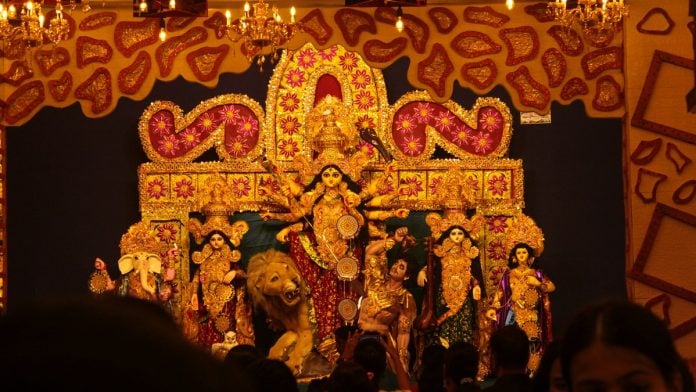

Durga Puja in Kolkata is not just a festival — it is a city-wide act of imagination, and one that reverberates with the Bengali and Indian diaspora globally. Every year it transforms West Bengal and many parts of India into the world’s largest public art festival as an immersive blend of worship, craftsmanship, and social messaging.
In December 2021, UNESCO inscribed “Durga Puja in Kolkata” on the Representative List of the Intangible Cultural Heritage of Humanity, making it the 14th entrant from India to the prestigious list. It described the city’s festivities as “the best instance of the public performance of religion and art” and also celebrated it for its inclusive nature that welcomes marginalised groups and women.
As Tim Curtis, UNESCO Representative in India and a close friend, put it, the festival “embodies the Sarbojonin spirit (for all people) that has defined community worship since 1926. From clay sculptors to drummers, designers to local organizers, the entire city contributes to one of the most vibrant cultural expressions in the world.” It’s now one of 16 elements on UNESCO’s intangible heritage list, along with Vedic chanting, sacred theatre, yoga, Kumbha Mela, Garba and Deepavali.
This grand spectacle represents community life in motion: local clubs raising funds, families volunteering, craftspeople collaborating, and entire local economies springing to life around food, lights, music, and art.
Families map their ‘pandal-hopping’ routes, musicians set the rhythm, food stalls weave the city together, and the city itself becomes a stage. All kinds of divisions – class, caste and ethnicity just melt away.
Also Read: Yoga, heritage sites, chicken tikka—India’s soft power is more important than new world order
Kolkata to Netherlands
Ma Durga is among the most powerful female figures in the Hindu pantheon, depicted as riding a lion. The symbolism runs deep. Ma Durga’s victory over evil is celebrated with joy.
This is culture and heritage, not locked away in monuments but alive in practice, passed hand-to-hand through craftsmanship, reimagined every year with new themes, and binding communities across class, faith and language.
Every year, the lunar calendar depicts Ma Durga’s arrival differently. This year, she is depicted riding a lion with an open sword in her hand. It normally represents an upcoming military conflict. One will know after she departs, this time on a boat. Each year, the symbolism is different.
Another name for the festival is Sharodotsav, which heralds the beginning of autumn and the harvest season. It is now a pan-Indian festival, cutting across religious and communal divides. Continuing over five days, the festivities symbolise India’s abiding messages of tolerance, unity in diversity and inclusiveness.
It is equally anticipated by our diaspora globally. As a former Indian Ambassador to the Netherlands, I take pride in the fact that the first Durga Puja there, organised by its 200,000-strong diaspora, was held during my tenure from 2010 to 2013. Today, this Puja attracts the Indian diaspora from London, the Benelux and Germany.
Durga and the nation
Durga Puja has a powerful link with India’s national movement. In many ways, it represents Bengal’s unique contribution to our struggle for freedom. After 1857 and the savage reprisals by the colonisers, Durga Maa became an icon of our freedom struggle and synonymous with Mother India.
Ironically, one of Kolkata’s earliest famous Durga Pujas was held in 1757, and lore has it that it was organised for Robert Clive after his victory at Plassey. Raja Nabakrishna Deb is said to have arranged the Puja as Clive wanted a grand religious ceremony.
There are many legends about this iconic festival. The best known and most popular is the belief that Durga Maa was sent by the gods to kill Mahisasur, the buffalo demon who had started ravaging the world. She rides a lion, with a weapon given by the gods in each of her ten hands, to kill the demon. This remains a powerful reminder of the triumph of good over evil.
It also symbolises the strength of ‘Shakti’, or women power — a timely pointer in today’s India to the importance of Shakti in the country’s development narrative. The Manusmriti reminds us: “Yatra Narayastu Poojyante, Ramante Tatra Devataha”, or ‘Where women are worshipped, there the Gods reside’.
The traditional tableaux in the ‘pandal’ (shamiana) now depict many beautiful manifestations of Durga with her four children — Karthik, Ganesha, Saraswati and Lakshmi. They represent respectively the Protector, the Initiator of the Puja, the Symbol of Knowledge and the Provider. In reality, it is the complete divine manifestation of the Goddess herself.
The tableaux are a powerful symbol of the historical inter-linkage, going back millennia in India, between education, sustainable development and prosperity. From ancient times, knowledge and its pursuit were worshipped before the pursuit of prosperity.
Saraswati, the symbol of knowledge and education, is celebrated in spring. In autumn come Durga Puja and Bijoya Dashami. These celebrations are completed by Diwali and Lakshmi Puja, dedicated to the goddess of wealth. Thus, there is a natural rhythm in the commemoration of these festivals, where the Provider and the Benefactor bring prosperity and wealth. Many communities regard the first day after Diwali as the beginning of the new year.
Shri Aurobindo has often been quoted in UNESCO debates from his seminal poem “Who”, which underlines mysticism on the one hand and the unity of India’s complex culture on the other:
“In the blue of the sky
in the green of the forest,
who is the hand
that has painted the glow?
It is He in the Sun
who is ageless and deathless,
and into the midnight
His shadow is thrown.
When darkness was blind
and engulfed with darkness,
He was seated within it,
immense and alone.”
Also Read: Dear VHP, spend one Durga Puja in Kolkata before giving Bengalis food diktats
A universal goddess
There are many ancient legends about the goddess who rode the lion. She was well known in the Middle East and the Mediterranean region for millennia — Ishtar in Mesopotamia, Astarte in the Levant and Cybele in Anatolia. Cybele was, in fact, so powerful that her cult was brought to Rome from Anatolia in 204 BC, where she was worshipped as the ‘Great Mother of the Gods’ or Magna Mater Deum. Till the 4th century, a shrine dedicated to her was located where the Vatican stands now.
The Babylonian goddess Ishtar has been linked by scholars to the ‘Queen of Heaven’ referred to by the Prophet Jeremiah. A prayer describing her—”She who dost make the green herb to spring up”— makes one think of Shakambari or Durga as the goddess of vegetation.
The mother goddess was visible in the Indus Valley. The Satapatha and Taittiriya Upanishads refer to “Ambika”, but it is only in the Sutras of Boudhayana and Sankhayana that the name ‘Durga’ appears for the first time. The Epics have references to Devi and Shakti.
The Bhisma Parva mentions Arjuna worshipping Durga. A few Puranas mention Durga, but it was only when the Devi Mahatmya section of the Markandeya Purana glorified Durga’s victory over Mahishasura that she was legitimately inducted into the Hindu pantheon.
Texts and sculptures in Bengal portraying different images of the goddess started appearing in the late Gupta period. Several centuries passed before the resplendent images of the present day were crafted together.
In Gitanjali, meaning ‘An offering of prayers’, for which he was awarded the Nobel Prize, Rabindranath Tagore can be seen as alluding to Durga:
“He maro Debota, bhore dehopraan
Ki amrito tumi, chaho koribare pan”.
In English:
“What divine drink would’st thou have my God
From this overflowing cup of my life?
My poet, is it thy delight to see thy creation through mine
eyes,
And to stand at the portals of my ears silently?
To listen to thine own eternal harmony?
Thy world is weaving words in my mind and thy joy is
Adding music to them.
Thou givest thyself to me in love and then feelest thine own
entire sweetness in me.”
After a difficult year of tariffs, conflicts and serious challenges to international peace and security, let us take comfort from these age-old customs and traditions, interwoven into India’s beautiful fabric of culture and civilisation, cutting across all divides. This culture represents India’s gift to the world.
Bhaswati Mukherjee is a retired IFS officer. She has served as India’s ambassador to UNESCO, Paris, and the Netherlands. She tweets @AmbBhaswati1. Views are personal.
(Edited by Asavari Singh)