






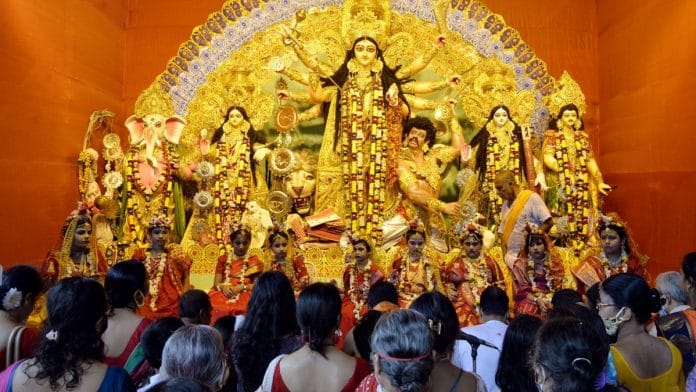

The Vishva Hindu Parishad discovered long ago that Bengalis eat meat during festivals. Now, as the BJP holds Bengal’s reins, the VHP’s state leadership has asked Durga Puja organisers to prohibit non-vegetarian food inside pandals, arguing that meat and fish should be kept outside the sacred premises. The organisation says it is not asking the state to abandon its food habits; it merely wants meat stalls and consumption kept away from the goddess.
It is an endearing thought. But there is only one problem: who exactly peddled this misinformation that Bengalis were eating their kosha mangsho inside the pandal?
Anyone who has actually spent Durga Puja in Bengal knows the difference. People worship Durga in the pandal, form queues for darshan, eat bhog, and take part in rituals. The lanes around it are another matter entirely.
Food stalls mushroom outside the pandals, restaurants overflow, neighbourhoods become temporary gastronomic republics. People eat, drink, chat, and walk for kilometres through the city. They visit pandals with egg rolls in hand, stopping for phuchka and biryani on the way to the next. But nobody needs a VHP diktat to tell them that a plate of mutton and rice does not belong inside the sanctum of a Durga Puja pandal.
Bengal does not need a lesson in how to keep its goddess sacred. It might, however, appreciate a little more homework from those who have suddenly appointed themselves its cultural custodians.
The bhog served at pujas is traditionally vegetarian. The culinary exuberance of Pujo happens elsewhere — at home, in restaurants, at community gatherings, and in the hundreds of food stalls that surround the pandals. The distinction is so ordinary to anyone who has grown up with the festival that the VHP’s intervention feels less like a correction of Bengali practice than an attempt to regulate something it has not bothered to understand.
Bengal, its goddess, and food
Bengal’s relationship with food and gods is also considerably more untidy than the neat vegetarian/non-vegetarian binary that Hindutva politics often prefers. In some East Bengali (Partition refugees from Bangladesh) households, a pair of hilsa is traditionally offered during Lakshmi Puja. These are regional and familial practices, not universal rules. Bengali Hindu ritual culture has never been one long march toward a single dietary orthodoxy.
That is because Durga Puja in Bengal is not just a religious observance in the narrow sense. It is a cultural inheritance, a public carnival, and an annual act of collective joy. The government itself describes it as a socio-cultural festival that brings together devotion, art, community, and public celebration; UNESCO’s recognition of Calcutta’s Durga Puja as intangible cultural heritage points to this expansive character.
There is another reason the VHP’s intervention feels particularly tone-deaf in Bengal: Bengalis do not encounter Durga only as a distant deity. They encounter her as Uma, the daughter who has come home.
She comes with her children every year. She is welcomed into the parental home and fed, fussed over, and celebrated. On Vijaya Dashami, she is bid farewell like a daughter returning to her husband’s home. This domestication of the goddess is one of the defining features of Bengal’s Durga Puja.
People touch her face. They feed her, kiss her. They cry when she leaves. The goddess is powerful enough to destroy Mahishasura and familiar enough to be someone’s daughter.
You cannot understand that relationship with a checklist of what should or should not be eaten near a pandal.
Also read: Bengal BJP’s Trinamoolification can prove costly in 2029
Layered traditions
There is, then, a larger question beneath this apparently innocuous dietary diktat: who gets to decide what Bengali Hinduism is?
The BJP may have won Bengal. But political expansion does not confer cultural fluency. Bengal is not a blank slate onto which a standardised version of Hindu identity can be pasted.
Durga Puja itself is evidence of that. Its history is layered with folk traditions, Shakta worship, Vaishnav influences, zamindari grandeur, nationalism, public art, and para (neighbourhood) culture. It has changed repeatedly because Bengali culture has always absorbed, argued with, and reinterpreted its traditions rather than preserving them in a single frozen form.
So, dear VHP, before issuing instructions about what Bengalis may eat at Durga Puja, come and spend time at the festival this year. Then you may discover that the meat you are trying to ban inside the pandal was never there to begin with.
Views are personal.
(Edited by Aamaan Alam Khan)