







Gujarat had helped Narendra Modi and the BJP win India in 2014. The biennial Vibrant Gujarat Global Summit was successfully marketed to project the contrast between a pro-business, swift-on-delivery state government under Modi’s chief ministership and the alleged corruption and policy paralysis of the central government under Manmohan Singh.
Twelve years later, as Modi prepares for a historic fourth term in office, a resurgent Bengal model sold as effectively to the rest of India as the Gujarat model once was could do wonders for the party in 2029.
But the ‘Trinamoolification’ of the BJP in West Bengal is not helping the party’s cause as the electorate that has enthusiastically voted the BJP to power in the state for the first time in history has already started asking: Has anything really changed on the ground?
Historic mandate, early let-down?
In 2011, Mamata Banerjee had stormed to power in West Bengal with her battle cry of ‘poriborton (change)’, ending the 34-year rule of the Left Front government led by the CPI(M). Banerjee had promised to end the party-state model of the Left, as well as political violence and forced land acquisition for industrialisation, which the Left Front government had tried to do in Singur and Nandigram.
Yet by the time she was unseated from power in May 2026, not only she had repeated some of the mistakes of the Left Front government but also added a few of her own. A big charge against her party workers was the widespread practice of taking ‘cut money’ or illegal commissions from government welfare schemes, ‘tolabaji’ or extortion from businessmen, transporters, and shopkeepers, and land-grabbing.
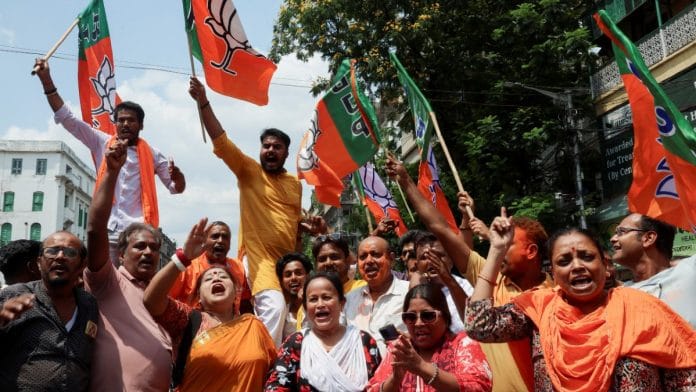
For the BJP, which had never been in power in West Bengal, unseating the Mamata Banerjee-led Trinamool Congress was a historic chance not just to undo the wrongs of the previous governments but to also make a mark as the first Hindu Right government.
Instead, there are already murmurs of disappointment not just from the BJP’s detractors in the state but also from some of those who voted the party to power. A new report in The Telegraph, dated 6 August, said the “trio that felled the 15-year-old Trinamool Congress regime in Bengal” — namely extortion, highhandedness, and landgrab — are bouncing back despite the BJP’s “avowed zero-tolerance policy against corruption”.
BJP sources told The Telegraph that dozens of complaints have already reached the party’s senior state leadership, “accusing a section of leaders, including a few MLAs in and around Calcutta and several districts, of replicating the syndicate culture of the former Trinamool government”.
The report went on to say that Chief Minister Suvendu Adhikari has launched three toll-free helplines for complaints related to cut money, syndicate extortion, and illegal toll collection, and urged people to report such crimes.
Three senior IPS officers have been transferred to the anti-corruption branch, and a source told the newspaper that the Bengal government would maintain round-the-clock surveillance on the activities of both its leaders and officials. The party, according to the report, has already expelled nearly 50 BJP leaders and removed more than 100 others over allegations of extortion and corruption, including working hand in glove with former Trinamool leaders.
It is not just one newspaper report that has exposed the new Bengal government’s inability to put an end to the political culture of corruption and extortion. On 20 August, Scroll’s political editor Shoaib Daniyal tweeted: “The Bengal BJP might have experienced one of the shortest honeymoon periods after an election win. The social media anger started within a few weeks and now even ABP Ananda is attacking BJP for ‘becoming worse than Trinamool in only a 100 days’”.
Even the party’s supporters and insiders are alarmed at how fast perceptions have changed about the BJP in Bengal. Senior advocate of the Calcutta High Court and RSS swayamsevak Joydeep Sen told ThePrint that Bengal’s historic mandate was not just for the BJP but also against the Trinamool Congress.
“BJP needs to be extra careful about even a miniscule replication of the TMC menace by its cadre base. Though some reports and social media posts on corruption under the new government are exaggerated, they are not wholly untrue. The government needs to address the corruption and extortion issues right away,” Sen said.
What has made matters worse, as far as public perception goes, is the BJP going soft on the Trinamool Congress after the elections. A Frontline report said what has irked people is the “rapidity with which many top Trinamool leaders have been accommodated within the NDA for political convenience”.
“At the State-level, the BJP government is perceived to be on good terms with the Trinamool legislators who, led by Ritabrata Banerjee, broke ranks with former Chief Minister Mamata Banerjee and staked claim as the main opposition in the Assembly,” the report said.
Also read: India has bent too far for Bangladesh. Tarique Rahman is testing us
Promise of resurgent Bengal
Being unable to manage the optics game in Bengal may not augur well for the BJP in the next general elections. Conversely, if BJP manages to contain corruption and fulfil its key election promise of bringing industries back to Bengal, it might help the party put up a Bengal model for all of India to see and admire.
Economist and Economic Advisory Council member Sanjeev Sanyal has said that for a “Viksit Bharat”, a “Viksit Bengal” is necessary. “In order for you to have Viksit Bharat, you need to have a Viksit Eastern India and Viksit Bengal and Viksit Kolkata are key to this because effectively getting a major urban hub firing up in Eastern India and creating a network of high growth in urban centres,” Sanyal has said.
Speaking during an interaction at Chittaranjan Bhavan in Delhi, West Bengal Finance Minister Swapan Dasgupta said that the state had spent nearly five decades in a “mood of permanent depression”, with a growing sense that it was no longer relevant to India’s economic growth story.
Dasgupta said the challenge was not merely to attract capital but to change the mindset of Bengali entrepreneurs and enable local businesses to make the transition from small and medium-sized enterprises to the “big league”.
If the new state government can meet that challenge, resurgent Bengal may well become the BJP’s big ticket for 2029.
Deep Halder is an author and a contributing editor at ThePrint. He tweets @deepscribble. Views are personal.
(Edited by Aamaan Alam Khan)