






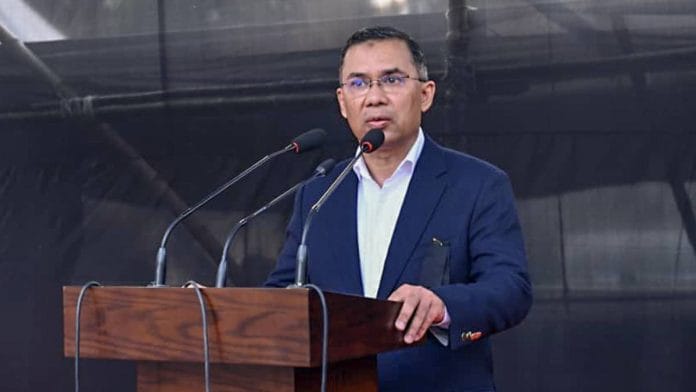

India has taken the lead in inviting Bangladesh Prime Minister Tarique Rahman to attend the outreach session of the upcoming BRICS summit in New Delhi on 12–13 September. Any pragmatic leader would have grabbed this opportunity and used the visit to strengthen bilateral ties to the best advantage of his country. It is unfortunate that the Bangladesh prime minister is hesitant to reciprocate India’s invitation to visit New Delhi, probably on the advice of advisers whose domestic and foreign policies are rooted in building an anti-India narrative.
The anti-India stance will surely help Rahman consolidate his hold over politics in a country reeling under economic stress and simmering discontent over unemployment, rising prices and a deteriorating law-and-order situation. The prime minister, whose experience in governance seems to be poor, probably hopes to address these challenges by supporting Islamic radicalism and anti-India sentiments.
Tarique Rahman was groomed to head the Bangladesh Nationalist Party (BNP) in 2001 and set up his office in Hawa Bhaban. It was Rahman who oversaw the formation of a coalition between the BNP and Jamaat-e-Islami, the party that had violently opposed Bangladesh’s independence from Pakistan.
The BNP has long relied on alliances with radical outfits such as Harkat-ul-Jihad-al-Islami (HuJI-B) and Islamist political parties such as Jamaat-e-Islami. These groups continue to maintain strong anti-India and pro-Pakistan sentiments, putting immense pressure on Rahman to take a hardline stance to solidify his domestic base.
Though HuJI is not a political party, several investigations, court testimonies and electoral victories in the past indicate that underground HuJI factions allegedly received tacit patronage, operational leniency and logistical support from certain influential office-bearers within the BNP-led government during its 2001–06 tenure.
Tarique’s Islamist baggage
The kingpin of this Islamist militant outfit, Mufti Abdul Hannan, had submitted a petition to then-home minister, Altaf Hossain Chowdhury, seeking to have his name dropped from the case relating to the August 2004 grenade attack on an Awami League rally in Dhaka. It was a meticulously planned assassination attempt aimed at eliminating then opposition leader and Awami League President Sheikh Hasina, along with several senior leaders of her party.
In October 2018, Justice Shahed Nuruddin of the Speedy Trial Tribunal-1 sentenced 19 people to death and 19 others to life imprisonment, including BNP leader Tarique Rahman, Khaleda Zia’s eldest son and now the prime minister. In the explosives case, Rahman, Babar and 36 other accused were also found guilty of grievously injuring victims through common intention, planning and criminal conspiracy.
However, in December 2024, the High Court scrapped the 2018 trial court verdict, declaring the original trial process illegal. In September 2025, a six-member bench of the Supreme Court, headed by Chief Justice Syed Refaat Ahmed, dismissed the state’s final appeal and unanimously upheld the complete acquittal of all the accused.
It is ironic that Rahman is now seeking India’s handover of Sheikh Hasina so that his radical non-state actors can carry out their unfinished job from 2004 — eliminating the opposition. At the top of Rahman’s list of preconditions for a visit to India is the repatriation of Sheikh Hasina.
Bangladesh’s International Crimes Tribunal (ICT) has issued arrest warrants for Hasina and 45 others, including senior Awami League leaders, over alleged crimes against humanity during the mass student movement that ousted the former prime minister.
New Delhi has explained to Dhaka that the India-Bangladesh extradition treaty of 2013, later amended in 2016, clearly provides procedures, a legal framework and categories of crimes for repatriation requests, mostly covering individuals involved in cross-border insurgency and terrorism, drug and narcotics smuggling, and similar offences.
The 2016 amendment simplified the extradition process for transferring wanted individuals between the two countries. One example was the 2020 transfer of two convicts involved in the 1975 assassination of Sheikh Hasina’s father, Sheikh Mujibur Rahman, who were returned to Bangladesh for execution. Another was the case of Anup Chetia, general secretary of the banned United Liberation Front of Assam (ULFA), who had spent 18 years in a Dhaka prison.
Dhaka should know that Sheikh Hasina’s case does not fall under any of these provisions. Besides, under Article 6 of the treaty, extradition may be denied if the alleged offence is of a “political nature”. Clearly, New Delhi rejected Dhaka’s Note Verbale and took no cognisance of the alleged crimes.
India must rethink its Bangladesh policy
It is no secret that India-Bangladesh relations have nosedived since Hasina’s forced exit. The interim administrative head, Muhammad Yunus, and his successor, elected PM Tarique Rahman, have demonstrated a calculated antipathy towards India.
As far as the Narendra Modi government’s Neighbourhood First policy is concerned, realism gave way to idealism, allowing a policy of non-reciprocity and a willingness to accommodate the demands of neighbours, notwithstanding their tilt towards China, in the case of Nepal, and towards China and Pakistan, in the case of Bangladesh. This has led to a steep deterioration in the regional security architecture, greatly putting India’s security at risk on land and at sea.
In this context, New Delhi urgently needs to tweak its foreign policy orientation and recognise the intransigence and stubbornness of Dhaka. The government should send a strong message to Dhaka that it will not hand over Sheikh Hasina to a government that believes only in vendetta.
India should also press the Rahman government to take Hasina’s government’s counter-terrorism policies to the next level. As chair of BRICS, India is committed to advancing the interests of the developing economies. In this effort, BIMSTEC also plays a significant role. New Delhi should seriously consider shifting its headquarters out of Dhaka.
Seshadri Chari is the former editor of ‘Organiser’. He tweets @seshadrichari. Views are personal.
(Edited by Prashant Dixit)