




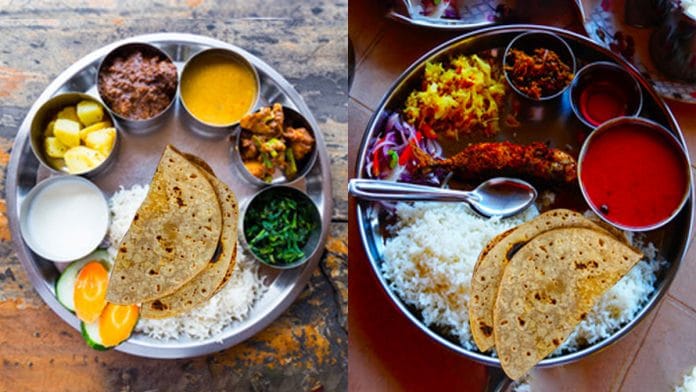

Food has suddenly become a new battleground in Indian politics. More significantly, food is no longer understood merely as a matter of biological survival, but as a deeply contested ideological and political project in contemporary India. Food purity has become a new obsession, a neo-Freudian fixation, and increasingly a totalitarian fantasy that threatens the conventional edifice of psychological and symbolic order through which societies have historically negotiated desire, taboo, and social boundaries.
Further, food purity has been elevated to a moral virtue, as though without it society can neither be truly non-violent nor morally ordered. The ongoing vegetarian-versus-non-vegetarian debate in West Bengal offers a revealing example of this transformation.
India’s extraordinary culinary diversity is, in many ways, a living archive of its civilisational plurality. One of the most fascinating and also intriguing aspects of this is the relationship between food and religious identity, particularly the idea that vegetarianism is somehow the natural or timeless essence of Hinduism. Since time immemorial, Hindu communities have never possessed one uniform food culture. Some have been strictly vegetarian, others have eaten fish, meat or particular animals according to caste, region, sect, ritual context, and local custom. To turn vegetarianism into a universal Hindu norm is therefore not merely simplistic, it is historically selective and myopic. Bengal makes it clear.
Bengal, faith, and food
Historically, Bengali Hindu culture has never neatly fitted into a vegetarian/non-vegetarian binary. Fish is woven into Bengali social and cultural identity, while vegetarian food occupies an equally important place in ritual and quotidian life. Within the Shakta traditions, meat and animal sacrifice have historically formed part of religious observance. Consumption of sacrificial meat associated with Kali and Durga worship belongs to a long Bengali tradition. Here, meat is not necessarily the opposite of Hindu religiosity. In fact, it is seen as part of Shakti itself, the ritual expression of the power of the feminine divine, the primordial source of the universe.
Bengal is also a site of competing Hindu traditions. The Vaishnava devotional movement associated with Chaitanya Mahaprabhu placed bhakti at the centre of religious life and developed an ethic of non-violence. Gaudiya Vaishnavism with deep roots in the Gaud region of Malda and Murshidabad, subsequently institutionalised practices in which vegetarian food offered to Krishna became sanctified as prasada.
Vegetarianism thus acquired a distinctly theological meaning. It was not simply a matter of caste status or social respectability in the sense of what sociologist MN Srinivas calls “Sanskritisation”. It gradually became part of a devotional way of life. Amidst post-colonial socio-religious anxieties and new middle-class aspirations, the Vaishnava tradition later acquired an increasingly global form through transnational missionary work of Swami Prabhupada(Abhay Charan De), the founder of ISCON.
He carried Gaudiya Vaishnavism onto the international stage, where vegetarianism acquired almost a cult status. This resonated with Orientalist imagination in which Hindus are often represented in the West as inherently non-violent, vegetarian, and spiritually oriented. ISKCON is not unique in elevating vegetarianism beyond dietary preference. Other transnational Hindu movements, including the Swaminarayan tradition, similarly valorise and institutionalise vegetarianism as a marker of religious discipline, moral conduct, and collective identity. ‘Hindu Vegetarianism’ thus acquires a quasi-totalising cultural significance, linking everyday consumption to ideas of purity, self-control, devotion, and respectable religious belonging.
This history of the evolution of Gaudiya Vaishnavism matters because dietary practices in Bengal or elsewhere have more than one genealogy. They can emerge from Brahmanical status practices, negotiations of cultural identity, and competing constructions of nationalism. The Bengal Renaissance provides an interesting counterpoint. The Brahmo Samaj and its leading figures challenged orthodox ritualism without making vegetarianism the essence of Hindu reform.
Raja Rammohan Roy, Debendranath Tagore, and Keshub Chandra Sen belonged to a reformist intellectual tradition. They challenged orthodoxy on religious authority, caste, women’s status, and social practice without making dietary abstinence the defining measure of religious or social modernity. Within this broader cultural context, fish acquired such symbolic and semiotic centrality in Bengali consciousness and food culture that it blurred distinctions between the bhadralok and the wider Bengali masses.
Also read: Fish for votes, eggs for ideology in BJP’s Bengal. Children pay the price
More than just food
Further, Bengal’s revolutionary nationalist politics complicates the monotheistic ideal of vegetarianism. The Anushilan Samiti, influenced by Bankim Chandra Chattopadhyay, particularly his novel Anandamath, and the concept of Anushilan Tattva as well as Shakta traditions of Chandi and Bhavani worship drew upon an intensely Hindu vocabulary. This helped them to direct their energy toward devotion (bhakti) and patriotism (swadesh preeti). Yet young revolutionaries brought spiritual discipline, martial masculinity, and dietary practice together without necessarily making vegetarianism a defining ideal in their pursuit of anti-imperialist struggle. This dietary eclecticism also shaped Hindu political mobilisation in pre-partition Bengal.
The Hindu Mahasabha, led by Syama Prasad Mookerjee, mobilised Hindu identity within Bengal’s culturally plural society. At its 1939 All-India session of Hindu Mahasabha in Calcutta, elaborate arrangements were made for both vegetarian and non-vegetarian food stalls. In other words, the coexistence of secular bhadralok culture, Hindu religiosity, and political mobilisation in pre-Partition Bengal allowed for considerable dietary diversity, challenging the contemporary tendency to equate Hindu authenticity with vegetarianism.
This dietary eclecticism is also deeply rooted in Bengali literary traditions. In Bankim Chandra’s Anandamath, the sanyasi Jivananda is offered fish cooked with milk and spices, while Tagore’s Gora and Chokher Bali, Sarat Chandra’s Srikanta, and Bibhutibhushan’s Pather Panchali similarly embed food within the textures of domestic and rural life. The 19th-century poet Ishwar Gupta’s famous couplet “All Bengalis live on rice and fish; the land is full of paddy, and therefore the waters are full of fish” captures the cultural centrality of fish in Bengali life. Non-vegetarian practices, especially fish-eating, thus appear as part of Bengal’s everyday social, cultural, and ritual world. These literary representations point to a uniquely Bengali Hindu identity in which dietary plurality remains compatible with the ethos of a vibrant syncretic society.
In other words, the contemporary effort to collapse these histories into a single vegetarian ideal therefore encounters not only basic historical problems but also reflects what cultural theorist Ashis Nandy identifies as the homogenising impulse of modern identity politics. Bengali Hinduism has never been one dietary tradition. Its trajectory is not a straight march from meat to vegetarianism, impurity to purity, or tradition to modernity. Rather it emerges from competing traditions, overlapping identities, and changing meanings. The contemporary debate over vegetarianism in Bengal is consequently about more than food. It is also a contest over which of Bengal’s diverse Hindu pasts will be remembered, elevated, and presented as the authentic one.
As a practising poet, I often encounter this culinary eclecticism not only in Bengal’s literary festivals but, more vividly, on the streets of Kolkata. Here, vegetarian and non-vegetarian worlds meet without apology. Aloo posto, mochar ghonto, shukto, and luchi share the stage with bhetki paturi, macher jhol, kathi rolls, kosha mangsho, and mutton biryani. And, more deliciously and lyrically, idli, dosa, momos, and chowmein mingle with Arunachali kholam and Assamese khar, with raw papaya and fiery bhut jolokia chutney. Kolkata knows no boundaries. While singing bhajans of Mahaprabhu Chaitanya or playing sindoor khela, one can enjoy any food. Here, diversity is not an exception but an everyday habit. The city simply celebrates Maa Annapurna, feeding everyone according to her own taste and way of life.
Ashwani Kumar is a poet, political scientist, and a senior visiting fellow at the Centre for Policy Research (CPR), New Delhi. Views are personal.
(Edited by Aamaan Alam Khan)