






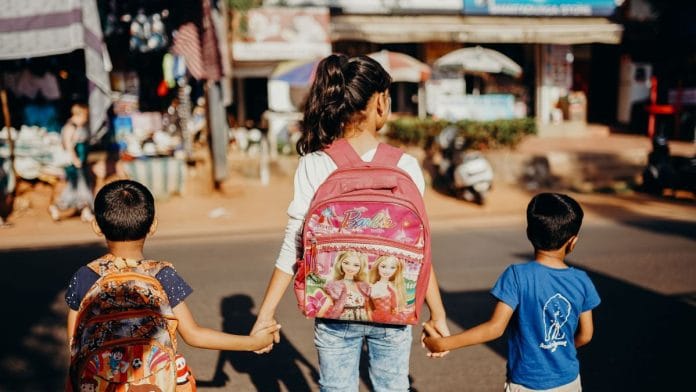


It is surprising to see that nearly 51 per cent of kids in Delhi walk and bicycle to schools. While these numbers help us see a promising sustainable future for our country, they do not tell us the full story — School choices and mobility patterns are highly unequal in cities like Delhi.
The idea of “school choice” assumes that households can freely decide where to send their children. But these choices are shaped not only by educational preferences, but also by income, mobility, and location.
A recent study by the Transportation Research and Injury Prevention Centre at IIT Delhi across six neighbourhoods (Anand Vihar, Aya Nagar, Jahangirpuri, Lodhi colony, Pusa Road near IMD, and Wazirpur) found that low-income neighbourhoods often have good access to nearby government-aided schools. As a result, children from these households commonly access schools located at shorter distances and frequently walk.
Yet access to nearby schools is not the same as having broader school choice.
Higher-income households are more likely to send children to unaided private schools. They are also more likely to use motorised transport and travel longer distances to access schools. Compared to this, lower-income households are more likely to depend on nearby schools that can be reached through affordable travel options like walking.
The study found that only 16 per cent of children from very high socioeconomic groups accessed schools within 1 km of home, compared to 77 per cent of children from low socioeconomic groups. In effect, higher income households in Delhi are the primary “choice users” as they afford both unaided private schools and the longer journeys required to access them. As a result, disparities in school choice are shaped not only by differences in educational affordability, but also by unequal mobility capabilities.
Also read: What India can learn from Jordan’s journey to the 2026 FIFA World Cup
Heading to school
The study found that while 51 per cent of those surveyed walked to school, the dependence on walking was highly unequal. Walking remains the dominant mode of transport for the majority of low-income households, partly because they accessed schools at shorter distances and partly because alternative transport options were either unavailable or unaffordable. However, for most, walking to school meant walking on broken footpaths, unsafe crossings, and being exposed to traffic.
The inequality becomes even sharper when the type of school and mode of transport are examined together. Among children from very low socioeconomic groups attending private schools, nearly 73 per cent still walked or cycled to school and attended schools within 1 km of home. In comparison, only 8 per cent of children from very high socioeconomic groups used active modes such as walking or cycling. In many cases, walking reflects constrained mobility choices rather than genuine preference.
However, the study also found that inadequate walking infrastructure and unsafe travel environments are pushing children away from active school travel. This is reflected in the increasing shift towards personal motorised vehicles as children move to higher grades. This shift has implications beyond transport alone.
In any city, a major share of daily commuters are children headed to and fro school. This travel shapes children’s daily experiences and influences lifestyle habits and learning. It also has wider implications on public health and carbon emissions.
Despite this, the everyday question of how children reach schools receives little attention in either education policy or transport planning. Educational discussions continue to focus on enrolment and school infrastructure, while transport planning prioritises congestion and commuter movement.
Also read: Indian Comedy has a gender. Apoorva Mukhija faced threats, Pranit More got off with a sorry
Policies and solutions
Delhi has, in recent years, adopted initiatives such as the nearby school policy and the Safe School Zone initiative under the high impact project adopted by the transport department. These projects focus on reducing speed limits, adding speed bumps, deploying signs, creating safe sidewalks, and restricting heavy vehicles in areas around schools. However, the implementation remains limited.
So far the Safe School Zone intervention has been implemented in only one school — DAV Public School in Vasant Kunj built by the Public Works Department (PWD) and anchored at Lead Agency for Road Safety through HumanQind, a non-profit design organisation, and IIT Delhi.
At the DAV Public School a safe street was co-designed by school students. The initiative built consensus amid local residents, students, and resident welfare associations about the need for such streets.
This case study offers an important lesson for policymakers and implementers The challenge lies in scaling such interventions across the city and ensuring that safe access to school is a planning and road building priority.
The study suggests that access to education in cities cannot be understood only through the number or location of schools. It must also be understood through the unequal ability of children to access schools comfortably, safely, and affordably.
Ensuring equitable access to schools requires an integrated approach involving education planning, spatial planning, and transport planning. As Indian cities continue to expand, prioritising safe and accessible school travel will become essential not only for sustainable mobility, but also for achieving equitable access to education.
Safer walking infrastructure around schools, better pedestrian crossings, improved neighbourhood accessibility, regulated shared school transport systems, and children-sensitive street design must become central components of urban policy rather than isolated pilot projects.
As Indian cities continue to expand, the geography of educational opportunity will increasingly be shaped by the unequal ability of households to move across urban space. School choice, therefore, cannot be understood only as an educational issue. It is also a question of mobility, justice, and urban inequality.
Deepty Jain is a professor and researcher at the Transportation Research and Injury Prevention Centre (TRIP Centre), Indian Institute of Technology Delhi. Views are personal.
(Edited by Janaki Pande)