






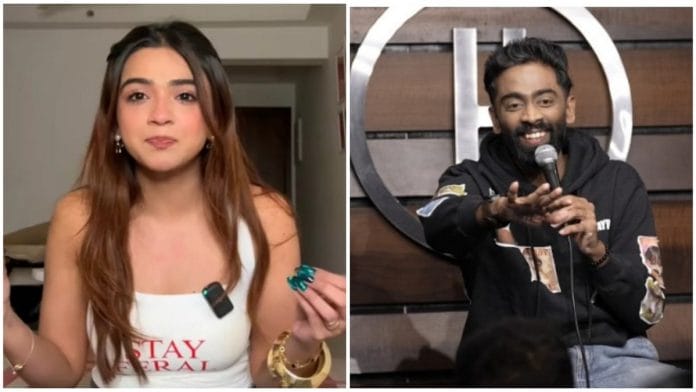


Comedy is gender-neutral only until a woman tells the joke. Because if you’re a man making a vulgar joke or being part of it in any capacity, people don’t waste time saying, “Don’t be so sensitive” or “Comedy has no limits.” But if you are a woman? Suddenly, society is reminded of ‘sanskar’.
In yet another example of how men and women are judged by entirely different standards, we have the cases of Apoorva Mukhija, who faced backlash for her comments on India’s Got Latent in April, and Pranit More, who was part of the infamous Rs 370 biryani exchange on his show.
The qualitative difference in the public reactions to each raises an important question: does comedy have a gender? And the answer seems to be yes.
Also Read: Men can’t buy women’s consent by paying for dinner. Dating is not vasooli
A tale of two comedians
Remember when Apoorva Mukhija hit back at a contestant on India’s Got Latent after he made an obscene remark about her body? She responded in similarly crude language about him seeing the said female body part upon his birth, but the original comment was brushed aside and she became the subject of ire.
The internet lost its cool. She was called every name in the book. She got rape threats. Her character was dissected. Her mother was harassed on social media. Multiple FIRs were filed against her.
The focus wasn’t on whether the joke crossed a line; it became about who she was as a woman. She got “cancelled”. The backlash was so severe that she practically had to rebuild her social media presence from scratch.
Now compare that to what happened at comedian Pranit More’s show.
Himanshu Jangra, a web developer, went viral for saying he expected a woman to “repay” him after he spent Rs 370 on chicken biryani for her—an obvious hint at sex.
“Maine kaha ki Rs 370 lage hain to use to wasool to karunga hi (I said, I’ve spent Rs 370, so I’ll get my money’s worth come what may),” he said on More’s show.
It revealed a mindset that views basic human interaction as a transaction and women’s bodies as reimbursement. And where the idea of consent takes a backseat to male entitlement. But my focus isn’t what Jangra said because he has already paid the price. His company, Gurugram-based social media and branding firm Starvik Design, has fired him.
But what about More? He was equally involved as he laughed off Jangra’s remarks, calling it “peak Gurugram content”. He even handed Jangra a cash prize and applauded him. And no one in his team thought it was problematic when they edited and uploaded the video.
Since the outrage over the biryani incident, More issued an apology, saying it was a lack of judgment. He too faced criticism and has since deleted his Instagram account. But that is where the similarities end. There has been no nationwide character assassination. No threats of bodily harm. No endless lectures about how men are destroying societal values. No demands that male comedians should stop being vulgar because “boys from good families don’t talk like this”. No insistence that he disappear from public life.
Hypocrisy 101
Funny how we calibrate our anger depending on whether a man or woman has been ‘offensive’.
When Mukhija made people uncomfortable, she faced rape, death, and acid attack threats. More, on the other hand, received what amounts to a rap on the knuckles. It’s hypocrisy 101.
More has a long track record of cracking inappropriate jokes, and even got a dressing down from Salman Khan over it when he was a contestant on Bigg Boss last year. It clearly didn’t deter him.
It’s simple—if vulgarity is unacceptable, then apply that standard equally. But if the rules change depending on whether the person standing on stage is a man or a woman, then let’s stop pretending that it’s about comedy. It’s about who society believes has earned the right to be offensive.
Views are personal.
(Edited by Asavari Singh)
I know triya you want to defend a particular set of ideas and thats perfrctly fine but atleast filter and research a little more before writing such articles in hastebecause weboth know about that female doctor in kem remark over patient body private part size still no outrage or question over it if someonehas done wrong everyone should be punished equally but for god sake not everything is about gender wars there are way more things i hope you atleast consider my comment forjust few minutes wish you a good luck
I second the thoughts of A Concerned Reader. ThePrint is damaging its own reputation by indulging buffoons like Triya Gulati, Ratan Priya, Karanjit Kaur, Stela Dey, etc.
I would any day pay to read and hear Snehesh, Moushumi, Apoorva, etc. Dr. Bidisha and Dr. Rao are doing some amazing stuff as well.
But a bunch of clowns are spoiling the show. It’s sad that Shekhar Gupta and Shailaja Bajpai are turning a blind eye to this.
The guy who made the 370 hoke was fired, and a woman proudly claimed to file false cases, is still roaming free.
Between the articles written Karanjit Kaur, Stela Dey, and Triya Gulati, I’d be really curious to know how much does ThePrint actually pay these writers? Surely a fair amount given how prolific they are. I’m not going to throw a tantrum because I don’t pay for ThePrint (nor will I if this is where that money goes). But I will surely pay The Indian Express as an alternative to reading ThePrint for free is such articles become any more of a mainstay then they already are. At least give readers the option to filter out certain writers from their feed!