




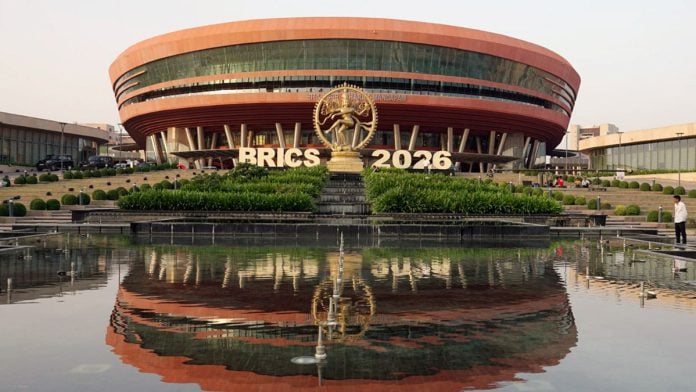

Beyond BRICS’ global messaging as pro-rest rather than anti-West, and the idea of an ‘India moment’, there is a third line of observation that deserves attention. India’s immediate neighbourhood is watching the Summit closely, particularly for what the presence of Russia and Iran could mean for the wider global crisis.
Closer to India’s borders, the BRICS conversation is driven less by the grouping itself than by FOMO—Fear of Missing Out and bilateral angst—over access, exclusion and unresolved tensions with New Delhi.
And the reading of it actually provides visuals of India’s leadership in the future at regional and global forums, and the discomfort regional countries might attach to it. Let’s read Dhaka at first.
Dhaka invited but not invited
Statements from Dhaka on BRICS may be more explicit, as they offer a closer view of the state of affairs between India and Bangladesh. In a reported statement on the Bangladesh Prime Minister Tarique Rahman not being invited to the BRICS Summit for outreach, its Foreign Affairs State Minister Humaiun Kabir added, “How shall we go? Has anyone from the Bangladesh government been invited? Our prime minister was not invited. Who told you that our Prime Minister was invited? The BIMSTEC Chair was invited.”
Without a doubt, India invited Dhaka as the current chair of the Bay of Bengal Initiative for Multi-Sectoral Technical and Economic Cooperation (BIMSTEC), as it did to Nepal in 2016, but not in its capacity as a state. Bangladesh is neither a member nor a partner country, so an invitation in a state capacity should not arise at all. BRICS engages with regional forums on economic issues; hence, Dhaka was invited as the current BIMSTEC chair.
For Delhi, it is purely a matter of prerogative and priorities, especially given the need to pay enough attention to Chinese, Russian and Iranian counterparts.
Meanwhile, with tensions looming between Dhaka and Delhi, and no visible signs of a bilateral meeting between Prime Minister Narendra Modi and Bangladesh Prime Minister Tarique Rahman, maintaining the status quo in ties is worthwhile. The tensions help the ruling Bangladesh Nationalist Party (BNP) dodge the barrage of criticism it faces from an opposition led by Jamaat-e-Islami.
However, by declining to attend or send even an envoy to BRICS to represent BIMSTEC, Bangladesh may have missed performing one key responsibility “The Member State holding the Chairmanship of BIMSTEC shall actively promote and enhance the interests of BIMSTEC through policy initiatives, coordination, consensus building and cooperation. The Chairman shall represent the organisation to external partners,” the charter of chairmanship suggests.
For some, this may be a counterproductive step by Dhaka, contrary to the spirit of multilateralism.
Nepal has a say too
Nepal is the current chair of the South Asian Association for Regional Cooperation (SAARC) but, unlike Bangladesh, Kathmandu did not receive an invitation from Delhi for BRICS. This may be explained by SAARC’s inability to function as an active organisation and Delhi’s less optimistic approach about it. At the same time, Nepal’s Prime Minister Balen Shah remains occupied with recovery and relief from recent floods at the Nepal-China border, and he needs more time on home turf.
But some also believe that the Balen Shah government’s unwillingness to engage with regional and multilateral forums is itself an answer to those who wish to engage.
Interestingly, Nepal has not issued an official response or comment on the BRICS Summit or on not being invited, but popular conversation on social media needs attention.
A Central Committee Member of Nepal Communist Party-UML (CPN-UML) wrote on X, “Nepal, just 85 minutes away, did not make it to the invitation list…I simply do not think Balendra Shah can sit patiently for even half an hour at any formal event. I am unsure of his personal issues, but I increasingly believe that the country is bearing the consequences.”
This is a more balanced view where the blame is not on India but on Balen Shah’s overall conduct of diplomacy. However, the post gets a few facts wrong by citing “Iran and Indonesia” as non-members.
One comment that actually attracts more attention comes from an account of an alleged Nepal-origin international jurist. “Is Nepal’s Foreign Ministry even aware that the BRICS Summit is happening in Delhi? There is no public statement from Nepal about it despite its significance for Nepal’s diplomacy, economic interests, and regional strategy, given India and China’s central roles in BRICS,” the tweet read.
Soon it attracted criticism within Nepal.
A seasoned journalist countered the user, responding, “Why should Nepal issue a statement on BRICS? Neither has Nepal expressed any interest in joining BRICS, nor is the grouping intended to include Nepal in any capacity… Not every international development requires a public response from Kathmandu. Diplomacy also means knowing when to speak—and when not to.”
A veteran Nepali diplomat seconded the thought, suggesting, “Fully agree. Nepal doesn’t need to speak at the BRICS summit. Of course, Nepal’s MOFA is keeping eye on it and access the impact and opportunities.”
Some users recalled the optics that Prime Minister Pushpa Kamal Dahal ‘Prachanda’ managed it in 2016, when he attended the BRICS outreach summit as BIMSTEC chair. The photos of Modi, Xi, and Prachanda sitting on a sofa were termed a ‘trilateral’ convening on the sidelines. It was later found out that they were just sitting in the lobby, waiting for the next session.
Nepal’s public position on BRICS seems more reasoned and less FOMO-driven. However, Nepal could have made better use of its representation at BRICS to seek global support on the climate crisis and its future. Doing so would have required India to make the ask.
Also read: The real BRICS story is what China, Russia want & India wishes
What do others say?
A scan of government and social media responses from Sri Lanka, the Maldives, Bhutan, and Afghanistan shows no conversation around BRICS. However, Western neighbour Pakistan has an active conversation going.
Pakistan’s Ministry of Foreign Affairs was asked a question on 2 September: “The BRICS Summit will take place in New Delhi, and Chinese President Xi Jinping is expected to attend. His visit would be his first to India in seven years. So, how is Pakistan viewing the growing closeness between China and India?”
In response, the Pakistani MoFA spokesperson replied, “I am not aware of any confirmation regarding that visit. Let me elaborate on a broad principle – Pakistan views relations between other countries within their own bilateral context. However, we welcome any engagement that contributes to regional peace and stability. Let me also add that Pakistan’s long-standing, close, and all-weather strategic partnership with China is not affected by the relationship of either country with a third party.”
Of course, Islamabad has a say. But its diplomatic response on BRICS comes from nothing but annoyance. In 2024, Pakistan reportedly applied for BRICS membership, which India seemed to have blocked. Ideally, Pakistan would want a seat at every regional forum where India has a key leadership role. Whether Islamabad can prove its strong economic or global leadership potential remains secondary.
The bigger question is whether Pakistan sees any groupings from an economic partnership angle?
At almost any gathering where Russia is a member, Pakistani Prime Minister Shehbaz Sharif does not hide his temptation to shake hands with President Vladimir Putin. He did so at the recently concluded Shanghai Cooperation Organisation (SCO) gathering in Bishkek, where he was seen approaching Putin in a frantic attempt.
What Pakistan wants from Russia is a military bit and a signal that can challenge India-Russia ‘all-weather friendship.’
Just last year in September, Prime Minister Sharif sought a meeting with President Putin in Beijing on the sidelines of China’s 80th Victory Day military parade. He said, “I must say that we respect your relationship with India – that is perfectly fine – but we also want to build very strong relations, and these relations will be supplementary and complementary for the good, and for the progress and prosperity of the region. I find in you a very dynamic leader, and I want to assure you but like to work with you very closely.”
Islamabad’s desperation to secure strategic relevance by reassuring Delhi’s key partner that deeper relations with Islamabad were not sought at India’s expense is hard to believe. In diplomacy, while great goals require extraordinary efforts, Pakistan’s ambitions to penetrate India-Russia bonhomie come across as desperation.
To conclude, while the BRICS presidency is India’s moment, it has neighbours needing support and a voice. Political and military tensions in the region may make their presence at the outreach session less than natural, but India did not overlook their concerns. By advocating stronger action to tackle climate-induced disasters, it ensured that the interests of countries such as Nepal were represented.