




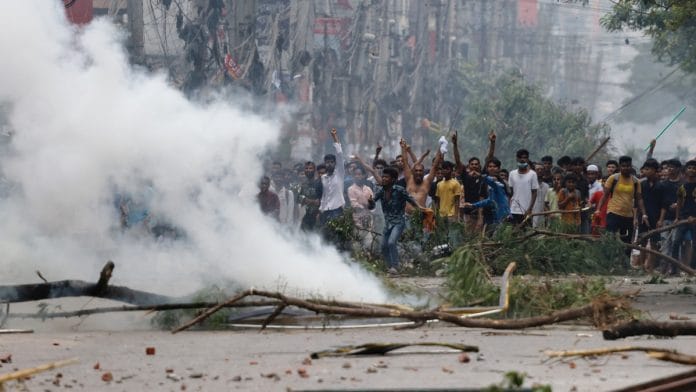

Bangladesh witnessed an intense political period in July-August 2024, with casualties reported from both sides. As per the fact-finding report by the Office of the High Commissioner for Human Rights, or OHCHR, published in February 2025, up to 1,400 people may have been killed between 1 July and 15 August 2024. The report also documented the post-uprising mob violence that targeted police officers and Awami League officials without providing a specific number of casualties.
The Bangladesh government’s estimate provides a narrower figure. The Ministry of Liberation War Affairs made public 836 fatalities from the uprising. Around this list, the government has organised a compensation framework and trials before the International Crimes Tribunal. But no names or numbers have been provided for the fatalities of the other side. And after the passing of the July Mass Uprising (Protection and Liability Determination) Act (henceforth, the “July Indemnity Act”) on 8 April 2026, no one can question those deaths in any court in Bangladesh.
Before the enactment, the Ministry of Home Affairs issued an order in October 2024 that anyone who participated in the July uprising would be absolved of any crime committed between 15 July and 8 August 2024. After 15 months, the president made this policy statutory by passing an ordinance under Article 93(1) of the Constitution of Bangladesh. Finally, on 8 April 2026, the parliament converted the ordinance into an Act.
The deaths that cannot be probed
The Act defines a “revolutionary” as a person who participated in the July uprising, indemnifying them from ongoing and future civil and criminal prosecutions. It further makes a crime committed between July and August 2024 non-cognisable before any court of law. Nonetheless, if there is a murder allegation, the complaint goes to the National Human Rights Commission (NHRC), which determines whether the killing constituted “political resistance”, defined as “the acts committed by July revolutionaries to restore democratic governance, toppling the fascist government”. If it is deemed to be such, no proceedings follow; the family might receive compensation; and such a decision is to be non-justiciable before any court. NHRC has also been vested with the power to investigate any murder committed for personal gain, taking advantage of the chaos. NHRC’s investigation report is to be construed as the “police report”, and can be forwarded to a court of law.
On its face, the Act covers every death in July and August. In reality, it runs one way, only protecting the ‘revolutionary’. Those killed by revolutionaries, such as police officers, Awami League activists, and most of the dead in the days after 5 August, are left with no forum at all. Take the example of the deaths of police officers. Forty-four officers were killed in Bangladesh between 1 July and 15 August, as confirmed by the Police Headquarters. Many of these deaths were retaliatory in nature. The July Indemnity Act removed the judicial process for these deaths and transferred it to an administrative agency, the NHRC, whose decision is final and conclusive.
But the redress mechanism has contradictions. On 9 April 2026, the day after the Act was passed, parliament repealed the 2025 Human Rights Commission Ordinance and restored the previous 2009 NHRC Act, thereby dissolving the forum to which every July killing had been routed within a day. Moreover, section 18 of the restored Act bars the Commission from investigating the disciplined forces directly. In its current standing, the NHRC is forbidden from investigating the deaths of 44 police officers.
Also read: PM Modi’s BRICS masterclass shows how real diplomacy is done
A history of statutory impunity in Bangladesh
Statutory impunity is not new in Bangladesh, and often fails to survive the test of time. Twice before, parliament has placed a category of killing beyond the reach of the courts, and neither enactment survived judicial scrutiny. However, in each case, the reckoning came only after the government that passed the Act had fallen. The first was the Indemnity Ordinance promulgated by Khondaker Mostaq Ahmad six weeks after the killing of Sheikh Mujibur Rahman in 1975, protecting the men who had killed the founding father of Bangladesh and his family. The Fifth Amendment of 1979 later gave it the force of an Act of parliament. When the Awami League formed the government in 1996, parliament repealed the Act, and 12 of the assassins were sentenced to death. The Fifth Amendment fell in Bangladesh Italian Marble Works Ltd. v. Government of Bangladesh (2010).
The second precedent was the Joint Drive Indemnity Act 2003, indemnifying around 40 custodial deaths during Operation Clean Heart. It was defended under Article 46 of the constitution, although human rights organisations and constitutional law scholars vehemently criticised it. In 2015, the High Court Division declared it void and held that the government cannot indemnify “arbitrary killing”.
Article 46 permits parliament to indemnify any person for acts done “in connection with the national liberation struggle or the maintenance or restoration of order,” subject to the condition that parliament exercises this power by statute. However, during the interim administration, when no parliament was in session, the administration used the ordinance-making power to withdraw proceedings against “revolutionaries”.
Article 46 is also specific as to circumstance: it applies in connection with the Liberation War of 1971 and, in peacetime, to maintaining or restoring order. The destruction, vandalising, and burning of 450 of the country’s 639 police stations; looting of arms; violence against women; burning of a five-star international hotel; and the killing of 24 civilians (including a foreigner) do not constitute the “maintenance or restoration of order”. If Article 46 applies to these acts, it applies to everything, and a narrow exception becomes a general license.
Also read: The India-China reset will be tested in the Northeast
‘Political resistance’ not a recognised defence
One might say the scale of the July uprising demanded an extraordinary response. The regional record suggests otherwise: set beside comparable upheavals, Bangladesh is the outlier. In Sri Lanka, among the protesters who set ablaze the residences of 75 legislators and killed a member of the government, Amarakeerthi Athukorala, and his police bodyguards, 42 individuals were charged, with 16 convicted and 12 sentenced to death.
The interim government in Nepal appointed an inquiry commission to investigate both the deaths and arson associated with the Gen Z movement. According to the Nepal Human Rights Commission’s May 2026 report, the arson attacks constituted organised criminal activity. The report called for further investigation into fake social media accounts impersonating the Nepal Police to escalate the protest and the use of school students as human shields. While the agreement between the state and Gen Z excluded criminal behaviour, prosecutions have been ongoing before regular tribunals.
“Political resistance” during civil unrest is not a recognised defence, nor a matter of impunity, for murder in any comparable jurisdiction. Such defences are opposed for purely technical, not emotional, reasons. Private defence, under the Bangladesh Penal Code 1860, turns on the immediacy of the threat and its proportionality, which are matters of fact for a court to decide. Nonetheless, the Indemnity Act passed in April provides for “political resistance” as a valid defence for any “revolutionary” who might have been involved in activities that could have resulted in civil or criminal actions but who now enjoys impunity before the courts of law.
The impact of the Act is worse on those who died in the aftermath of the fall of the Awami League government. They are now made invisible, their deaths institutionally unmourned, rendered ungrievable. The OHCHR documented up to 1,400 deaths. Yet, several hundred of the dead appear on no register at all, despite the report’s findings of “revenge abuses” against police, members of the Awami League, and the media.
The report further documented instances of violence against women and the vandalisation of the homes of Hindu families. Yet it failed to name the culprits. Moreover, it failed to categorise the killings that took place after 5 August 2024, making it difficult to form an accountability mechanism. Throwing those acts of counter-violence into the “aftermath of the protests” mix, the report obscures their distinct nature and circumstances. The July Indemnity Act further diminishes the chance of bringing those perpetrators to justice whose violence was purely retaliatory.
Indemnity is antithetical to the justice system. Currently, the law of Bangladesh states that the victim’s political affiliation decides whether a killing would be construed as a criminal act. When the State refuses to prosecute select killings while consistently failing to inquire into others, the result is neither restoration nor strengthening of the rule of law. Impunity is not defeated by relocation.
Sangita Gazi is a lecturer at the Wharton School, University of Pennsylvania, and a Transatlantic Technology Law Fellow at the Stanford Law School. She tweets @GaziSangita. Views are personal.
(Edited by Prasanna Bachchhav)