





The acronym BRIC, was first coined by Goldman Sachs economist John O’Neil in 2001; it referred to the international organisation comprising Brazil, Russia, India and China. South Africa was added subsequently in 2010. These were the countries expected to be the world’s leading nations by 2050.
The BRICS nations sought to maintain their own identity and remain neutral, rather than aligning with a particular power bloc.
With regional alliances taking place and grouping and ungrouping of different countries with different associations and different interests, a layperson might’ve assumed that the BRICS was not gaining much traction.
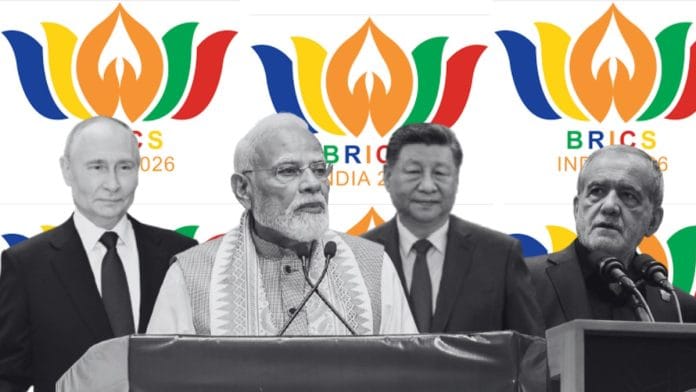
And yet, Indian Prime Minister Narendra Modi managed to pull off a coup of sorts this weekend in New Delhi, with the 18th Summit, held on 12 and 13 September. Chinese President Xi Jinping, Russian President Vladimir Putin, and South African President Cyril Ramaphosa, as well as Brazil’s Foreign Minister, Mauro Vieira flew into the Indian capital. Apart from the core members, Iranian President Masoud Pezeshkian, Indonesian President Prabowo Subianto, Egyptian President Abdel Fattah El-Sisi, Ethiopian Prime Minister Abiy Ahmed Ali, and Abu Dhabi’s Crown Prince Sheikh Khaled bin Mohamed bin Zayed Al Nahyan (representing the UAE) attended the Summit under the personal invitation of PM Modi.
Malaysian Prime Minister Anwar Ibrahim, Philippine President Ferdinand R. Marcos Jr., Burundian President Évariste Ndayishimiye, and Kazakh President Kassym-Jomart Tokayev also participated.
After the weekend, it is clear that BRICS is rapidly emerging as an extremely influential group. It aligns 11 major emerging world economies, which together represent nearly 49.5 per cent of the world’s population; approximately 40 per cent of global GDP and nearly 30 per cent of global trade.
But what makes BRICS relevant today?
I have been associated with BRICS and have had the opportunity to work with its different cultural and economic committees. In the run-up to the Summit, I have had the opportunity to speak across multiple forums: Economic, innovation, artificial intelligence, investment, sustainability and clean energy. During my time interacting with the press and world leaders, I realised that the organisation is as relevant today as it was a quarter of a century ago.
“BRICS has emerged as a key platform for coordinating economic policy among major emerging economies. It serves as the principal forum where these nations shape a common position on global governance,” read a PIB report.
The organisation has become a “channel for advancing the interests of the Global South”, by using dialogue to promulgate the agenda of finance, development, tech, trade and interpersonal exchange. It seeks to promote the aspirations of developing economies; to share experiences and face the common challenges together.
As the world stares in the face of trade and supply disruptions chains due to regional conflicts, global economic growth suffers. With the Middle East and the Russia-Ukraine war seeing no end in sight, world trade is in jeopardy due to blockages in various trade routes, and escalating gas prices are affecting all economies, especially those of aspirational countries. Therefore, a bloc which is neutral and chooses not to participate or take sides in a war that belongs to no one is more relevant than ever in the current geopolitical climate.
As I said in an ANI interview on the sidelines of the Summit yesterday, with all the disruptions around, diplomacy is something which has been given a chance to survive. Especially now when people have stopped talking to each other, BRICS offers a platform where people can express themselves in a truly democratic way. Whether you agree or disagree is a separate subject and each one has their own perception.
Negotiating further pathways for everybody’s well-being is done by listening to others and then finding solutions to the problems. PM Modi made a statement about building for resilience, innovation, climate and sustainability. The message is that while we have to make investments, we have to find alternative mechanisms for financial inclusion and working.
Also Read: BRICS is India’s moment. Its neighbours are watching—and worrying about missing out
A saner voice
Everybody needs a saner voice in the room, where disruption is replaced by diplomacy. For any civilised society to work and progress for the humanitarian cause, it will have to learn to talk and sort out the differences.
There will always be differences when ideologies are different, but to navigate diplomacy is the path of reason. How to navigate through those differences is the question, and that is where the influence of BRICS can be seen. Under India’s Presidency, Modi has set the ball rolling by redefining the purpose of BRICS: Building for resilience, building for climate change, building for world peace, building for innovation, climate and sustainability.
BRICS is a methodology offering traction in 3Ts: Technology, trust and trade. In the uncertainty surrounding investments, tariffs, trade issues, disease and epidemics, how you work with each other becomes all the more crucial. The very cause of humanity, international relations and interpersonal dynamics is based on trust, which is a fiduciary relationship. Trust and technology go hand-in-hand and in an increasingly AI-dependent world, technology that can be trusted is the need of the hour.
Three cheers for 18th BRICS Summit
As leaders depart and the city goes back to normal, the conclusion of the 18th Summit marks an important moment for the global south and for India’s diplomatic leadership. India’s ability to bring together world leaders such as Xi, Putin and Pezeshkian is no small feat. Further, PM Modi got the BRICS leaders to unequivocally condemn terrorism, with special reference to the 2025 Pahalgam terror attack, which took the lives of 25 innocent civilians.
The unanimous adoption of the New Delhi Declaration was a substantial 45-page document reflecting consensus among an increasingly diverse BRICS membership. Reaching a unanimous consensus in these volatile geopolitical times of tension, particularly in West Asia, is a significant diplomatic accomplishment. India played an important role in building bridges between differing positions and keeping the group focused on dialogue and cooperation.
The summit also strengthened the BRICS agenda on economic cooperation, including greater use of local currencies, more efficient cross-border payment mechanisms and resilience in global supply chains. It emphasised advanced cooperation in AI; an extremely critical achievement after a former Anthropic employee made alarming claims that AI could kill us, likening it to an alien species.
The BRICS further suggested aligned thoughts on sharing of critical minerals, health, agriculture, energy, climate action, space, science and technology. They also suggested giving adequate attention to start-ups, MSMEs, skills, and women-led development.
India’s successful chairship has demonstrated that BRICS can remain a platform for dialogue even amid profound differences and that the global south is increasingly determined to shape new rules for a new emerging global order.
Also Read: BRICS is not a bloc of rising powers. China is hauling it alone
A bridge for the world
The New Delhi Declaration was adopted unanimously even though there are some big differences between member nations, especially over the Russia-Ukraine war and a broader relationship with the United States.
That is a significant diplomatic achievement, no doubt. India has successfully demonstrated that it can simultaneously talk to Washington, Moscow, Beijing, Tehran, the UAE and the Gulf without formally aligning itself with any one camp. India is a “Vishwa Mitra” (global friend) and a voice for the world.
Equally significant was an emphasis on a more representative and multipolar global order, with suggestions of reform of global institutions and a louder, stronger voice for developing countries.
The summit’s criticism of unilateral sanctions, protectionism and the existing global financial architecture is significant. The declaration has also pushed for greater representation of developing countries in world leadership institutions such as the UN and global financial institutions.
BRICS declaration brought forward a message that institutions working to resolve challenges have to make space for convergence of ideas and rise above individual interests. My special compliments to Iran and the UAE, which came forward in support of the declaration. The Summit produced a common position that called for restraint and de-escalation, while the gathering also created space for direct engagement of different countries. Rather than a military alliance, the focus was on creating a diplomatic space.
PM Modi stated at the conclusion of the BRICS Summit 2026 that the grouping has evolved into an “ecosystem of solutions” and emphasised that as BRICS enters its third decade, “the world now expects concrete results from the group, and not just ideas and commitments”.
I was invited to kick off a football match organised by the BRICS International Football Alliance (BIFA) and also inaugurate its Delhi chapter. I was reminded that football has a simple rule: You may compete fiercely on the field, but you gotta play by the same rules. BRICS is much like that: different countries, different interests, different strengths; sometimes very different strategies. But the real game is about finding common ground, creating opportunities and keeping the ball rolling. Because in football, as in geopolitics, no one wins by refusing to pass.
Meenakshi Lekhi is a BJP leader and lawyer. Her X handle is @M_Lekhi. Views are personal.
(Edited by Insha Jalil Waziri)