





My column in The Indian Express on 11 September 2026, Forget BRICS: India’s Future is as Global Partner of Europe, the US, generated some interest from both sides of the debate — I am grateful. For India, it was a curious coalition that opposed my suggestion: a coalition of the quasi-extreme left and the quasi-extreme right. That is a rare instance. The common theme running through the opposition was that why should India not be friends with all. To which my reply was: diplomacy requires that we be friends with all. But how does having a closer political and economic relationship with the West negate the tenets of diplomacy? An answer which was met by stony silence from the venerable opposition.
I rest my case — but not before this substack, a brief deep dive into the true contours of BRICS. Strip away the debating points and two serious objections remain. The first is that BRICS is a platform for the global South in a dollar-dominated order, and that its value is political rather than commercial. The second is that BRICS is insurance: it has not paid out, but that is what insurance is for. Both can be tested the same way. Whether the value is solidarity or leverage, a bloc that is rising should have members that are rising. That is a measurement question, and the data exist.
So here is the arithmetic. Income is GNI per capita, Atlas method, current dollars: the World Bank’s own classification measure, the one that decides whether a country is high-income, and therefore the one that matters if the word Viksit is to mean anything. Aggregate income is that figure times population. Trade is goods trade from the IMF’s Direction of Trade Statistics. The window is 2011 to 2025 for income and 2011 to 2023 for trade, because that is where the trade statistics end.
A more Chinese grouping
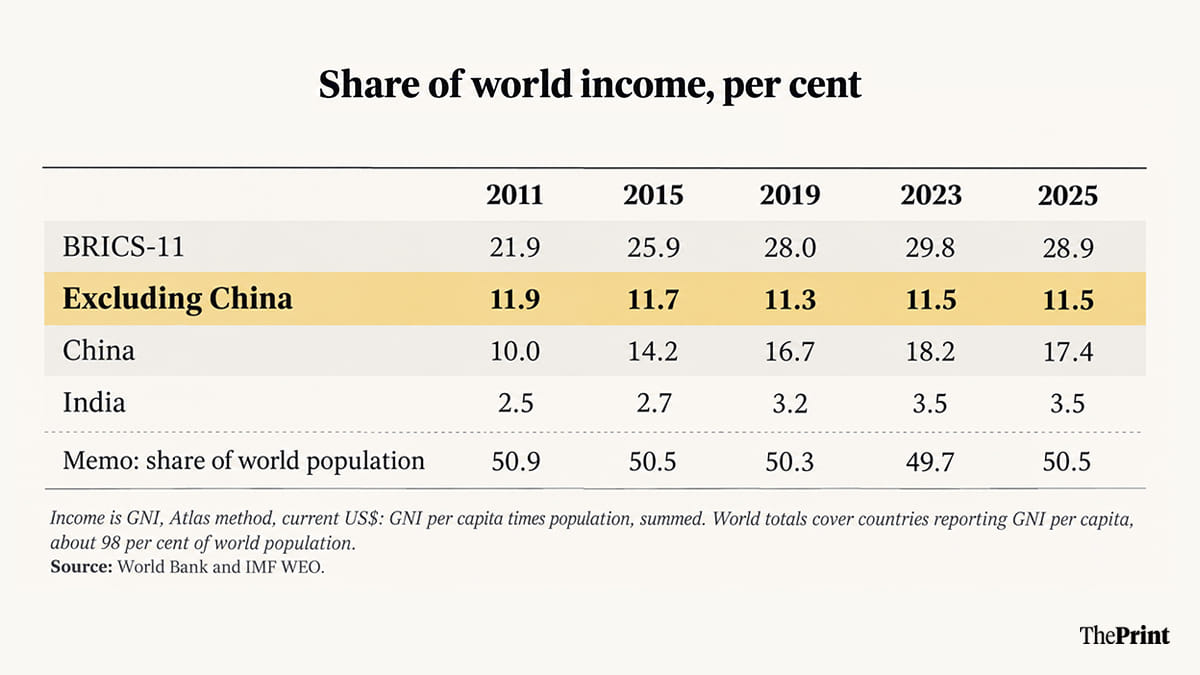
BRICS went from 21.9 per cent of world income in 2011 to 28.9 per cent in 2025. That number is true, and it is the number every BRICS communiqué is built on.
Now remove China. The other ten members were 11.9 per cent of world income in 2011 and 11.5 per cent in 2025. They did not rise. They fell.
China went from 10.0 to 17.4 per cent. It accounts for 72 per cent of the entire increase in BRICS income over the period — and because the others lost ground, for rather more than all of the increase in the bloc’s share of the world. Nor does it help to object that six of the eleven joined only in January 2024. Take the four members other than China that have been in the grouping throughout — Brazil, Russia, India and South Africa — and their share of world income went from 8.5 per cent in 2011 to 7.9 per cent in 2025. On the original membership the result is the same.
Notice what did not move at all. BRICS was 50.9 per cent of the world’s population in 2011 and 50.5 per cent in 2025. Half the world’s people, less than three-tenths of its income, and no convergence outside one country. Notice too that the peak was 2023, at 29.8 per cent, and the share has fallen in each of the two years since.
Inside the club, the concentration is starker. China was 45.6 per cent of BRICS income in 2011 and is 60.2 per cent now. Among the five long-standing members it has gone from 54.1 per cent to 68.9 per cent. Over the same fifteen years China’s share of BRICS population fell, from 38.4 per cent to 35.7. The grouping has become more Chinese by every measure except people.
Nothing happening
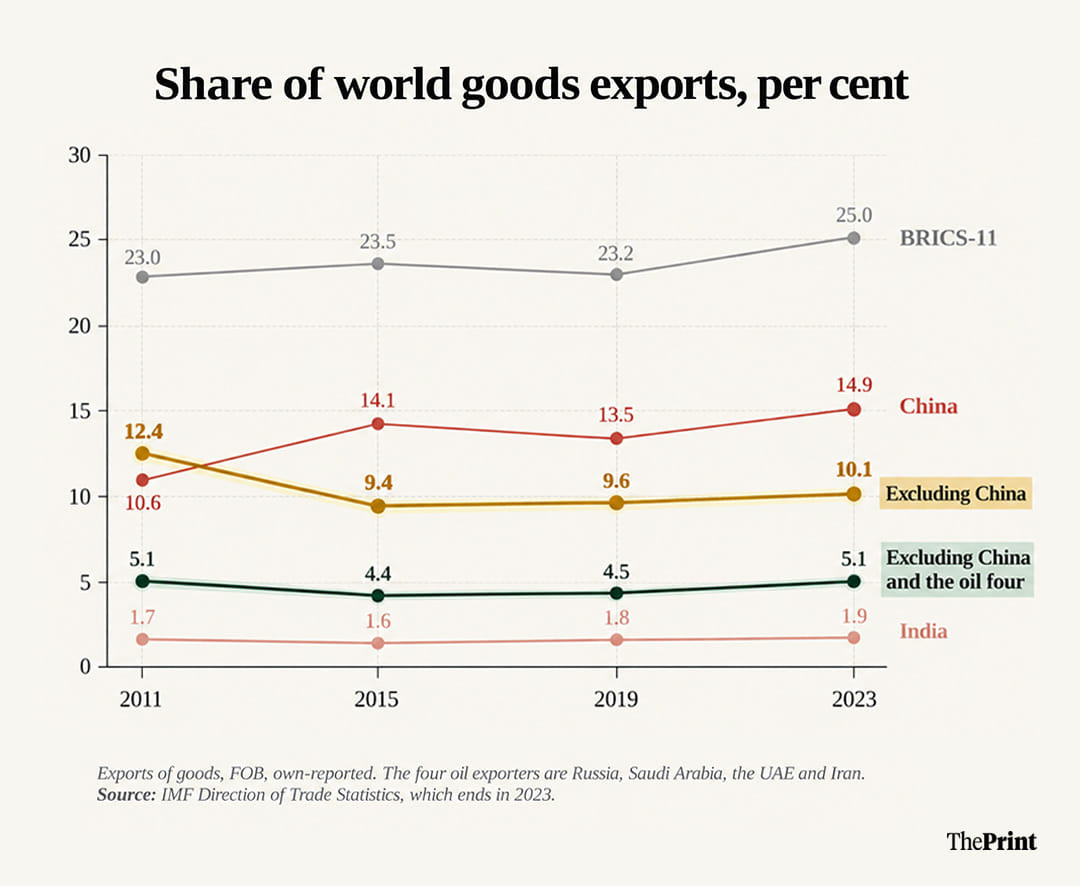
BRICS’ share of world goods exports rose from 23.0 per cent in 2011 to 25.0 per cent in 2023. Take China out and it fell, from 12.4 per cent to 10.1. Of the increase in BRICS goods exports over those twelve years, China is 94 per cent.
Here an honest caveat is owed, because the ex-China line is not a clean series. Four BRICS members — Russia, Saudi Arabia, the UAE and Iran — are oil exporters, and their dollar export share is largely a picture of the oil price: 7.3 per cent of world exports in 2011, 5.0 in 2015, 4.2 in 2020, 5.0 in 2023. Strip out both China and the four oil exporters and the remaining six — Brazil, India, Indonesia, South Africa, Egypt, Ethiopia — were 5.1 per cent of world goods exports in 2011 and 5.1 per cent in 2023. Twelve years, no change at all. That is the cleanest number in this exercise, and it is the most damning: it is not an oil-price artefact and it is not a China story. It is simply nothing happening.
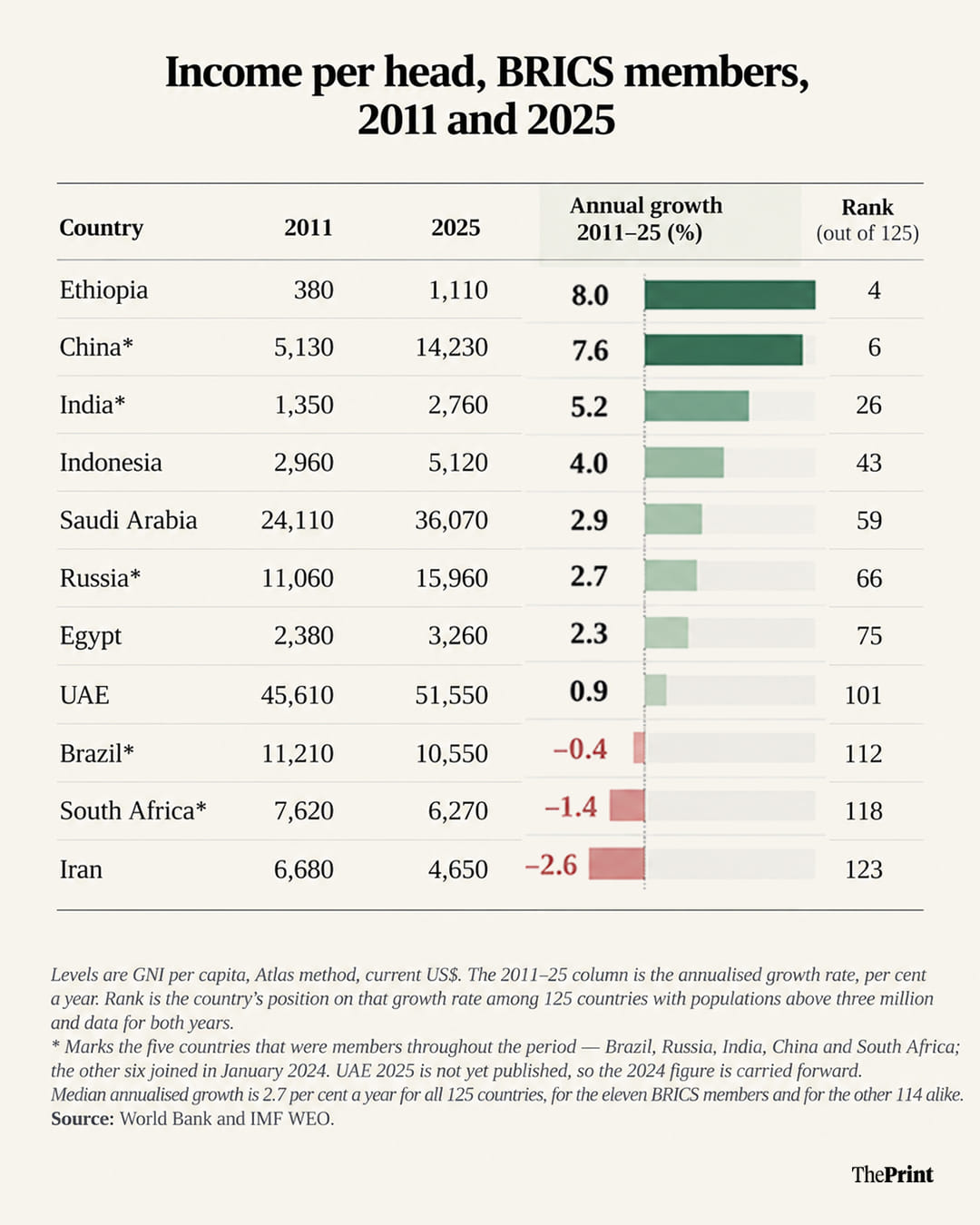
Ethiopia and China nearly tripled their dollar incomes. India doubled. Indonesia is respectable. Then the table turns: the UAE gained nine-tenths of a per cent a year, and Brazil, South Africa and Iran are absolutely poorer in dollar terms in 2025 than they were in 2011. Brazil is down 6 per cent, South Africa 20 per cent, Iran 36 per cent. Two of the three have been members from the beginning of this period. South Africa was admitted in December 2010 and attended its first summit in April 2011; it has spent its entire membership going backwards.
Someone will say the 2014-16 oil collapse or the pandemic did this. Split the window at 2019 and Brazil and Iran do improve in the second half, and Russia dramatically so — from 0.1 per cent a year before 2019 to 6.1 per cent after, on energy prices and a war economy. But South Africa is negative in both halves, minus 1.8 and then minus 0.8, and the ranking of winners and losers barely changes.
What unites them?
BRICS has no tariff preference, no common market, no transfer mechanism, no binding commitment of any kind. Nothing in these tables identifies a causal effect of joining.
But that cuts against the enthusiasts, not for them. If membership does nothing, then a bloc’s rise is simply the sum of what its members did at home, independently of bloc membership — and the arithmetic above says that for ten of the eleven, what they did at home did not work.
The comparison that should settle it is with the countries outside the BRICS membership. Among 125 countries with populations above three million and data for both years, the median BRICS member ranks 66th. The median BRICS growth rate is 2.7 per cent a year. So is the median for everyone else. The club is precisely average, and only five of its eleven members beat the world median.
And who is at the top? Bangladesh first, at 8.8 per cent a year. Vietnam third. Cambodia fifth. Then Armenia, Nepal, Georgia, Bulgaria, Romania, Costa Rica, Kenya. Twenty-three of the twenty-five fastest-growing countries of the last fifteen years are not BRICS members. What they have in common is not a summit. It is trade access, investment and domestic reform — which is to say, they got on with it.
(The top of any dollar-income ranking should be read with care: Zimbabwe and Somalia appear in the top twenty, and their dollar series are not to be trusted. Bangladesh, Vietnam, Cambodia, Nepal, Armenia, Georgia, Bulgaria and Romania are solid.)
A look at India
India is the second-best performer among the five long-standing members and 26th in the world, at 5.2 per cent a year. Our share of world income rose from 2.5 per cent to 3.5. Per head, we moved from 13.4 per cent of the world average to 18.7. That is real progress and it should be said plainly, because the fashion is to say otherwise.
It is also not enough, and the trade numbers say why. India’s share of world goods exports was 1.71 per cent in 2011. In 2023 it was 1.88 per cent. Twelve years, seventeen-hundredths of a percentage point. Over the same twelve years Vietnam went from 0.52 per cent to 1.50 — from $93 billion of goods exports to $345 billion, against India’s $307 billion to $432 billion. A country with a fifteenth of our population has almost caught us, and did it while we were attending summits about the reform of the international order.
That is not a BRICS failure. It is ours. But it is the answer to anyone who thinks the grouping is where India’s economic future is being decided. On the evidence of fifteen years, the grouping is where two-thirds of the income and 60 per cent of the exports belong to the one member whose interests are least aligned with ours — the member that runs a $112 billion trade surplus with us, has put $2.5 billion of direct investment into India against America’s $100 billion, and throttled our rare-earth supply last year.
Also read: BRICS is India’s moment. Its neighbours are watching—and worrying about missing out
The best of the rest
I would revise all of this on evidence, and the evidence is specifiable. If intra-BRICS trade grew faster than each member’s trade with the rest of the world; if the New Development Bank lent at a scale that moved any member’s investment rate; if the Contingent Reserve Arrangement were ever drawn on; if the grouping’s income share rose with China’s contribution held constant — any one of those would be a fact in favour, and I would report it. None of them is true today.
Until then the honest description is the arithmetic one. BRICS is not a bloc of rising powers. It is one rising power, four members going sideways, three going backwards, and six who arrived in 2024 and cannot yet be judged. India is the best of the rest, which is a distinction worth considerably less than it sounds.
Views are personal.
This article was originally published on the author’s Substack.