




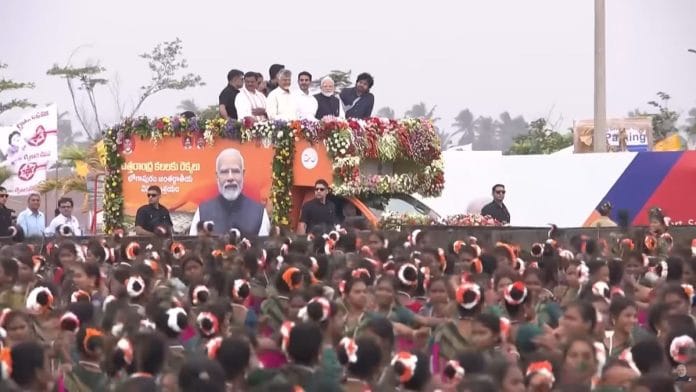

Over thirteen thousand Adivasi girls (students) and women, in pink sarees with green borders, dancing in 433 circles along a motorcade route. On 1 August, Prime Minister Narendra Modi, flanked by Andhra Pradesh Chief Minister Chandrababu Naidu and Deputy Chief Minister Pawan Kalyan, rode through them in an open-top vehicle and inaugurated the Alluri Sitarama Raju International Airport at Bhogapuram. Later, “Power Star” Pawan Kalyan told an attentive crowd that abuse aimed at the Prime Minister at the Gen Z Jantar Mantar protests had brought tears to his eyes, and asked what we can do as Hanuman to him.
If Kalyan is Hanuman, who does that make the Prime Minister? Evidently, the impulses of medieval masculinity and polity are still very much alive and kicking. The events of late July-early August 2026 confirm that many would like to believe women owe their rulers public devotion and participation in spectacle. From the Indo-Roman trade to the erasure of bawdy 17th-century poetry, dominant-caste male power in India has only ever allowed women to be one thing — and punished them when they disobey.
The emperor’s women
Let’s travel back two millennia, to when monsoon winds brought fleets of Roman ships to Indian shores. The Periplus of the Erythrean Sea, an ancient mariner’s manual often quoted to establish the Roman craze for Indian goods, also tells us what Indian courts wanted from the Mediterranean. It candidly remarks that to get permission to trade at Bharuch, Gujarat, traders were expected to gift the king “precious silverware, slave musicians, beautiful girls for concubinage, fine wines, etc.”
As historian Kathryn Hain argues in The Prestige Makers: Greek Slave Women in Ancient India, the more women (especially foreign women) at a king’s court, the mightier he was believed to be. Buddhist legend, she writes, claimed that the Mauryan emperor Ashoka had 16,000 women at his court. Jatakas tell us that the much greater Siddhartha Gautama — the future Buddha — had left behind 40,001 wives when he embarked in search of enlightenment. These were not meant to be taken literally, but rather to suggest the grandeur and resources of legendary royal figures.
Over the centuries, these numbers reached literally astronomical proportions. Historian Jennifer Howes, in The Courts of Pre-Colonial South India, reads the Mansara Shilpashastram, a medieval architectural treatise with prescriptions on the arrangement of the king’s palaces, retinues, cities and temples. It lays out nine grades of king. The lowest grade was to maintain 50,000 foot soldiers, 500 court ladies, and one queen. The grandest, the chakravartin, the great king of kings, was to maintain 1,000,000,000,000 foot soldiers and 10,000,000,000,000,000,000 (ten quintillion) court ladies — ten million women at court for every soldier on the march. Bhogapuram’s Guinness World Record of 13,500 women utterly pales in comparison.
More realistically, Howes demonstrates, we can gauge premodern rulers’ rankings in relation to each other by looking at their palaces. The Setupatis of Ramnad, a small but important court in 18th-century Tamil Nadu, maintained a palace roughly 32,000 square metres in area. About 15,000 of these belonged to the antapuram, the women’s quarters — nearly half the building. Much as the men of the court might wish otherwise, the ladies of the Setupati clan were profoundly ambitious, quarrelsome, and autonomous, but the overall point remains: the number of women set the size of the palace, and the size of the palace declared the king’s place among other kings.
Courtly display
When the Cockroach Janta Party (CJP) called off its protest on 25 July, television media and Right-wing influencers immediately seized on one detail: young women at Jantar Mantar had sworn at Modi. In a week of breathless coverage, even after Modi announced he had “forgiven” the women, they were (and continue to be) harassed both by the state and its loyalists. Returning to the medieval world: what were these hundreds, perhaps thousands, of courtly ladies expected to actually do for the king?
There is a Sanskritic manual for this too. Someshvara III, a 12th century Chalukya emperor seated at present-day Basavakalyan, explains in the Manasollasa, a sprawling encyclopaedia running from perfumery to veterinary medicine to kingcraft. In historian P Arundhati’s Royal Life in Mānasollāsa, Someshvara discusses how the ruler was to “enjoy the court” (āsthāna-upabhōga). Once the king had given the order, the doorkeeper first goes to the harem, and the royal ladies come out in curtained palanquins under swinging umbrellas while staff-bearers walk ahead with teak canes, yelling and shoving the crowd out of the way. The women take their seats by rank, on every side of the throne, except directly in front of it.
Fan duty is assigned by province: the “dark woman of Kuntala” (southwest Karnataka) uses one kind of whisk, the women of Saurashtra use another made of strips of coloured silk. Someshvara even catalogues the women of his territories by physical attributes and costume: the curly hair of the Kuntala ladies, the long faces of the Maharastrians; the upper garments of the Andhra ladies, the “false way” the Gujaratis wear their blouses. (Apparently Someshvara knew better than the ladies did). Women of all ages were to be present, from children to matrons. Only then do the men enter: every lord of consequence arrives to find the emperor already surrounded by beautiful, compliant women. It is perhaps merely a mark of Bharatiya sanskaar that wherever PM Modi travels abroad, he is met by women in regional costume.
Expectations and consequences
In a room next to the audience hall at the Ramnad palace in Tamil Nadu, the Setupati king is depicted among adoring women. One all but stages him as Krishna in the rasa lila. According to Prof Howes, the men admitted to this room were meant to identify with the women: to feel, as courtiers, the yearning of a devotee separated from her lord. This was an established tradition in South Indian poetry: the Chola-era ula processional texts, detailing the king’s parade through his capital, describe — sometimes in shockingly sexual terms — women of all ages, just like in the Manasollasa, drawn to his beauty, virtue, and power. Art and poetry deliberately blurred the boundaries between king and god: courtiers were to feel bhakti for the king.
Brahminical texts made the price of courtly women’s non-devotion, women’s disobedience, very clear. Take, for example, the Arthashastra, the early Indian text on statecraft. In Patrick Olivelle’s translation, the text describes a Superintendent of Courtesans, who was to organise women “of beauty and skill” to “add distinction to the parasol, ceremonial water jug, fan, palanquin, seat, and chariot”, the attributes of royal power. Courtesans who refused to go to a man when ordered by the king were to be punished with a thousand lashes, or a fine of 5,000 coins — one of the worst punishments, short of execution, in the entire text. (Book II, Chapter 27, verse 19). This extends to the household. A wife was fined three coins for drinking against her husband’s wishes; six for going by day to a women’s show, double at night. For conversation in a ‘suspicious’ place, five lashes, to be delivered by a Dalit man in the middle of the village, a calculated caste-based insult. (Book III, Chapter 3, verses 20–29).
Women who insisted on transgressing, on wielding their sexuality, could expect complete erasure from the historical record. Harshita Mruthinti Kamath, in Kṣētrayya: The Making of a Telugu Poet (2019), dismantles the persona of a 17th-century poet-saint. Kamath argues that he was not a historical figure at all: the sexually explicit poems attributed to him, interpreted as spiritual metaphors, were likely composed by several hands — including courtesans — in the Nayaka courts of Thanjavur. The poems were then sanitised across several centuries of dominant-caste moralising and Telugu literary reform until an imaginary, pious male persona had absorbed the work of intelligent, confident, articulate women who made later elites uncomfortable.
Also read: Dharna was sacred even in medieval India. BJP is following the path the British created
What the record won’t show
It’s worth recapping events that led up to the Guinness World Record at Bhogapuram on 1 August. The Cockroach Janta Party’s protest was withdrawn on 25 July, the same day then-Education Minister Dharmendra Pradhan resigned. By 28 July, accounts were circulating cropped and AI-altered photographs of the young (some underage) women who had been there, captioned “Find Her” — ThePrint documented the campaign reaching Delhi, Mumbai and Kolkata. On 31 July, Modi posted a video forgiving them. On 1 August, 13,000 Adivasi women danced at Bhogapuram, and Pawan Kalyan declared “we” (the citizens? TDP workers?) were to be like Hanuman to Modi. Are we to see Modi as the god-king Rama, as the Setupati’s courtiers once saw him as Krishna?
The dancers were Adivasi schoolgirls of classes VIII, IX and X from ITDA schools at Paderu, Seethampeta, Parvathipuram, and Rampachodavaram, drilled by master trainers at Araku under the state’s tribal welfare department. Seventy kilometres down the coast, Dalit women at Tarluvada are under pressure to sell land assigned to them under 1970s land reform, to make way for the Google-Adani data centre. One set of marginalised bodies are to lose land and water, as they have for centuries; another set are ‘volunteered’, on the taxpayer’s rupee, for a performance charged with the ancient symbology of submission and devotion to a king. But the history of India’s kings tells us unequivocally: performance is not belief. Within a century of Manasollasa‘s writing, the Chalukya empire had shattered beyond all recovery. The Setupati palace stands crumbling. And no algorithm can censor every meme.
Anirudh Kanisetti is a public historian. He is the author of ‘Lords of Earth and Sea: A History of the Chola Empire’ and the award-winning ‘Lords of the Deccan’. He hosts the Echoes of India and Yuddha podcasts. He tweets @AKanisetti and is on Instagram @anirbuddha.
This article is a part of the ‘Thinking Medieval‘ series that takes a deep dive into India’s medieval culture, politics, and history.
(Edited by Aamaan Alam Khan)
Are we to believe that we are still living in the medieval age?