






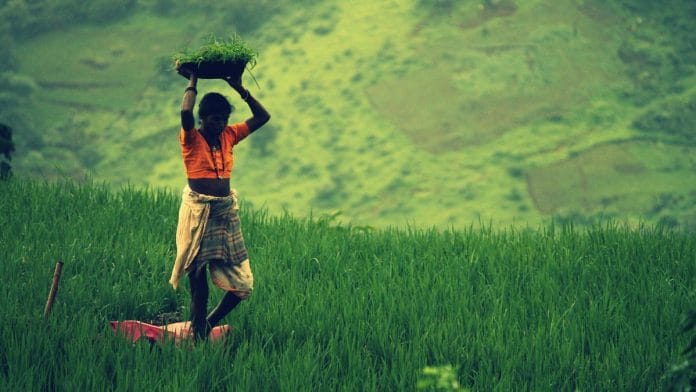


In late April, on the outskirts of Visakhapatnam, the foundation stone was laid for a 600-acre, one-gigawatt Artificial Intelligence data centre—some day to be Asia’s largest digital infrastructure investment. Part of the land had belonged for generations to Dalit families in the village of Tarluvada. Through May, the women of those families refused to sign it away. A video documenting their protest crossed 2.5 million views before the government of India had Instagram restrict it under the Information Technology Act.
Other Indian states, including Karnataka, have been bullish about data centres even amid soaring temperatures and water shortages across the country. Simultaneously, state-led water initiatives — Mission Kakatiya, Mission Amrit Sarovar, the Jal Shakti Abhiyan — are attempting to restore “traditional” hydrological methods, on the premise that precolonial systems, relying on rain-filled tanks, were more equitable and more communal than what came after.
But is this what the historical record attests to? Looking beyond epigraphs, into oral tradition, a more chequered picture emerges. Take, for example, the Kerege Haara — a celebrated Kannada song narrating the ritual sacrifice of a Gowda chief’s daughter-in-law to ensure the construction of a tank. This is not exceptional in Kannada popular memory. Many old reservoirs in Karnataka have attached to them a song or a story of sacrifice, shortage or death, varying by caste.
These memories are in stark contrast to the idyllic tone of medieval inscriptions, which praise the courtly patrons of rainwater tanks, and describe prosperous surrounding farms, orchards, and temples. The designers and beneficiaries of medieval water systems were not the same as the people whose hands had built the tanks and canals — in much the same way as the people signing off on data centres today are not the ones whose water is being taken away.
Lords and labourers
Thousands of tanks were built over nearly a thousand years (c. 8th to 18th century CE). Village landscapes were frequently criss-crossed by tank channels and streams. Inscriptions recording these tanks are, on first encounter, idyllic. Take, for example, a gift made by the 12th-century Brahmin merchant Kammata Chatti-Setti. He was a trader in horses, elephants and pearls, who boasted of kings as clients. In the village of Banavur, near the town of Arasikere (literally “Queen’s Tank”), he enlarged two tanks. Other inscriptions recorded by historians GS Dikshit, GR Kuppuswamy and SK Mohan describe the environs as “filled with clusters of groves, with well-filled channels, with large tanks like seas, surrounded with growing crops, with crowds of people and splendid temples.”
Chatti-Setti also built a large tank near the capital city of Dvarasamudra (present-day Halebidu, in Karnataka), which was home to several vast reservoirs holding the waters of the Yagache river, bearing annual harvests of sugarcane and rice. In this, he was part of a larger trend among the court elite of the Hoysalas in South Karnataka. Sanskrit eulogies praise Hoysala kings themselves as sponsoring agraharas (Brahmin settlements) without count, “multitudes of charitable tanks,” and temples that pierced the sky.
Several highly-placed court officials are recorded commissioning tanks, each surrounded by valuable agricultural land in which they held a stake. Brahmins and merchants (sometimes the same individual could be both), Jain and Hindu, male and female members of the royal family and aristocracy, mathas, and temples were all involved in financing and benefiting from the expansion of tank agriculture.
However, the inscriptions of this time have little to say about who actually built the tanks. How many hands were needed to move and pack all the earth? Hundreds, thousands? And how were they paid? This information was, apparently, not recorded in stone but probably on more transient materials, like palm-leaf.
In comparison, another class is much better represented in the 13th-century inscriptions. The historian Kesavan Veluthat, in his paper “Landed Magnates as State Agents: The Gavundas under the Hoysalas”, describes Gavundas — urodeya in Kannada — as the landed proprietor class of the medieval countryside. A single village could have many Gavundas, who owned land in multiple villages, yielding various returns in gold and crops. The Hoysala state hired many of its functionaries from this class, and Gavundas are mentioned in several tank donative inscriptions as maintaining and patronising tanks. In return, they received a share of the profits from the irrigated lands below the tank.
About a century later, under the Vijayanagara empire, Gavundas remained the village’s landed elite, the state’s local agents, and the chief beneficiaries of tank-building grants. Dikshit et al. provide several examples. One Bhattara Bachiyappa excavated six tanks named after his king, his father, his mother, a female relative, himself, and a male relative. The lands below the sluices were granted to the tank-builder in perpetuity as kattukodige — two parts in ten of the rice fields, rent-free, for as long as the sun and moon endured.
Local Nayakas, military leaders like Bengaluru’s famous Kempe Gowda, built both forts and tanks to control the local water supply. Engineers and Brahmins belonged to the same class: when the bund of the Arali dam on the Palar broke, Dikshit et al write that the priests of the Katariyanahalli temple granted land to a group of Brahmins on the condition that they pay for repairs. The Brahmins kept three of four parts of the rice fields below the bund in exchange.
The city of Vijayanagara itself saw massive hydrological interventions that extended rice cultivation into altogether drier and more arid zones in northern Karnataka. Bunds extending several miles, built by small armies of labourers, altered the course of entire rivers and gathered mountainous amounts of water. Chains of small tanks, tracing out relief contours, captured runoff.
A 16th-century inscription describes one of these monumental artificial lakes, “with eddying waterducts/sluices”. It is also at pains to enumerate for us the qualities of a good reservoir. It begins with “a king endowed with righteousness, rich, happy and desirous of acquiring the permanent wealth of fame, and a Brahmana learned in hydrology…”. Its 12th and final quality, ranked after the physical properties of the landscape, the availability of quarried stone, etc is “a gang of men skilled in the art of its construction.”
Later, the inscription is more boastful of these teeming hands. It tells us that the lake, named Anamtaraja, was built by “one thousand labourers working at the tank and the dam every day, and a hundred carts were employed for the masonry work of the sluice and wall.” This small army completed the work in two years, and the inscription says no expense was spared in money or grain. The Portuguese traveller Domingo Paes witnessed one of these enormous tanks being built in the 1500s.
Sacrifice and Idyll
Outside the Vijayanagara king Krishna Raya’s new city of Nagalapur, present-day Hospet, Paes counted 15,000 or 20,000 labourers assembling a bund, crowding “like ants, so that you could not see the ground on which they walked.” This is our first description of what these tank builders actually looked like. Paes wrote that the king’s captains directly oversaw sections of the embankment. After the wall had buckled under the weight of the water multiple times, Paes said that the king — on the advice of his priests — ordered that 60 men be sacrificed, with horses and buffaloes, to appease a god. This was promptly enacted by his officials.
It is entirely possible that Paes didn’t actually witness this, and was only adding to a story he had been told. But this discordant note actually resonates with another tradition. Dalit women’s songs also associate tank construction with death, sacrifice, and divinity. Historian Esha Shah in “Telling Otherwise: A Historical Anthropology of Tank Irrigation Technology in South India” recorded a group singing ‘Kanne Viramba’ in Dannayakankere village. In her words, it was “a eulogy to the great victory and glory of a virgin goddess (a young girl sacrificed in a tank) and then tells the story of the tank being built by Muddanna (a village chieftain) who invited 700 Voddas to build a tank. Seven sluices were built in seven years with seven human sacrifices and five more deaths.” The song then sings the glory of Muddanna, declares that the tank was built based on moral truth and the dharma, and finally sings of the virgin goddess, praising her sacrifice as the most glorious among all the sacrifices in the tank.
The Voddas, then, were the groups that built the tanks. We also have what appears to be a memory of social violence: human sacrifices and accidental deaths in the process of assembling the embankment. This process, described by early 20th-century British engineer WG Bligh, involves throwing basket after basket of soil, carried on the head, into small basins dug into the earth filled with water. Each layer of earth was “soaked to dissolve clods of dirt, so that the whole bank was composed of wet earth devoid of air spaces”. The work was slippery and dangerous. Voddas’ own songs preserve memories of “carving” tanks with just a rake and basket, sometimes pickaxes, crowbars, and shovels. In their stories, Voddas are tricked by temple accountants, divinities, and Gavundas out of the gold they have been promised for their work. “The Voddas,” Shah wrote, “present themselves as being eternally cursed by the gods: their situation is fated and not subject to changes in dynastic rule.”
Despite surviving the dynastic shift in a position of privilege, the stories and songs of the Gavundas/Gowdas also carry an undercurrent of sorrow.
In an earlier column on Vijayanagara’s water systems, borrowing an argument from the archaeologist Kathleen Morrison, I described these reservoirs as essentially crowdfunded — small donations and investments, often from Gavundas, pooled to finance large irrigation works without any centralised initiative. It is worth remembering which crowd was doing the funding and reaping the returns: the landed elite, not the landless labourers. Fortunes linked to the prosperity of the tank, Gavundas were also vulnerable to the hydrological irregularities that caused drought or flooding, stressing the waterworks and requiring death and sacrifice to restore.
In many songs, the sacrificed woman-turned-goddess belonged to the family of the village Gavunda or Nayaka chieftain. Both daughters and daughters-in-law.
It is to this broader genre that Kerege Haara belongs. Found across castes associated with medieval manual labour, songs such as Voddar Boyi, Kanne Viramba, and others still sung by Dalit women — across the present-day districts of Kolar, Bellary, and Chitradurga — share a common narrative structure. A Gowda invites a Vodda chief to build a tank. The bund will not stand. The water goddess demands a sacrifice. The Gavunda or Gowda is asked to offer himself and then, one by one, his sons. He refuses each time before settling on a daughter-in-law, either the eldest or youngest, who is walled into the embankment.
In another song, the neerghanti — the lower-caste watchman of the tank — is killed by the village leaders. His body is cut into three pieces and scattered to the north, the south, and the west, so that he cannot return to bargain with the Gangemma, the water goddess.
The Voddas, the tank-builders, preserve memories of coercion or mistreatment. Meanwhile, it is only a subset of aristocratic inscriptions that describe the world of agrarian plenty that benefited them. Even these records have repeated mentions of cycles of bunds breaking, droughts, and financial insolvency which afflicted tanks and their surrounding lands.
What the bund remembers
The social structure not entirely shown in inscriptions was preserved in landscape and songscape. The inscriptions are focused only on gifts and deal with landowners, so the picture they present of the medieval world is a small part of the totality of what was going on. Rather than being a collaborative effort that benefited all and was maintained by all, medieval rainwater tanks were embedded in a social structure that was organised to benefit the aristocracy over the many.
Wealthy landowners competed to build tanks, because tank-irrigated lands allowed them a share of rice and cash crops. Meanwhile other castes, typically manual and landless labourers, were at least partially coerced into maintaining or erecting the embankments. The logic of tank access and tank purity further overlapped with caste structures. Inscriptions, studied by historian Malini Adiga in The Making of Southern Karnataka, sometimes distinguish hydrological features by caste: suvarna-kere, the goldsmith’s tank; a rajaka-tataka, the washerman’s tank; an asaga-pole, the washerman’s stream; and so on.
There is also much to say about the Voddas: the people absent from the Hoysala inscriptions, who built the tanks of the mixed-zone lands between the Western Ghats and the Deccan. While earlier inscriptions, dating to the 9th century, mention a corvée or forced labour called visti, it disappears in the 11th–12th century inscriptions and is only mentioned in passing in the 16th. The historian Tejaswini Yarlagadda has argued this reflects its commutation to money rather than its abolition.
If Vodda oral tradition is any indication, however, it wasn’t bringing in a lot of money either. Their songs records work without pay, payment in disguise, payment in sweets when promised gold. Today they continue to work in construction, of pipes, roads, telephone cables, and so on.
The structure of the medieval water system, Shah argued, produced recurring violence that was recorded in the collective memory of these castes. The tanks of the mixed zone, including Vijayanagara, were built into terrain not entirely suited to the cultivation of paddy, no matter how profitable. Premodern states also operated with much less information and capacity than modern ones, so corrections to the embankments did not always happen on time and were largely devolved onto local authorities, which in turn tended to be landowners of various degrees of solvency. Often, authorities would sell lands and profit-shares to ever-wealthier private individuals, who advanced cash for tank maintenance or expansion.
These were systems designed to benefit the wealthy, which also failed cyclically and structurally. And when the water did not come, or when the embankment threatened to give, the system crushed whoever was nearest at the bottom of it — while offering those at the top further avenues for investment.
Also read: The Netherlands is confronting its colonial history. It’s time for India to do the same
Mirages and missions
The same pattern is at work in southern Karnataka in 2026. The Bengaluru Water Supply and Sewerage Board has deployed over 1,000 tankers across high-alert pockets this summer. Meanwhile, 31 operational data centres cluster in the city’s eastern ring road corridor. Karnataka’s Information Technology Minister, Priyank Kharge, told the state assembly in March that one megawatt of data-centre capacity demands 25,000,000 litres of water a year. Meanwhile, on the outskirts of Visakhapatnam, the Adani-Google site sits next to the Mudasarlova reservoir, the city’s water source. And it is Dalit women whose lands and livelihoods are first on the line.
Meanwhile, Indian water policy continues its revivalist streak. It is returning to a “traditional” utopia, which isn’t entirely on solid evidential grounds. The Jal Shakti Abhiyan markets itself as the “revival of traditional methods of rainwater harvesting”, and Prime Minister Narendra Modi has tied it to the Water Vision @2047 plan. The same can be said for Mission Kakatiya and Mission Amrit Sarovar. What does this mean on concrete grounds? What is the past we are returning to? Does it change the underlying structure of who loses, who bears risk, who gains?
The tanks of medieval India were sophisticated engineering achievements, and they changed hydrological landscapes and patterns of cultivation. Understanding the systemic violence they were entwined in is the only way we can avoid repeating the cycles that have lasted centuries and outlasted empires. The donor is celebrated, while the labourer is erased. Even as data centres rise, the Voddas still work in construction. The ladies of Tarluvada still try to keep their lands from drying out.
Anirudh Kanisetti is a public historian. He is the author of ‘Lords of Earth and Sea: A History of the Chola Empire’ and the award-winning ‘Lords of the Deccan’. He hosts the Echoes of India and Yuddha podcasts. He tweets @AKanisetti and is on Instagram @anirbuddha.
This article is a part of the ‘Thinking Medieval‘ series that takes a deep dive into India’s medieval culture, politics, and history.
(Edited by Ratan Priya)