






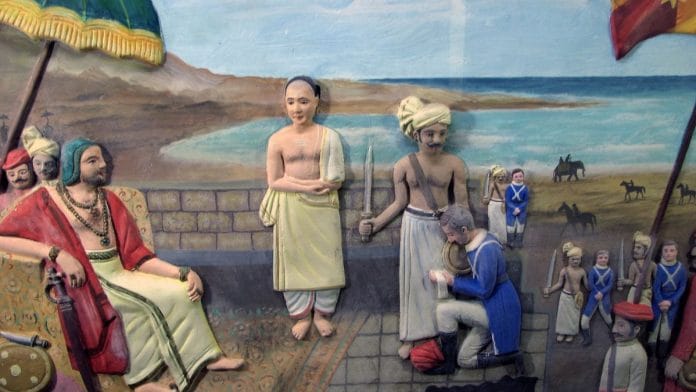


The University of Leiden in the Netherlands returning a set of Chola-period copper plates raises an interesting question in India. What, precisely, did the Dutch have to do with India? In the crowded theatre of the subcontinent’s colonial history, the Dutch East India Company—the Vereenigde Oost-Indische Compagnie, or VOC—barely features.
School curricula teach us the British East India Company, Robert Clive and the battles of Plassey and Buxar. Perhaps a side note on Dupleix and the French in Pondicherry. X, meanwhile, gives us never-ending atrocities committed by the Portuguese in Goa. Meanwhile the Dutch, if they appear at all, are a footnote. They appear abruptly, to lose a battle to King Marthanda Varma of Travancore, and immediately disappear.
But for nearly a century, the VOC was the pre-eminent power in Asia, bringing Indian fashions to Europe, Southeast Asian spices to India, and scattering often-enslaved Indians from colonies in South Africa to the farthest reaches of the Indonesian archipelago. The VOC’s networks arguably laid the basis for the British Raj’s iron grip on the Coromandel Coast, which involved the industrial-scale transport of indentured Indians across the planet.
In a statement shared with me, Her Excellency Marisa Gerards, the Netherlands Ambassador to India, said that “An open dialogue on the return of objects that were taken during the colonial era is part of a critical reflection on our past, and the basis for solid cultural cooperation in the present and future.”
If India is to participate in an equally-open and confident dialogue about the colonial era, we need to not only understand the VOC, but to challenge the amnesia that surrounds our own involvement in perpetuating colonial legacies.
Also read: Leiden Plates returned by Netherlands aren’t for ASI storerooms. They belong at Nagapattinam
The merchant-warriors
The VOC was founded in 1602 in the Dutch Republic, granting it a 21-year monopoly on all Dutch trade east of the Cape of Good Hope. It was also given the right to wage war, conclude treaties, build fortresses, and administer justice. By this point, both Spain and Portugal had their own colonial empires. Spain, in fact, ruled a chunk of the Netherlands: The independent Dutch Republic had seceded from the Spanish Empire only a few decades prior.
From the outset, the VOC was a joint-stock company—indeed, the world’s first. Historians George Winius and Marcus Vink, in their book The Merchant-Warrior Pacified, describe it as a merchant-warrior apparatus that combined commercial extraction with military coercion. An imperial system by design, owned by citizens of the Dutch Republic, with shares traded on the Amsterdam stock exchange. It was to be the first multinational corporation, and it ran the 17th century’s most profitable colonial operation in Asia for nearly a hundred years.
The VOC’s profits rested on the Indonesian spice trade, which, in turn, centred on Indian cotton textiles. In 1612, VOC navigator Hendrik Brouwer described the Coromandel Coast as “the left arm of the Moluccas” (the spice-producing Indonesian archipelago).
Indonesian producers of nutmeg, cloves, and mace had been exchanging Indian cloth for their spices for centuries prior—likely even before the 10th century, when inscriptions suggest a booming textile-weaving industry in Chola-ruled Kanchipuram. The VOC wrestled this ancient circulatory network into a monopoly that changed the history of the Netherlands and of Europe.
Painted, dyed, block-printed, Indian cottons—designed by Gujarati, Tamil and Telugu weavers for buyers in Java, Sulawesi, and Banda Island among many other specific clientele—were the VOC’s primary purchase currency in the archipelago. Weavers received advance payments against specific orders, creating debt dependencies. By the mid-seventeenth century, the VOC had ‘factories’ (effectively fortified warehouses) running from Cape Comorin (present-day Kanyakumari), at the tip of the subcontinent, to Point Calimere (present-day Kodiyakarai) on the northern edge of the Coromandel. To this day, port cities like Visakhapatnam are home to crumbling Dutch ruins that play little to no role in regional memory.
However, the VOC never possessed the overwhelming military ascendancy that the British EIC would about a century later. Historian Lennart Bes, who assisted the committee that recommended the return of the Leiden Plates, has studied the VOC’s interactions with South Indian powers in many of his works. In his paper “The Setupatis, the Dutch, and Other Bandits in 18th–century Ramnad”, he writes that the VOC were considered one among many groups of armed and dangerous traders, such as the Maraikkayar merchants of Kilakkarai, and jostled in a fluid political landscape with the Marathas of Thanjavur and various city-states ruled by Telugu-speaking Nayakas.
Also read: History of Indians in the Arab world—port builders, Jat governor, translators, and slaves
Indian fates and the VOC
For most of the VOC’s history, their business ran on two parallel, entangled tracks: The export of fine cotton textiles and the export of enslaved people. During periods of famine and military devastation, the same class of Indian brokers who advanced payments to weavers also managed the procurement of enslaved people for VOC buyers, as described by Professor Vink in his paper “The World’s Oldest Trade”. Military destruction, commonplace in 17th century South India, eliminated food supplies. Starving families were forced to sell their children to Indian intermediaries, who offered immediate cash. Those intermediaries, in turn, resold to the VOC, or to the autonomous Asian slave traders who operated alongside and independently of the Company. From 1621–1665, Dutch archives record the VOC transporting 38,441 enslaved Indians from Pulicat and Madras (present-day Pazhaverkadu and Chennai) on 131 ships. In this process, is it possible to disentangle the culpability of European buyers from Indian warlords and brokers?
The trafficked labour would quite literally lay the foundations for further European expansion. In 1652, a Dutch colony was established at the Cape of Good Hope as a halfway house for Company ships, which sailed a six-month circuit between the Netherlands and Jakarta. The settlement required labour that the indigenous Khoe people could not supply, requiring forced migration. Historian Nigel Worden, in his study “Indian Ocean Slaves in Cape Town, 1695–1807“, found that up to 1749, slaves from the Indian subcontinent—Bengal, Malabar (in Kerala), Nagapattinam, Tuticorin, (both in Tamil Nadu) and Ceylon (present-day Sri Lanka)—formed over half of all imported slaves in Cape Town with identifiable origins.
When the British absorbed the Cape Colony in 1806, they received a city constructed substantially by Indian hands enslaved by the Dutch. They promptly extended the model, recruiting Indian indentured labourers to work sugar plantations from the 1860s. Alongside them, Gujarati merchants built profitable trading networks under British protection. One of them, Dada Abdulla, brought the young British-trained lawyer Mohandas Karamchand Gandhi to South Africa in 1893. The same system that profited some Indians crushed many others.
By this point the VOC had long since become defunct, owing to the ever-mounting expenses of maintaining military and political commitments across three continents, and systematic private trading, embezzlement and nepotism practiced by company officials.
For example, from 1729 onwards, Marthanda Varma, ruler of Venad in present-day southern Kerala, annexed small principalities that had previously supplied the VOC’s pepper. After a victory over the Dutch at Colachel (in Tamil Nadu) in August 1741—one of the earliest defeats of a European army by an organised Asian power—Varma recruited the VOC’s commander to train his army and effectively reduced the VOC to a nonentity in Malabar. Institutional rot was entrenched by this time. Professor Bes reports a 1731 audit, where the VOC found that their Resident at Kilakkarai had spent over a decade selling their merchandise below price, and loaning Company funds to local worthies, including the Setupati ruler of Ramnad. Over decades, all this effectively hollowed out the VOC from both within and without. By 1799, it was declared bankrupt and nationalised by the Dutch state.
With the outbreak of the French Revolutionary Wars in Europe, the British EIC was able to saunter in and absorb the VOC’s most valuable possessions: Ceylon in 1796, the Cape Colony in 1806. They inherited territories, institutions, trade networks, and historical records. The resulting British colonial apparatus was so total in its administrative reach—able to reshape land tenure, law, language, and historical memory itself — that in the Indian mind, it overwrote the Dutch almost completely.
Also read: Religion was not a consistent barrier for temple or mosque entry in India. It’s caste doing
Confidence, not guilt
The Dutch decision to return the Leiden plates in 2026 is, as Ambassador Gerards puts it, an act of critical reflection on the past. Restitution can only happen when a country is able to look at its past, confront it, and is able to institutionally repair it. The scale of what the VOC extracted from the Indian subcontinent was enormous, but the willingness to acknowledge that extraction and act on it is unusual in the 21st century, reflecting the confidence to truly embrace history.
Indeed, both the Ambassador’s office (personal communication) and the Dutch Colonial Collections’ Committee report demonstrate the Netherlands’ national policy framework for restitutions, which requires that independent advisory committees evaluate restitution requests. Post-Brexit Britain, which holds many more Indian treasures, is both unwilling and unable to do the same. The British Museum Act 1963, prohibits restitution, and the British Museum claims it will require an Act of Parliament to resolve.
Significantly, though, such restitution is equally inconceivable in India today, where the return of the Leiden plates, coming from a postcolonial Europe, are celebrated alongside Chola “colonisation” of Southeast Asia without the slightest trace of irony. Over the last decade, beyond replacing one set of deified freedom fighters with another, India has largely proved unable to address the lasting legacies of the British Raj, and India’s complex position both as victims and (in a limited manner, restricted to the ruling class) beneficiaries of Britain’s world-empire. To stick to the realm of artefacts, the National Museum in New Delhi holds over 12,000 objects from Xinjiang: manuscripts in Sanskrit, Khotanese, Uighur, and Tibetan; silk paintings from the Dunhuang grottoes; Buddhist murals from sites along the ancient Silk Road. All were removed by the archaeologist Aurel Stein between 1900 and 1916 under the auspices of the British Indian Government. The objects he removed are now held by an Indian national institution in our capital city. To whom should they return?
As we peer deeper, there are unaddressed complications and contradictions aplenty in India’s stance, declared and undeclared. The fact remains that the VOC did not introduce debt bondage or human trafficking to the Coromandel Coast. It expanded and exploited existing systems, with Indian intermediaries as willing participants. If the Dutch owe reparations, what about the mercantile and accountant castes that profited from this trade? And how far should this go?
Right-wing governments across India have hit upon the conversion of medieval temples to mosques as a crime for which contemporary Indian Muslims are culpable. At the same time, as historian Leslie Orr writes in “Slavery and Dependency in Medieval South India”, medieval South Indian inscriptions—including those of the Cholas—describe landlords and royal taxes driving cultivators into slavery from the 12th–15th centuries and beyond. Desperate people once sold themselves to temples in return for regular food. Yet in today’s discourse, these very same systems are spoken of purely in adulatory terms. The capacity to publicly grapple with the darkness of the past has effectively been eradicated.
Discourse about colonial extraction and restitution, if it is to be honest, cannot treat pre-colonial India as a state of utopian innocence that colonialism interrupted. The caste hierarchies that determined who was ‘sellable’ in the 17th century Coromandel predated the Dutch, and have outlasted them by nearly three centuries. Cultivators are still driven to debt suicide; dominant castes are still overrepresented in the global diaspora, academia, and the upper echelons of India Inc. We have done remarkably little, in the decades since Independence, to dismantle what colonial power amplified.
We want every colonial power to acknowledge the sins committed against us. That is legitimate. The repatriation of objects taken under colonial duress is an important step. But it is only the first step, and it ignores the long journey that India itself must undertake to truly confront and overcome the iniquities of the past. To do so is the true marker of civilisational confidence.
The return of the Leiden plates is an invitation to hold the whole of our entangled histories, not just the part that feels glorious.
Anirudh Kanisetti is a public historian. He is the author of ‘Lords of Earth and Sea: A History of the Chola Empire’ and the award-winning ‘Lords of the Deccan’. He hosts the Echoes of India and Yuddha podcasts. He tweets @AKanisetti and is on Instagram @anirbuddha.
This article is a part of the ‘Thinking Medieval‘ series that takes a deep dive into India’s medieval culture, politics, and history.
(Edited by Theres Sudeep)
Your article is well researched and clearly cogently written.
My ancestors came from the Nagapatinam area and I have heard some stories of people being sent to Marutiaus and Fuji. I even had a distant relative equivalent to my grandmother come from Fuji once.
This self-proclaimed “public historian’s” hallucinogenic writings are becoming a bor8ng norm here.
Pathetic article to shift the blame