






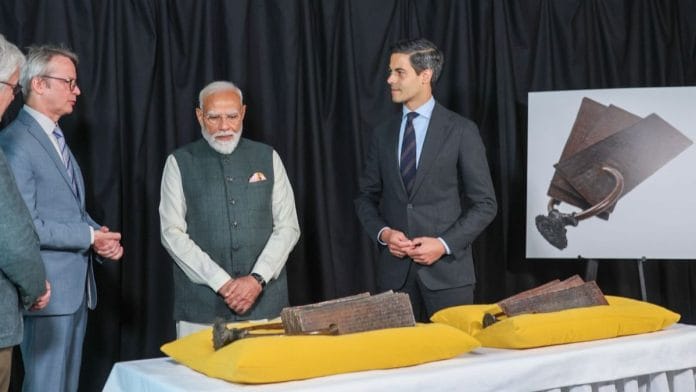


The Dutch government on 16 May formally returned to India a set of 24 copper plates that had spent the past three centuries in Leiden, a city in the western Netherlands. The handover ceremony took place in The Hague.
I was among the historians consulted by the Netherlands’ Colonial Collections Committee as it assembled its provenance report (one name among many, and far from the most important). The coverage of these objects has described them as “Chola Plates”, symbols of a vanished imperial glory and of cultural restitution.
But the Leiden Plates are much more: over their 1,000-year history, they were conduits for the many entanglements of the Indian Ocean World. Their story is of Buddhism and Shaivism, imperialism and colonialism; warfare, famine and cosmopolitanism.
Tides of medieval diplomacy
Throughout India’s early medieval period (c. 400–1100 CE), copper-plate inscriptions were issued by courts across the subcontinent, recording the granting of land to a religious institution or a Brahmin agraharam. Chola plates were issued for similar purposes but were exceptional in scale: typically several hundred acres at a time, gifted across the lush Kaveri delta, with eulogistic Sanskrit prefaces, and detailed Tamil sections outlining the terms of the gift. Typical recipients were agamic Shaivite temples and Vedic Brahmins.
Within this tradition, the Leiden Plates are exceptional for many reasons. For one, they sketch out the relationship of three separate institutions: the Chola court, a Buddhist complex at Nagapattinam port, and the court of the kings of Kedah. The Larger Leiden Plates are dated to the twenty-first regnal year (1006 CE) of Rajaraja I, whose imperial campaigns had carried his armies from the Krishna-Godavari delta to Polonnaruwa in present-day Sri Lanka.
The Sanskrit preface, added in 1019 during the reign of Rajendra Chola I, confirmed and recorded this gift made by his then-late father: the revenues of Anaimangalam village were granted to a Buddhist monastery called the Chudamani-Vihara, “of [such] high loftiness [as had] belittled the Golden Mountain [Meru]”.
The Chudamani-Vihara was named for Chudamani-Varman, the late king of the Malay port of Kedah. It had been paid for by his son, Mara-Vijayottunga-Varman, the then-king. The Tamil section then relates an order, not to any Chola official, but to the nadu assembly — the chief landholders of the region, organised as a collective — ordering them to enforce the grant as tax-free. Annually, 8,943 measures of paddy were transferred to the Chudamani-Vihara, a gift of several tonnes.
Rajendra’s renewal of the gift in 1019 may be significant, especially when read with other Nagapattinam inscriptions. According to professors Noboru Karashima and Y Subbarayulu, who provided a reassessment of the gift with other scholars in Nagapattinam to Suvarnadwipa (2009), Mara-Vijayottunga-Varman of Kedah had made a series of reciprocal gifts at the temple to Shiva Kayarohanasvami in Nagapattinam. Acting through Tamil agents from various ports, he donated a temple gateway, ornaments affixed with Mara-Vijayottunga’s makara emblem, and Chinese gold for the feeding of Ardhanarishvara, the Lord Who is Half Woman, and Brahmins.
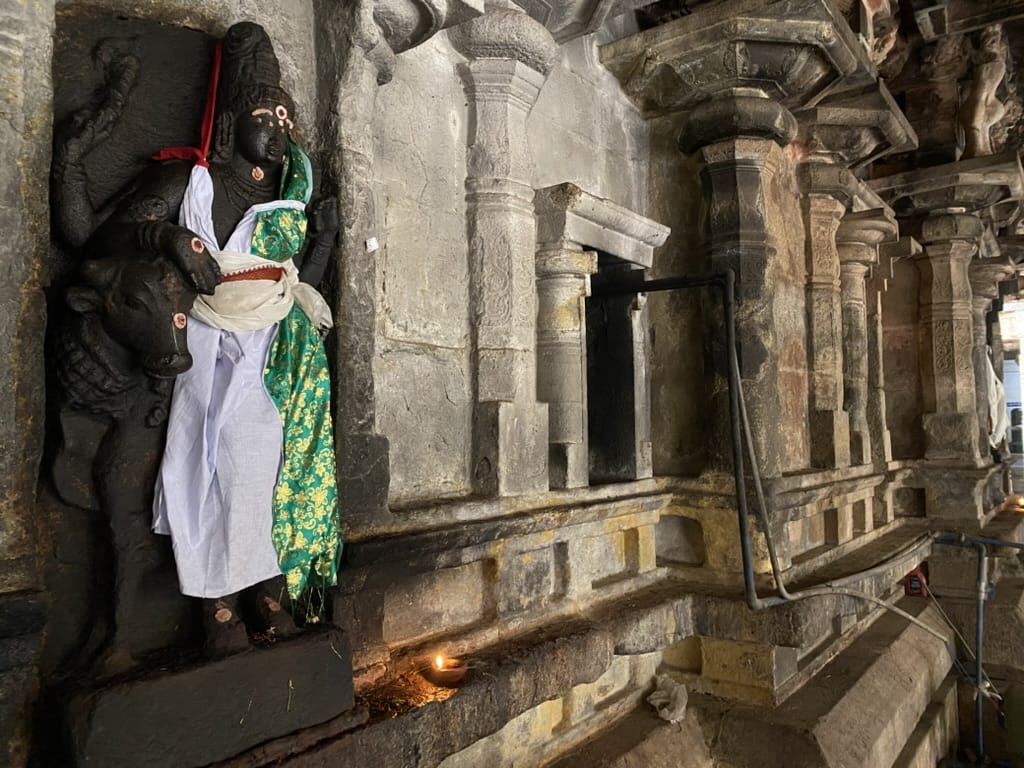
Which is to say: the donors were agents of the same ruler who was funding the Buddhist monastery across town; simultaneously, the divinity who received the Chinese gold was Shiva. And significantly, the last gift to the Shiva temple happened in 1019, the very same year Rajendra I confirmed his father’s grants to the Chudamani-Vihara. This, then, was ‘temple diplomacy’ as several historians have dubbed it: gifts made to religious institutions as part of larger diplomatic exchanges and positionings in the Indian Ocean. Nagapattinam was a rich and diverse port through which merchants of many lands passed: gifts of this sort presented both the Chola and the Kedah king as devout and benevolent rulers.
Thereafter, there is a gap of several decades in the Chudamani-Vihara inscriptions, until the Smaller Leiden Plates were issued in 1090. Quite a lot happened in those decades. Despite the amicable picture of the Larger Leiden Plates, Chola-Kedah relations soon deteriorated. In 1025-26, Rajendra I ordered an unprecedented overseas attack on Kedah, and possibly other nearby settlements. Various Chola inscriptions claim Mara-Vijayottunga-Varman was captured with his elephants and Kedah’s bejewelled gates. Rajendra Chola’s son, Vira-Rajendra, claimed to have undertaken a regime change in Kedah in 1070. In the wake of these attacks, an inscription from 1088 confirms that Tamil merchants set up autonomous colonies in Sumatra to extract valuable forest resins.
Meanwhile, there was a sea-change in Chola policy, with Rajendra’s grandson, Kulottunga I, effectively abandoning the court’s distant provinces to focus on economic reform at home. In 1090, apparently seeking to normalise relations, two senior aristocrats (sri-samantan) arrived from Kedah. They petitioned Kulottunga to dissolve the rights of all cultivators in several villages (not just Anaimangalam) that had been gifted to the temple. Evidently, as scholar Gokul Seshadri argues in Nagapattinam to Suvarnadwipa, the Chola court had allowed the grant to lapse during the tense decades.
Issuing the Smaller Leiden Plates, this time in Tamil, Kulottunga returned the revenue rights to the monastery. By then, two sub-shrines at the Buddhist complex, both built by an unknown Kedah king, bore the names of Rajaraja and Rajendra (Rajaraja-Chola and Rajendra-Chola-Perumpalli). They shared the sacred compound with the Vihara of the late Chudamani-Varman, whose son had been attacked in 1025–26.
Also read: Sabarimala god Ayyappa has many meanings. One of his forms is a deity for women
Nagapattinam’s Buddhist history
That quality of entanglement, the “mixing up of things and people” — was characteristic of Nagapattinam and other premodern Indian Ocean cities. It was not just courts but also merchants, goldsmiths, monks and grammarians (and everyone and everything in between) that jumbled together in ports like this.
Consider, for example, the great medieval merchant corporation known as the Ainurruvar, the Five Hundred Lords of the Eighteen Countries and the Thousand Directions. Historian Risha Lee, in her 2013 PhD thesis “Constructing Community: Tamil Merchant Temples in India and China, 850–1281”, shows that the Five Hundred Lords donated prolifically to Shiva temples: bronzes, structural additions, self-imposed levies on their own trade, and precious goods.
E Edwards McKinnon, in “Mediaeval Tamil Involvement in Northern Sumatra”, traces the same guild network sourcing camphor and gold from northern Sumatra — the resin wealth that funded their gifts on both sides of the Bay of Bengal. Their settlements have yielded archaeological remains of Buddhist, Shaivite and Vaishnavite temples.
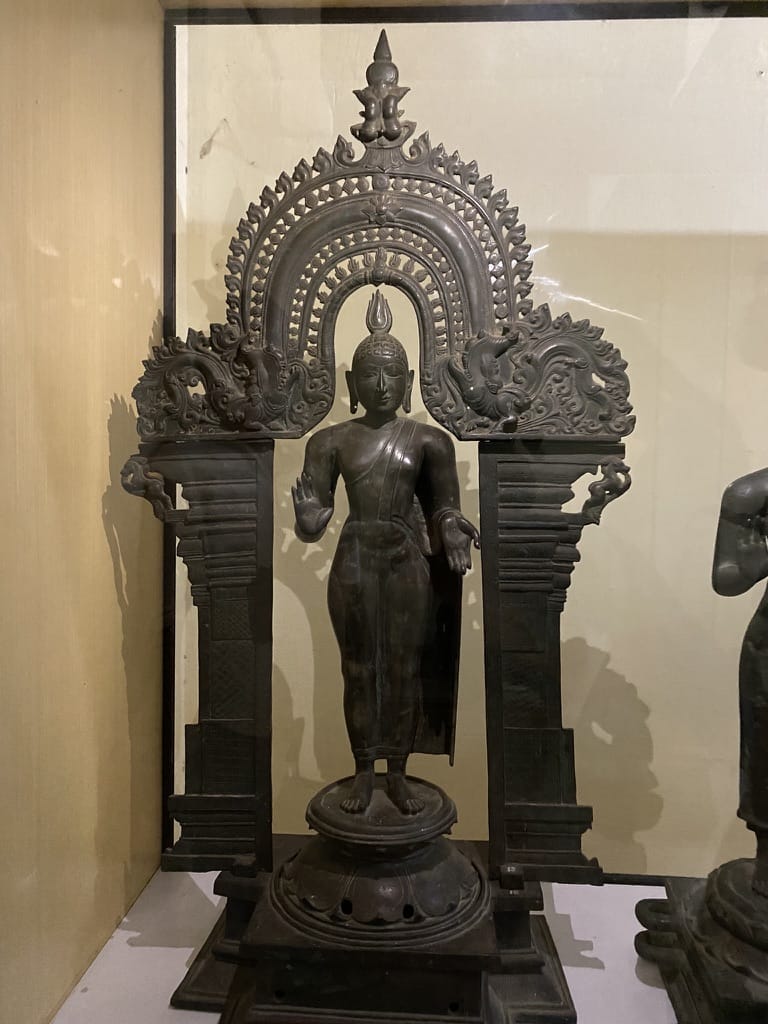
In Nagapattinam, historian A Meenakshisundararajan (Nagapattinam to Suvarnadwipa) makes note of a 12th-century bronze processional Buddha from the collection of the American Rockefeller dynasty. It was originally gifted by a group of metalworkers to a shrine named after them, in the Rajendra-Chola-Perumpalli monastery complex. The inscription mentions that the Buddha was sacred to those of the Eighteen Countries — likely the Ainurruvar.
Was there some connection between the gold obtained by the Ainurruvar in Sumatra, their Buddhist temples there, and this Buddhist gift in Nagapattinam? It’s impossible to say. However, as archaeologist Himanshu Prabha Ray writes in her paper “Nagapattinam Bronzes in Context”, hundreds of Buddhas were gifted to this monastic-temple complex over the centuries — mostly by craftsmen, traders, and mobile communities, rather than royals.
Indian Ocean entanglements were not limited to patrons and patronage, but also to ideas and faiths. Tamil Buddhists and Shaivites both paraded their sacred images through the streets in ceremonial procession and offered bronze, fine jewels, food, and aromatics. Indeed, in the 12th century, Tamil Buddhism seemed to be booming. As historian Anne Monius writes in Imagining a Place for Buddhism, the Viracholiyam, a Buddhist grammar presented to a Chola king, cites now-lost Tamil Buddhist texts such as the Bimbisara-Kathai, Tiruppatikam, and Kundalakesi — evidently produced by a thriving literary scene.
Meanwhile, Buddhist monks writing in Pali at the time were calling themselves Choliya or Damila (Tamil) — claiming the Chola homeland and Tamil identity as their own. Yet at the same time, Shaiva literature, such as the Periya-Puranam, describes Buddhist monks, humiliated by earlier Shaiva saints, humbly converting to Shaivism. The Buddhist world of the Leiden Plates record was thriving and contested at once. Contemporary notions such as “royal tolerance”, “Sanatana Dharma” or “secularism” all fall short of describing this richness.
The Tamil Buddhist tradition was far older than the plates, but the plates ultimately recorded a moment of brilliance before the downfall. As Leiden University professors Lennart Bes and Tristan Mostert note in the Netherlands’ Colonial Collections Committee dossier, the Leiden Plates — along with the hundreds of bronzes in the Nagapattinam monastery — were buried at some point before the 1600s.
When did this happen? Was it in the 1200s, when the Pandyas and Hoysalas launched attacks that destabilised Chola power and exacerbated famines in the region? Was it linked to shrinking global trade at the time, which must have hit merchant patrons hard? Was it in the 1300s, when the Delhi Sultanate’s raiders sacked major complexes like Srirangam and the Madurai Meenakshi? Or was it in the 1500s, when Vijayanagara inscriptions mention troubled grants to Buddhist and Jain institutions in South India?
Either way, it seems, without the reliable royal patronage, extensive landholdings, and political value of the Hindu temple complexes, no returning Buddhists re-established the Nagapattinam complex after the burial of the plates and bronzes. Aside from the ancient Manimekalai and the medieval Viracholiyam grammar, little of Tamil Buddhism survived the upheavals of centuries.
Also read: Pallavas to Mughals—a history of hero worship in medieval India
Nagapattinam to Leiden
The Dutch East India Company (VOC) captured Nagapattinam from the Portuguese in 1658 and shifted its Coromandel headquarters there in 1690. Contracted weavers in the Kaveri delta and the Andhra coast produced the painted Kalamkari cottons that became “Coromandel chintzes” in fashionable European costumes and drawing-rooms. The Dutch also traded in Gujarati ikat textiles, exchanging them for spices in factories they operated in island Southeast Asia. It is because of this exchange that so many heritage Indian textiles survive in Indonesia as heirlooms passed down family-to-family. In fact, at least as many textiles from this period survive in Southeast Asia as in India today.
In addition to trading in textiles and spices, though, the VOC also trafficked people: a history that has found absolutely no space in Indian media coverage. In his paper “The World’s Oldest Trade”, historian Markus Vink documents the famine-slave cycle: military devastation or drought collapses the food supply; families cannot feed their children; intermediaries arrive with cash. To be clear, the VOC did not run this system alone. In fact, Vink’s reading of the evidence suggests the Dutch were comparatively minor players in the slave trade compared to Asian traders.
And the political instability that fed all this — raids by the Bijapur Sultanate, often led by Maratha generals; the wars of various Telugu Nayakas; the newly-established Maratha state in Thanjavur; expanding Mughal power — were all masterminded by Indian powers and Indian warriors, who disrupted cultivation, looted indiscriminately, and damaged irrigation works.
In 1688, as the VOC constructed Fort Vijf Sinnen at Nagapattinam, the Leiden Plates and other precious artefacts from the now-lost monastery were picked up by European antiquities enthusiasts. As European power advanced, so did the value of ancient artefacts from conquered territories. Florentius Camper — a Dutch pastor stationed in Batavia, the VOC’s colonial capital in Java — brought the plates to the Netherlands in 1712, likely having acquired them in Nagapattinam.
Around the same time, Vink, citing VOC accounts from the old Chola capital of Thanjavur, mentions that thousands of people — predominantly children — were exported from Nagapattinam to Aceh, Johor, and other markets. The same port, in the same decade, shipped cloth, people, and spices. Enslaved people were as much a feature of premodern Indian Ocean ports as cosmopolitanism.
Camper’s descendants donated the plates to Leiden University in 1862. By then, the Coromandel Coast had already changed hands several times, ending up in British hands after the Carnatic Wars. Five years later, French Jesuits, with the approval of a British governor-general, demolished a “Chinese pagoda” that was the last structural remnant of the great medieval Buddhist complex at Nagapattinam.
Also read: History of Indians in the Arab world—port builders, Jat governor, translators, and slaves
Restitution and responsibility
In 2026, the Leiden Plates are being unconditionally returned to the Archaeological Survey of India, which will determine whether and where they will be exhibited. It is worth pausing on that sentence.
The Chudamani-Vihara and Rajendra-Chola-Perumpalli, endowed by the plates, no longer exist. The Tamil Buddhist community whose history the plates record has no heir in Nagapattinam. The ASI holds them by default, not by any logic of continuity. As ThePrint’s report from December 2024 documents, many repatriated objects end up in the ASI’s Central Antiquity Collection at Purana Qila — secured from public view.
When Zohran Mamdani, the mayor of New York, recently said he would ask King Charles to return the Koh-i-Noor, the question that followed was immediate: Return it to whom? The Leiden Plates raise the same question.
A seated Buddha image, repatriated from Australia in 2017, now sits outside the director general’s office at the National Museum in Delhi. The Pathur Nataraja, returned from Britain in 1991, has not been seen since. Other Chola bronzes have featured at prestigious G20 exhibitions. However, regional museums, which were originally home to the artefacts, are in a woeful state. When I visited Nagapattinam for fieldwork in 2025, the museum had been demolished, and nobody could tell me when or if it would be rebuilt, or if it had moved. The picture is similarly woeful at Madurai and Visakhapatnam, both crucial nodes in Indian Ocean history. The Nagapattinam Buddha bronzes are mostly in the Government Museum in Chennai, but like most of the museum’s treasures, they have little more than a small information card to communicate with curious visitors.
The repatriation of Indian artefacts seems to involve two tracks. Invariably, there is a media circus giving the credit to muscular foreign policy and the Prime Minister. But we would know little about medieval Nagapattinam if not for Karashima and Subbarayalu’s work on its inscriptions, Ray on its bronzes, McKinnon on its guild networks, Monius on its literary culture, and many others.
Public historians and history communicators have a part to play in this process too, though a smaller one: responsibly contextualising what the evidence shows, and what it does not. The Netherlands Colonial Restitutions Committee extended its thanks to both academics and public historians. PM Modi did not. The past decade under his government has seen a dangerous erosion of evidence-based histories in India, owing to an ongoing neglect of both public universities and museums, as well as direct support of propagandistic, polemical narratives.
In an ideal world, the Leiden Plates would return to the centrepiece of a world-class maritime museum at Nagapattinam — with programming in all Indian languages; the plates reunited with the Shaiva bronzes from the same port, with Tamil Buddhist bronzes now scattered across Chennai, London, Kolkata, and New York; the temple wall inscriptions recording the Kedah agents’ donations to Shiva and Buddha alike; and loans of Tamil-origin artefacts from Southeast Asia.
The Dutch history of the Coromandel Coast would also be explored with archival records, loaned textiles, and VOC prints scattered across Indian museum collections.
The return of such priceless artefacts should provoke new investigative projects, international scholarly grants, and centres of excellence to communicate scholarly knowledge to citizens. One can only hope the Leiden Plates will not suffer political misappropriation and institutional lethargy, as so many other repatriated treasures have.
Anirudh Kanisetti is a public historian. He is the author of ‘Lords of Earth and Sea: A History of the Chola Empire’, and the award-winning ‘Lords of the Deccan’. He hosts the Echoes of India and Yuddha podcasts. He tweets @AKanisetti and is on Instagram @anirbuddha.
Views are personal.
(Edited by Saptak Datta)