



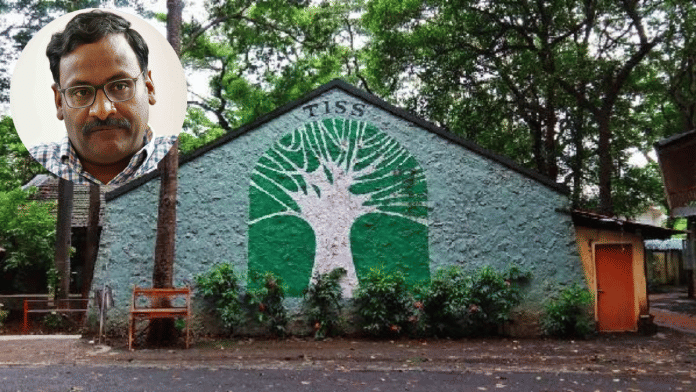

New Delhi: After spending a month in jail, former Tata Institute of Social Sciences (TISS) student Abhirup Paul got bail from a Mumbai magistrate court in the case related to a memorial event held for late Delhi University professor G.N.Saibaba.
On Thursday, the court stressed that the investigation was already ongoing for a considerable period without producing substantive evidence and that the allegations of commemorating Saibaba’s death anniversary and raising slogans could not, by themselves, constitute an offence.
It further noted that the books recovered from his devices were not banned and could be read for academic knowledge.
The magistrate reasoned that granting bail to the postgraduate student was necessary to safeguard his career, especially when the investigation had produced no incriminating material beyond suspicion. Continued custody in such circumstances would be unjust, Additional Chief Judicial Magistrate (ACJM) Dattatray Shankarrao Khedekar said.
The case
The controversy stems from an event held in October 2025 at TISS, where students commemorated the death anniversary of Saibaba, a former professor and supporter of Naxalite and Maoist organisations.
In the gathering, slogans such as ‘Rest in Power G.N. Saibaba’ and demands for the release of student-activists Umar Khalid and Sharjeel Imam, both facing trial under charges under the Unlawful Activities (Prevention) Act, were allegedly raised.
The FIR accused nine students invoking multiple provisions of the Bharatiya Nyaya Sanhita (BNS) relating to unlawful assembly, provocation to riot, obstruction of authority along with charges under the Maharashtra Police Act for violating police directions.
Paul was granted interim protection by the Sessions Court in October 2025. But, his anticipatory bail was rejected in August, leading to his arrest.
The sessions court had rejected the anticipatory bail on the reasoning that Paul’s conduct suggested ideological leanings towards banned organisations.
It noted that instead of the customary phrase ‘Rest in Peace’, the accused used ‘Rest in Power (1967–Forever)’ during the homage to Saibaba, which, when coupled with the recovery of Maoist literature and deleted files raised doubts about their intent. The court pointed to the alleged slogans demanding release of Umar Khalid and Sharjeel Imam and stressed that such slogans voiced within an academic institution were inappropriate.
In the court of ACJM, the prosecution opposed Paul’s bail, alleging that the event was a pre-planned conspiracy to disrupt law and order and create ideological rifts among the students and that he was an active supporter of Maoist ideology and would continue to promote it if released.
Further, it was argued that PDFs of Maoist literature written by active members of banned organisations, including the Purba Banglar Maoist Party in Bangladesh, were recovered from his devices. This, the prosecution argued, suggested cross-border ideological links and a larger organised network.
His activities were not limited to academic reading but amounted to direct contact with disgruntled local elements under the guise of coursework and fieldwork, which could instigate communities and disrupt public peace, they submitted.
Court’s reasoning
While allowing bail, the magistrate stressed that a substantial period of investigation (10 months) had lapsed without yielding any incriminating material to justify his continued custody and that Paul’s case stood on the same footing as another student, who was earlier granted relief by the High Court.
Quoting the HC’s reasoning, the order noted that while mobile phones and laptops contained downloaded books and materials, the mere possession of such literature or participation in a memorial event with slogans did not, prima facie, constitute any offence.
“The allegations against the accused as per FIR is prima facie of conducting activity of commemoration of death anniversary and slogan and during investigation,” it said. “It appears that the investigating officer has made suspicious activities of the accused by connecting with the nation and made suspicion the possibility of creating hatred in the community and in the society.”
Investigation was undertaken and prima facie there was no incriminating material, the magistrate said.
“Participation in the activity of commemoration and the uttering slogans along with the investigation carried out by the investigating officer prima facie does not find supporting material that the accused has got benefit of social network…,” it added
Emphasising that books which were not banned could be read for academic knowledge, the court said that such literature and the allegations were not showing incriminating material for connecting with the Maoists.
“…the student is bound to get updated knowledge by reading books and downloading books and collecting material as per the curriculum of the institute for updating knowledge does not amount to activity against the nation and the connection of accused cannot be joined with the alleged Naxal movement and the mindset of Maoist,” ACJM Khedekar said.
Alfreza Ahmed is an alum of ThePrint School of Journalism, currently interning with ThePrint.
(Edited by Tony Rai)
Also Read: Indus Waters Treaty & Hague ruling: The tussle over India’s ‘abeyance’ decision explained