





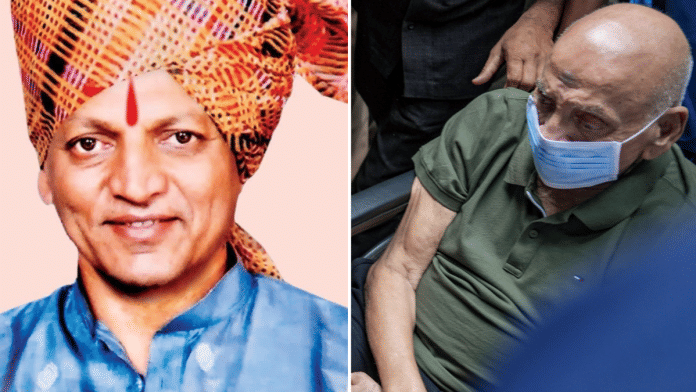


Mumbai: Ending a trial that lasted 15 years, a special CBI court Saturday acquitted former Maharashtra home minister Padamsinh Patil and seven others in the 2006 murders of Congress leader Pawanraje Nimbalkar and his driver.
Special CBI judge Satyanarayan R. Navandar acquitted all eight accused of charges including murder and criminal conspiracy under the erstwhile Indian Penal Code, along with offences under the Arms Act, after holding that the prosecution failed to establish its case beyond reasonable doubt.
Patil, the brother of Deputy Chief Minister Sunetra Pawar and a cousin of Nimbalkar, was the prime accused. The 86-year-old was brought to court in an ambulance.
A decade ago, on 3 June 2006, two gunmen intercepted Pawanraje and his driver Samad Kazi near Kalamboli in Navi Mumbai and shot them dead inside their vehicle.
The Central Bureau of Investigation (CBI) had alleged that Patil, once among the most powerful politicians in Osmanabad, now Dharashiv, arranged the contract killing following an escalating political and business rivalry.
But, the court rejected the testimony of Parasmal Jain, an accused who was granted a pardon and became an approver, after examining 127 witnesses. Twenty-nine of the total 128 prosecution witnesses turned hostile over the years.
Judge Navandar found Jain’s account unreliable, noting that he repeatedly changed his version during the trial. The court also expressed doubts over the statement Jain allegedly made while in illegal custody and under torture in 2009.
While the evidence indicated that political enmity developed between Patil and Nimbalkar after 2002, the court found crucial gaps in the prosecution’s reconstruction of the conspiracy.
It also held that the Central Bureau of Investigation (CBI) had not proved that the vehicle it seized was the one used by the assailants or that Jain telephoned Nimbalkar from a public call office and lured him to a meeting on the pretext of a land transaction.
The court left Jain’s position as an approver to be decided depending on whether the prosecution initiates further proceedings against him.
The verdict comes amid speculation that Pawanraje’s son Om Raje Nimbalkar is among the Shiv Sena (UBT) MPs being courted by Eknath Shinde’s Shiv Sena under its purported ‘Operation Tiger’.
Reports this week had linked Om Raje’s possible switch to the outcome of his father’s murder case. Following the verdict, Om Raje told ANI that he will make a final decision on his political future in the next two days. “I will clarify my political stance after consulting with the public. Regardless of my political decision, I have never spoken—nor will I ever speak—against Uddhav and Aaditya Thackeray,” he said.
#WATCH | Kolhapur: On CBI court acquitting all acccused in 2006 double murder case of Pawanraje Nimbalkar and his driver Samad Kazi, Maharashtra Deputy CM Eknath Shinde says, "…All accused have been acquitted. This is a highly unfortunate incident…CM Fadnavis and I have… pic.twitter.com/wUV2GorT3M
— ANI (@ANI) June 20, 2026
On his part, Shinde described the acquittal as “very unfortunate”. “All accused have been acquitted by the CBI court. This is a very unfortunate incident because Pawanraje Nimbalkar ji and one more person with him, were killed in broad daylight and this was a very serious crime. His family and other people believed that the accused in the case will be charged. But unfortunately, the CBI court has acquitted all accused,” he told ANI.
Shinde added that the acquittals would be contested in the Bombay High Court.
Later, Om Raje told ANI that he would be approaching the High Court after reading the full text of the verdict. “If all the accused are being acquitted, then the question of who actually killed Pawanraje Nimbalkar still confronts my family.”
Following the acquittal, Patil’s lawyer Bhushan Mahadik told reporters that Om Raje made several stay order requests in court for his political gains. “For about three and a half years, Om Raje’s family made many applications to the court and stayed the matter. He even went to the Supreme Court and asked for the trial to be heard in Uttar Pradesh and Bihar. A year later, he asked for the matter to be heard in Bombay,” he said.
The lawyer also alleged that former IPS officer Rakesh Maria, the then Joint Commissioner (Crime) of Police, Mumbai, “cooked up Jain” and got him ready to be handed over to the CBI.
The court, however, found Jain’s statements contradictory, Mahadik told reporters.
Also Read: Mumbai heat has turned Versova beach into a bedroom. Who is sleeping there?
The two-decade journey
The case had its roots in the deteriorating relationship between Padamsinh Patil and his cousin Pawanraje Nimbalkar, who had once worked within the same political and cooperative network in Osmanabad.
Pawanraje was among Patil’s closest associates and managed much of his political organisation in the district. Patil served as Maharashtra’s irrigation, home, energy and excise minister at different points between 1978 and 2004. Pawanraje later became chairman of the Osmanabad District Central Cooperative Bank and began building an independent political base.
Their ties started souring around 2002 amid disputes involving the cooperative bank and institutions such as the Terna Sugar Factory. In 2003, Pawanraje sought police protection after an incident at a board meeting, indicating the hostility between the two sides.
The rift became public in the 2004 Maharashtra elections, when Pawanraje contested as an Independent against Patil from Osmanabad. Patil retained the seat by just 484 votes, establishing Pawanraje as a serious challenger to his dominance.
Nearly two years on, Pawanraje and his driver were killed when they were en route to Osmanabad from Mumbai.
The Kalamboli police initially investigated the case before it was transferred to the Navi Mumbai Crime Branch in March 2008. Acting on a petition by Pawanraje’s widow Anandibai, the Bombay High Court transferred the investigation to the CBI in October 2008.
The CBI alleged that Patil, businessman Satish Mandade and former corporator Mohan Shukla conspired to eliminate Pawanraje. A Rs 30-lakh contract was offered to Parasmal Jain to arrange the killing, recruit shooters and procure a vehicle and weapons, it alleged.
The CBI arrested Patil on 6 June 2009, shortly after his election to the Lok Sabha, and named him as the principal conspirator in its chargesheet. He was granted bail in September that year.
The trial began in July 2011 and was transferred from Alibaug to Mumbai by the Supreme Court in November 2012. The court examined 128 witnesses, including Anandibai, Om Raje, and social activist Anna Hazare.
Patil’s political legacy
A doctor by training, Padamsinh Patil represented Osmanabad in the Maharashtra Assembly continuously from 1978 to 2009.
In his three-plus decades of state politics, he served as energy and excise minister (1978 to 1980), deputy speaker (1986 to 1988), water resources minister (1988 to 1994), and home and ex-servicemen welfare minister (1994 to 1995). Between 1995 and 1999, he was the deputy leader of the opposition.
After the Congress-Nationalist Congress Party (NCP) coalition came to power, Patil returned to the Cabinet, handling energy and water resources (1999 to 2002) and water resources (2002 to 2004). His influence also rested on cooperative bodies, educational institutions and the Terna Public Charitable Trust, which operates educational and medical establishments.
Patil’s rise was closely linked to Sharad Pawar. He was considered one of Pawar’s most trusted lieutenants and followed him through the Congress’ political realignments before joining the NCP in 1999.
The closeness eventually led to a family relationship, as Patil’s sister Sunetra and Pawar’s nephew Ajit Pawar got married in 1985.
But the ties between Sharad Pawar and Patil later deteriorated amid corruption allegations linked to the Osmanabad cooperative bank and worsened after Patil’s arrest in the murder case. The NCP suspended him in 2009.
Patil moved to national politics that year and served as Osmanabad MP until May 2014. He then withdrew from active electoral politics in 2014.
Patil’s son Ranajagjitsinha entered politics as a Maharashtra Legislative Council member in 2004 and later served as a minister of state. Elected as Osmanabad MLA in 2014, he left the NCP and joined the Bharatiya Janata Party in 2019. He won the Tuljapur seat twice, in 2019 and 2024. His wife, Archana Patil, contested the 2024 Osmanabad Lok Sabha election on an NCP ticket but lost to Om Raje.
Pawanraje’s rise
Initially regarded as Patil’s local organiser and political manager, Pawanraje rose to become chairman of the Osmanabad District Central Cooperative Bank.
Over time, he built a separate support base. Pawanraje Mitra Mandals emerged across villages, and his accessibility among local workers and farmers helped him challenge Patil’s authority. The 2004 Assembly elections saw an open struggle for political control.
The CBI alleged that Pawanraje’s electoral rise, his opposition to the Terna Sugar Factory management and his knowledge of alleged financial irregularities formed the motive for his killing.
Pawanraje’s killing brought his son Omprakash, popularly known as Om Raje, into active politics at the age of 22. He initially organised Shiv Sena workers and local-body campaigns before contesting from Osmanabad in 2009. He went on to serve as an MLA until 2014.
He lost the 2014 Assembly election to Ranajagjitsinha Patil but defeated him in the 2019 Lok Sabha election from Osmanabad. He remained with Uddhav Thackeray after the Shiv Sena split in 2022 and won a second Lok Sabha term in 2024, defeating Archana Patil.
The two political families now stand on opposite sides of Maharashtra’s fractured party system: Padamsinh’s son Ranajagjitsinha is with the BJP and his daughter-in-law Archana with the Ajit Pawar-led NCP, while Pawanraje’s son Om Raje was elected on a Shiv Sena (UBT) ticket.
The acquittal closes the trial-court chapter of a case that shaped politics in Dharashiv for two decades. But with the Nimbalkar family preparing an appeal and Om Raje’s political future under intense scrutiny, the case’s legal and political afterlife is far from over.
(Edited by Tony Rai)
Also Read: The many lives of Air India building, crowning jewel of Mumbai’s skyline that survived 1993 blasts