



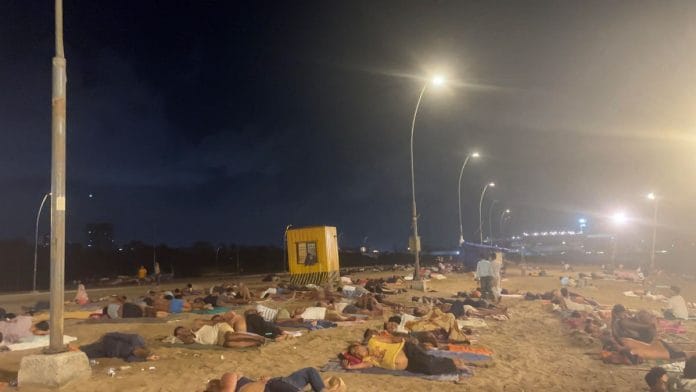
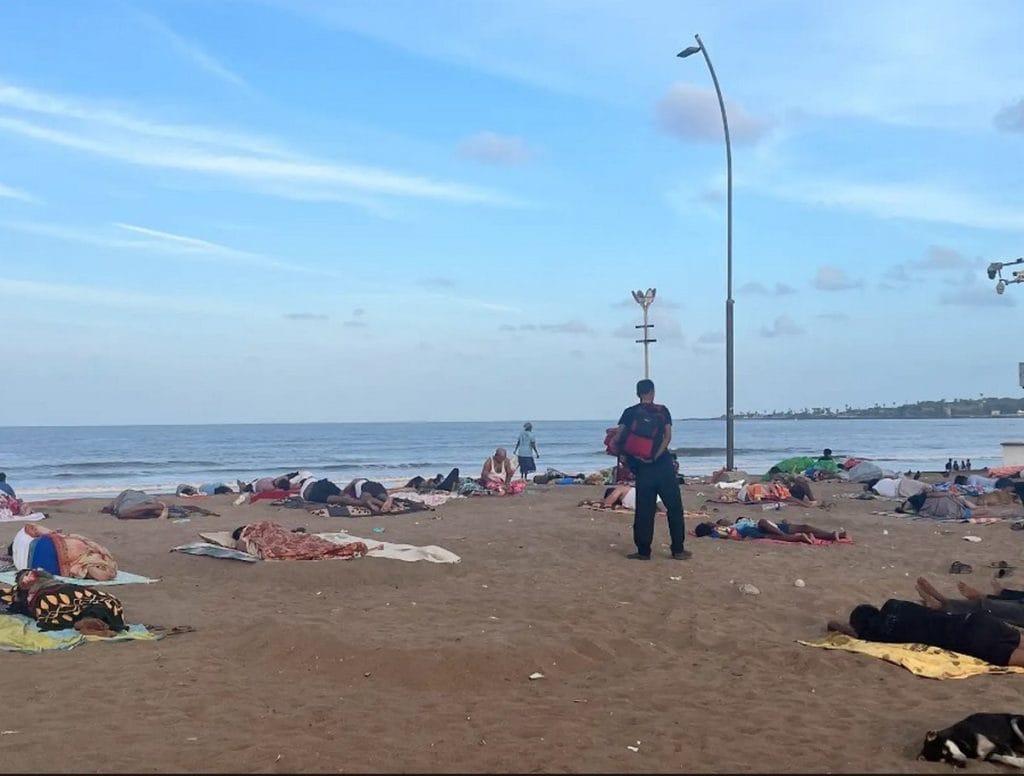
Mumbai: By 11 pm, after the last rotis have been eaten and utensils washed in the cramped lanes behind Versova, families begin walking towards the beach. Men step out in sleeveless vests and shorts, women in nightgowns, children rubbing sleep from their eyes, infants balanced on hips.
Some carry woven floor mats, others old rugs and thin bedsheets. They spread them across the sand, close enough to feel the sea breeze, but far enough from the water, and settle in for the night under the open sky.
But this simple act of sleeping outdoors has now turned Versova beach into the site of a class war, dragging in the old anxieties over migration and who deserves access to Mumbai’s public spaces.
“If you don’t have space to live then please leave Mumbai,” said an X post that went viral last week. Comparatively affluent residents have since shared photos of people sleeping on the beach, complaining about “encroachment” and “Biharification” on X and Instagram, with a few tagging the Chief Minister to “take action”.
“Versova beach is out of reach for people as all crowd from Sagar Kutir loiter around,” complained one post on X, referring to the nearby government-notified slum.
But these ‘outsiders’ of Sagar Kutir are part of the very engine running Mumbai: the dabbawalas delivering lunches to South Bombay offices, the auto drivers navigating the morning rush, the domestic workers scrubbing the airy apartments overlooking the shore.
People think we are coming to the beach for enjoyment. This is not a picnic. This is the only way we get some air. The heat does not leave even at night. We keep sweating till morning. How can anyone sleep like that? How do I let my school-going children sleep like this?”
— Sadashiv Patil, auto-rickshaw driver and Sagar Kutir resident
For them, the beach is not leisure, but a necessary respite from the crushing Mumbai heat. Some in the city can keep multiple ACs running day and night. Others carry a mat to the shore and hope the breeze lasts till morning.
“We come to the beach at night because here we can sleep for a few hours without sweating constantly,” said Surekha Bacche, who cleans air-conditioned homes in and around Seven Bungalows by day and returns at night to her own home in Sagar Kutir next to Versova beach in Mumbai’s northwestern suburbs. She doesn’t even have an exhaust fan in the kitchen.
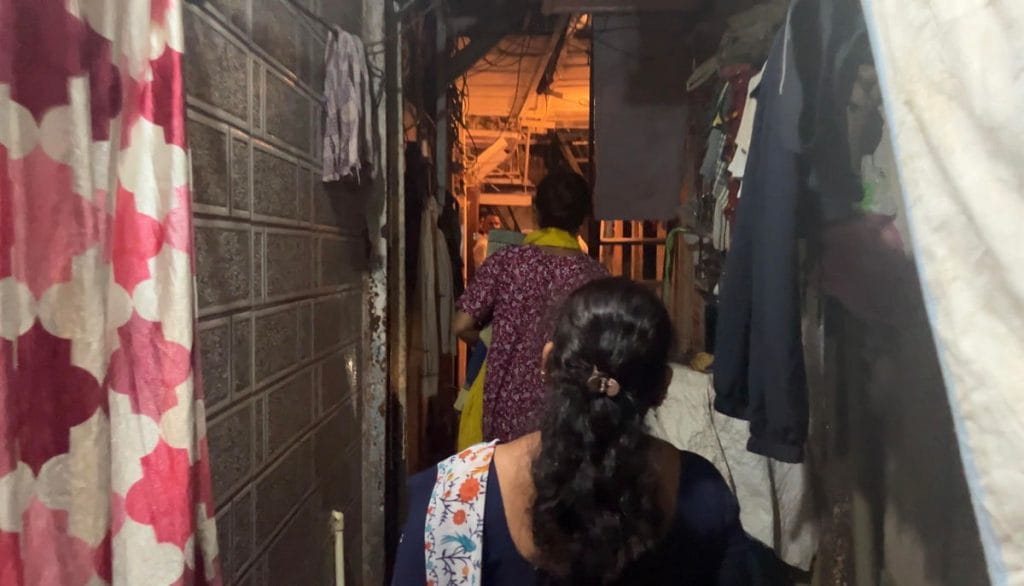
At Sagar Kutir Sangh, 150-sq-ft homes are packed with entire families, tin roofs, narrow windows, little ventilation and no air-conditioning. When the heat spikes, these rooms turn into suffocating furnaces.
This year, weak monsoon winds and a developing El Niño — a warming of Pacific Ocean waters that can disrupt rainfall patterns — have left Maharashtra waiting, trapping the city in weeks of sticky pre-monsoon weather. As Delhi saw last month, nights can become the worst part of a heat spell. Cramped, badly ventilated homes, especially, do not cool down after sunset.
Babloo Mandel, a 26-year-old martial arts trainer with a black belt in karate, also blames the heat on the loss of mangroves along Versova beach, cleared for the Coastal Road project’s northern extension connecting Versova and Bhayander.
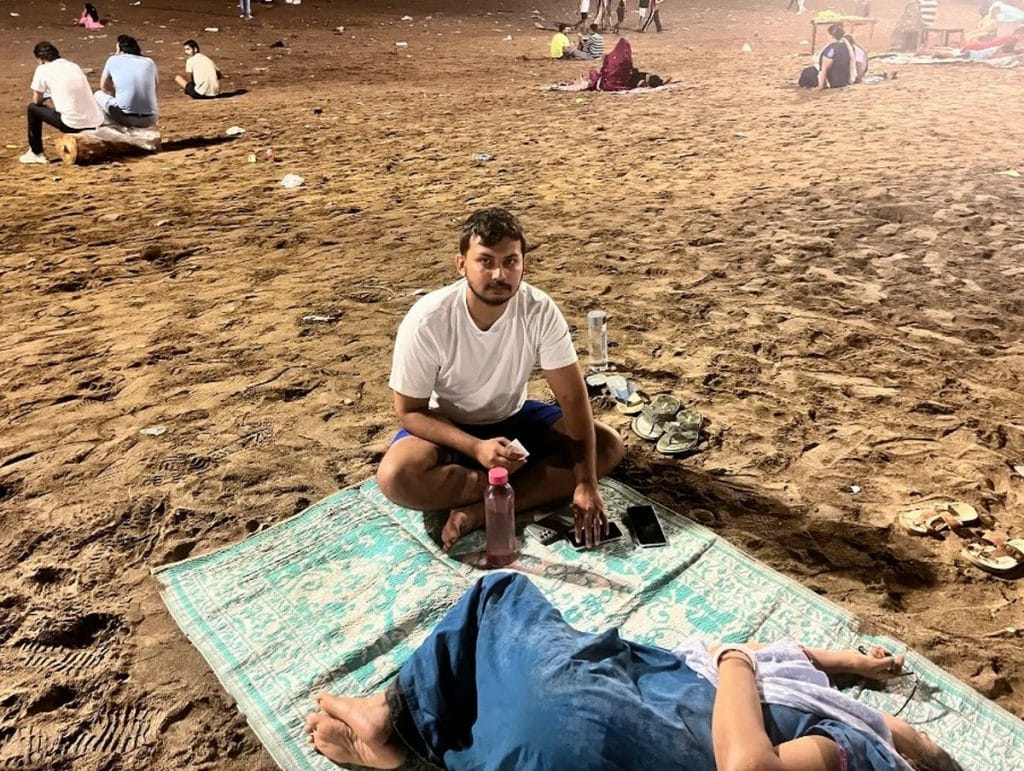
“These logs you see along the coast are from the mangroves they cut before they began work on the Coastal Road project. These trees provided some cooling and shelter for us. Our homes are barely 100 metres away from the sea. These mangroves also prevented flooding and water entering our homes. All we are left with is humidity and sweat,” said Mandel, who had come to sleep at the beach with his family.
“I was born in Mumbai but my father came here with his parents from Bihar in the late 80s. My father is an autorickshaw driver who works long hours. Like almost all the people sleeping here, my father needs a peaceful 6-7 hours of sleep without suffocation and constant sweating,” Mandel said.
Also Read: Bihar hasn’t created new cities in over half a century. Patna overloaded
Dabbawalas by day, beach sleepers by night
Mumbai’s dabbawalas are an over-century-old Mumbai institution, ferrying home-cooked meals from homes to offices across the city. Darting from local train to local train in their white uniforms and Gandhi caps, they are famous for their “Six Sigma” delivery accuracy. But dabbawalas get tired too. In Sagar Kutir, they just want a few hours of rest before the next day’s race begins.
Mauli Mohan, 46, works as a dabbawalla during the day. At night, he sits on a red-and-white woven plastic mat on Versova beach, not in his uniform but in an old yellow T-shirt and black shorts covered in sand.
In the mornings, while collecting the dabbas in Dadar, I wait at the doorsteps. Sometimes I look into their living rooms. The ACs are on, and the ceiling fans are on full speed. Some have balconies with so much breeze. I don’t envy them, but that is not the life we live.”
— Mauli Mohan, dabbawalla and Sagar Kutir resident
“I am nothing more than a normal citizen living a not-so-normal life,” he said. Home for him is a 200 sq ft room with barely any ventilation. He earns Rs 20,000 a month and only has a fan at home.
“In the mornings, while collecting the dabbas in Dadar, I wait at the doorsteps. Sometimes I look into their living rooms. The ACs are on, and the ceiling fans are on full speed. Some have balconies with so much breeze. I don’t envy them, but that is not the life we live,” Mohan said.
He is unsettled by how people sleeping on the beach have been photographed without consent.
“This is nobody’s choice,” he said sharply. “We are being looked at as encroachers who have taken over the beach. That is not true. We would prefer sleeping at home. But it is unbearably hot and sweaty there, and getting sleep is impossible. We are only here for a few hours late at night, and we wrap up before most people even wake up in the morning.”
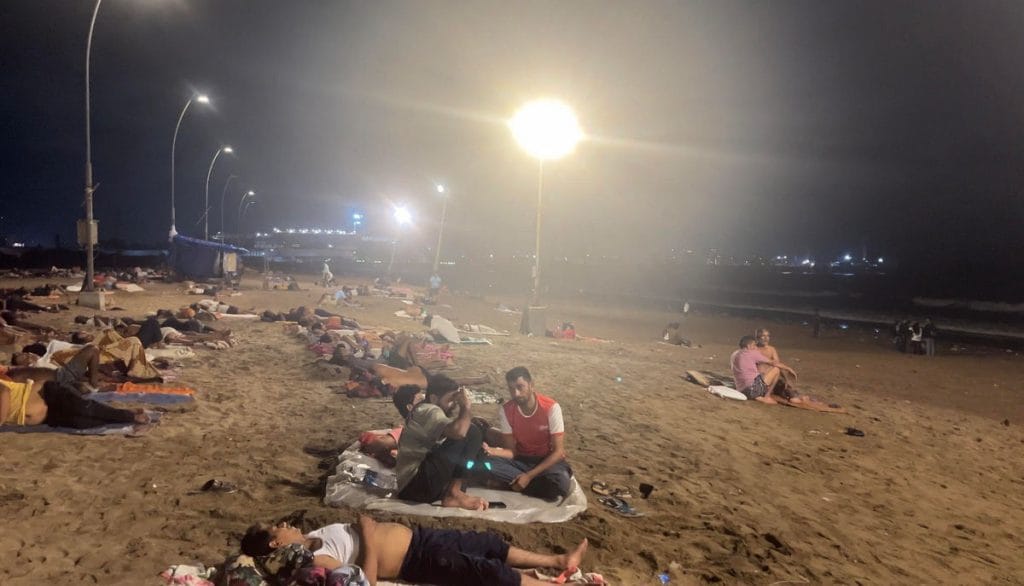
There is now a rhythm to a night by the shore. Men return from work by 8 or 9 pm, eat, and head to the beach with mats and bedsheets. Women and children arrive closer to midnight, after the dishes are done. As the night deepens, the beach becomes a space for the neighbours to share funny anecdotes and talk through the daily stresses of surviving the city.
Vilas Shinde, 52, a dabbawalla who moved to Mumbai from Pune two decades ago, sat in a circle with other Sagar Kutir residents, recounting his latest nightmare: his electricity bill.
“My electricity bill for April was Rs 22,550. For May, it was only Rs 2,290. Now they have sent a total unpaid bill this month for Rs 24,840,” he said. His friends stared at him in complete disbelief and asked him if he was joking.
To prove it, Shinde pulled out his phone, opened a WhatsApp message from Adani Electricity, and showed the bills to everyone. His two children are both in college and work part-time, while Shinde spends his day delivering fresh home-cooked food to people.
“I spent the last month in three different offices to get this sorted. My bill says ‘Net Charges’ in ‘Adjustments’ alone reached Rs 22,550 in April. Nobody is able to explain to me what that even means,” he said.
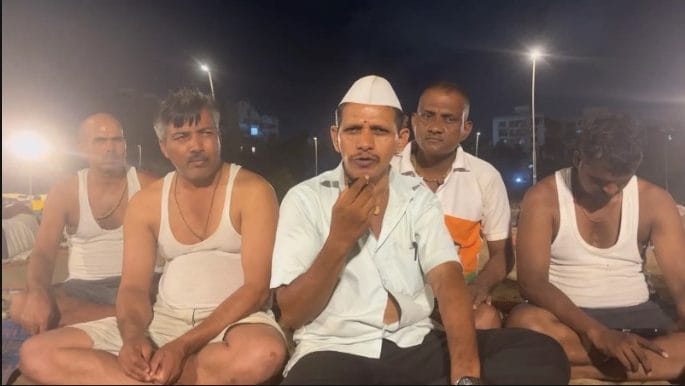
His friend Santosh Shivekar, who also delivers tiffins every day, read the bill grimly and then pulled up a message on his own phone before passing it around. This time, it was a bill for Rs 8,000. Everyone expressed their horror.
“How is your bill also high?” a friend asked. Shivekar replied that he had no idea. There was no one home all day. His wife spends her days working as a househelp, and his son works at a small finance company.
“I too don’t have a TV or AC at home. Nobody is home during the day. How can it be so high?” he said.
The two friends made a pact to raise a complaint at the Adani Electricity Customer Care Centre at MIDC in Andheri the following week.
“Let’s go together,” said Shivekar. Just as the circle began to disperse, their wives and children arrived on the shore, carrying colourful woven mats and plastic water bottles, ready to turn in for the night.
150 sq ft furnaces
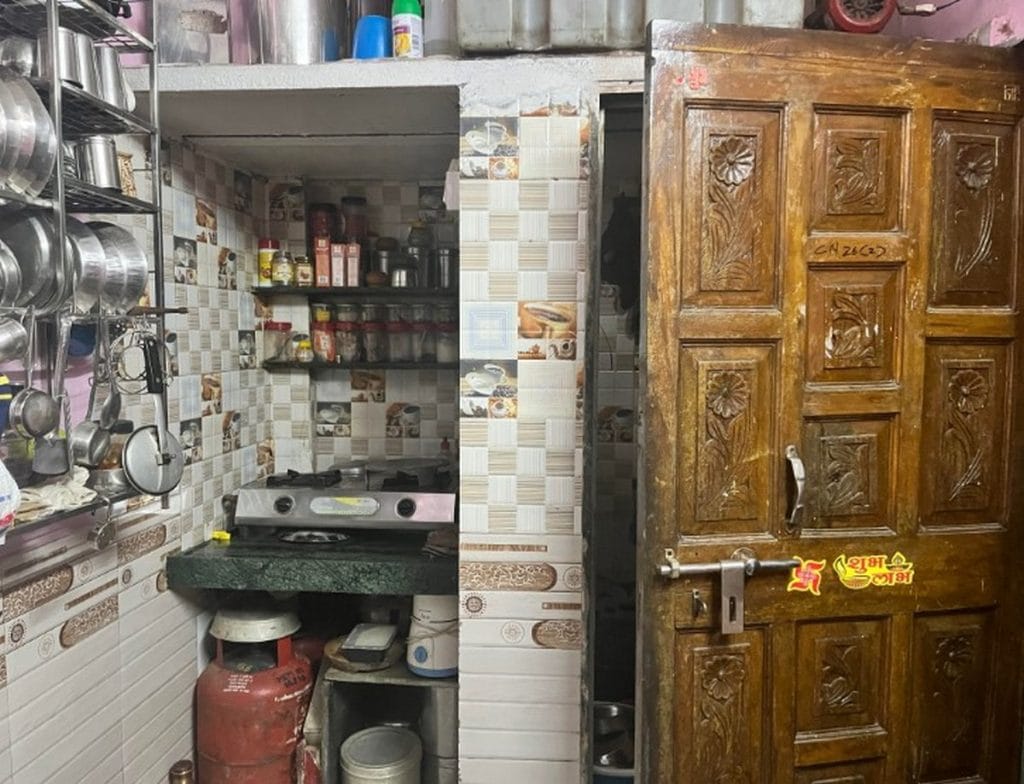
Inside the narrow lanes of Sagar Kutir, homes are not divided into rooms as much as folded into functions.
A 150-sq-ft space becomes kitchen, bedroom, living room, storage area and study corner all at once. Clothes hang above refrigerators and doorways, steel vessels climb up open racks, spice jars line tiled alcoves, and gas cylinders are tucked under cooking slabs.
Where the residents could add cheer, they have. Walls are painted in bright colours and covered with patterned tiles. There are small temple shelves and family belongings kept as neatly as possible in every available corner.
The 2011 Census recorded 2,414 households and 10,595 people in the government-notified and recognised slum under the Greater Mumbai Municipal Corporation. Today, residents say the 2-acre area houses roughly 3,000 families and 15,000 to 20,000 people. Most houses are owned by residents, though some families live on rent, paying between Rs 2,000 and Rs 5,000 a month.
For Surekha Bacche, who does domestic work in multiple houses and earns Rs 18,000 a month, the problem is not just the size of the house but what the heat does to it by night.
“The whole day we work in other people’s homes. We sweep, mop, wash utensils, cook, clean. By the time we come back, we only want a few hours of proper sleep,” she said. “But inside the house, it becomes so hot that even lying down feels difficult. The fan only throws hot air.”
If we don’t sleep properly, how will we work the next day? We have to go to people’s homes, do jhaadu-pocha, wash clothes, wash utensils. Come home and do all that for our homes and children. Our bodies need rest.”
— Ujjwala Padwal, Sagar Kutir resident
Her daughter, 20-year-old Vidhishi Bacche, a third-year Bachelor of Commerce student, said they were accustomed to the lack of space, but the heat had disrupted the normal flow of life.
“At night, when it is very hot, children and elders get restless. Babies start crying too. That is why people go to the beach. At least there is some breeze here.”
The low point came a few weeks ago when there was an electric short circuit and fire at an electric meter box near Nagori Dairy in the area.
“We lost electricity for four straight days. That was when the entire Sagar Kutir had to move to the beach for the night,” said Vidhishi.
Their neighbour, Ujjwala Padwal, noted that women in the settlement could not afford sleepless nights because their mornings began before dawn. To reach the apartment buildings where they work, they have to pack up and leave the beach either before or soon after sunrise. Their employers, waiting in AC apartments, don’t take kindly to latecomers.
“If we don’t sleep properly, how will we work the next day?” she said. “We have to go to people’s homes, do jhaadu-pocha, wash clothes, wash utensils. Come home and do all that for our homes and children. Our bodies need rest.”
For them, a walk to the beach with mats, rugs, daughters, and infants is not an evening outing. It is what allows them to rest just enough to start another day cleaning other people’s homes.
Sadashiv Patil, 55, an auto-rickshaw driver, resents the perception that people like him are misusing public spaces.
“People think we are coming to the beach for enjoyment. This is not a picnic. This is the only way we get some air,” he said. “The heat does not leave even at night. We keep sweating till morning. How can anyone sleep like that? How do I let my school-going children sleep like this?”
Also Read: Lal Dora villages are a parallel city in Delhi. No one wants to fix this dirty secret
The privilege of privacy
For 30-year-old Sagar Thakur, who works at a chartered accountancy firm in Mumbai, the heat is only one part of the problem. The other, he said, is Sagar Kutir’s old and overloaded electricity network. Many residents cannot install air-conditioners even if they try.
“The electric lines here are old. A new AC cannot run on this load. If many people use heavy appliances, the lines cannot bear it,” said Thakur, who lives with his parents and younger sister in a 200-sq-ft house in Sagar Kutir.
He too spoke with a shudder about the electric fire that led to a four-day power outage.
“Nobody came to help us during that time. People had to manage on their own. In this heat, without lights, without fans, what are families supposed to do?” he said.
With images of the packed beach going viral, the situation is taking on a political hue. Congress MP Varsha Gaikwad slammed the Mahayuti government in an X post on Thursday.
“A government unmindful of the heat island they are creating due to the rampant construction, uncaring about the frequent power cuts has literally brought the poor on the road,” wrote the MP, who represents Mumbai North Central and heads the Mumbai Regional Congress Committee.
A government unmindful of the heat island they are creating due to the rampant construction, uncaring about the frequent power cuts has literally brought the poor on the road. People sleeping at Versova beach due to the extreme heat amid power cuts. This government came to power… pic.twitter.com/TWsdV1ixWi
— Prof. Varsha Eknath Gaikwad (@VarshaEGaikwad) June 18, 2026
Some comments agreed with her. Others trotted out the familiar language of migrants and slums.
“This is what happens when you and your party continuously for more than 50 yrs create huge slums of migrants… today this slum dwellers majority migrants are sleeping in the beach tomorrow it will be public gardens,” said one.
Meanwhile, residents are getting increasingly angry about how they are being filmed and derided as encroachers while they are at their most vulnerable.
“The public here is furious. We are being looked at as encroachers, as if we have no home and no right to exist,” said Thakur. “Privacy exists for all. Would people living in apartments be comfortable with being photographed in the middle of the night? Our sleeping conditions are already so inconvenient. We don’t need more discomfort with people coming every night to film us.”
(Edited by Asavari Singh)