








New Delhi: In the summer of 2024, birds and bats fell dead from the skies in Madhya Pradesh, Rajasthan, and parts of Delhi. This year, fish lay lifeless at the bottom of a dried-up Sanjay Lake. This is what happens when the mercury shoots past 40 degrees Celsius and streets turn into ovens. India entered the summer season a little late this year. But now, the heat is here with a vengeance.
Even the nights offer no relief now. On Thursday night, Delhi’s minimum temperature was 31.9 degrees Celsius, 5.2 degrees higher than normal and the highest nighttime temperature in May in nearly 14 years. The last time the city saw such a sweltering night was on 27 May 2012, when Kolkata Knight Riders won their first-ever Indian Premier League title by defeating Chennai Super Kings.
In north, central, and east India, temperatures hovered between 40 and 46 degrees this week, with Banda in Uttar Pradesh clocking 48.2 degrees for the third consecutive day on Thursday — the highest in the country.
India is not new to heatwaves. But this time daily life has been disrupted to an unusual degree. Schools have brought forward summer vacations, markets are emptying out by the afternoon, and some farmers in UP have taken to working at night. Yet, even sundown is barely offering respite. The power grid is stretched to its limits, with the heat pushing India’s electricity demand to an all-time high this week. And the IMD’s forecast for June is no kinder. That’s why India’s heatwaves are ThePrint’s Newsmaker of the Week.
At 2:20 pm on 22 May, the India Meteorological Department (IMD) issued yet another weather report, forecasting heatwave conditions for the next seven days in several parts of the country. East Uttar Pradesh and East Madhya Pradesh are likely to face severe heatwave conditions during the same period.
Also Read: Gentoo penguins shifting breeding season, says Argentine study. Extreme heat is the problem
The heat toll
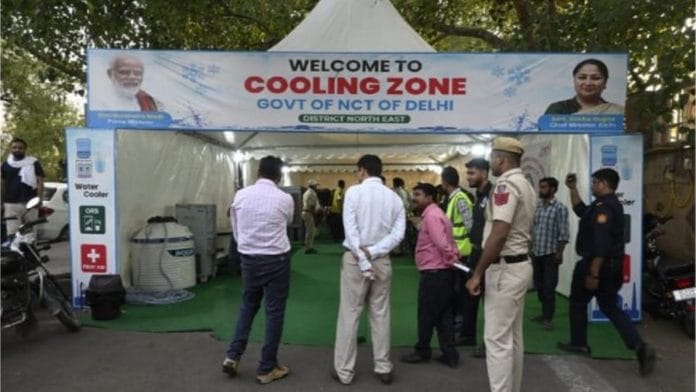
In Delhi, the “cooling zones” set up at places such as near the Jama Masjid metro station offer a moment of respite to some, with coolers, drinking water, ORS, and first aid. But many have no such refuge. This week, a video of workers carrying large Swiggy promotional boards in the heat went viral.
“There has to be a better way than turning people into walking billboards in this weather… it’s inhumane,” said the caption.
Delhi recorded its first two official heatstroke cases at Ram Manohar Lohia Hospital on Thursday, although the unofficial number is likely to be much higher. The nationwide tally, although hard to put together, has probably been mounting steadily since April. In Andhra Pradesh alone, more than 300 suspected cases of heat-related illnesses have been reported since March.
Two school teachers in Odisha died of heatstroke while carrying out their census duties in April this year. During the West Bengal elections, four deaths of voters were linked to the heat. Many others who may die of heat don’t make it to the news.
On Friday morning, in a ranking of the hottest cities in the world, nearly all the top 100 slots were filled by Indian cities, most of them in UP. India’s power demand too rose to a record high of over 270 GW. The peak demand could rise even further if the heatwave persists.
One of the most dangerous parts of this heatwave is the night, when the body needs cooler temperatures to recover from the day. A recent study titled ‘Nighttime Thermal Stress in Low and Middle Income Housing in India’ by the research organisation Climate Trends notes that elevated night temperatures hinder physiological recovery, raising the risk of fatigue, dehydration, cardiovascular strain, and sleep disruption. Monitoring 50 homes in Chennai, the researchers found that indoor temperatures rarely dipped below 31 degrees at night.
“Indoor temperatures for the representative households frequently exceeded 32°C, with prolonged
periods above 35°C, indicating sustained exposure to high thermal stress,” the study added.
Gender also plays a role in heat stress. Due to hormonal fluctuations and metabolic rates, the female body is more susceptible to dehydration, fatigue, and heat related illnesses.
However, no one feels the wrath of the sun more directly than gig workers and construction labourers.
In 2025, the National Disaster Management Authority (NDMA) put out an advisory for informal and gig workers, recommending that aggregator platforms suspend mandatory work between 11 am and 4 pm during heatwaves, and that workers be provided UV-protective long-sleeved shirts, cooling caps, and sunscreen. But it’s just advice, and falls short of providing a sustainable solution.
“Advisories don’t scare anybody, so no one is compelled to comply with them,” said Nirmal Gorana, national coordinator of the Gig & Platform Service Workers Union (GIPSWU).
Several labour unions have demanded legal protection for gig workers during extreme heat, but those demands are yet to be met.
Also Read: How a green resistance led Meghalaya govt to scale back luxury resort on a manmade lake
Why such intense heatwaves?
The ongoing intense heatwaves in India are driven by a mix of weather systems and long-term warming, according to
Anjal Prakash, research director at the Bharti Institute of Public Policy.
“High-pressure systems dominate, trapping hot air near the surface like a dome, preventing it from rising and cooling,” he said. The sinking air compresses and blocks clouds from forming, letting the direct sunlight heat up the surroundings. Prakash also noted that weak pre-monsoon rains and “lingering El Nino-like patterns” were also preventing cooling.
According to the IMD, severe heatwaves have become more frequent and prolonged over the past few decades. Meteorologists say the current spell has been driven by hot north-westerly winds blowing in from Rajasthan’s desert regions and making their way to central India.
Global warming is steadily pushing temperatures higher, and El Nino, a natural climate cycle, can amplify the effect. During an El Nino, the warm water that normally pools in the western Pacific spreads eastward toward the Americas, releasing heat into the atmosphere, drying out the skies, and often delaying the monsoon. This affects Indian summers too.
Research into heatwaves in India has shown that in 2024, India experienced its longest recorded heatwave since 2010. Many states had daytime temperatures of over 40 degrees Celsius for an entire month, leading to over 44,000 cases of heatstroke. Since then, the heatwaves have only gotten more persistent with every summer.
In addition, north India’s summers have also seen a delay, likely caused by shifting wind patterns that prevent the hot dry westerlies from flowing into central India. The result is a sudden sharp rise in temperature in May.
The state’s response is similar every summer—water kiosks, public advisories, shaded areas at bus stops. Going forward, maybe this won’t be enough.
For now, many are using humour to cope. One Instagram user said: “Ab mujhe acche dino ka nai, bas thande dino ka intezaar hai” — I am no longer waiting for better days, just cooler ones.
(Edited by Asavari Singh)