





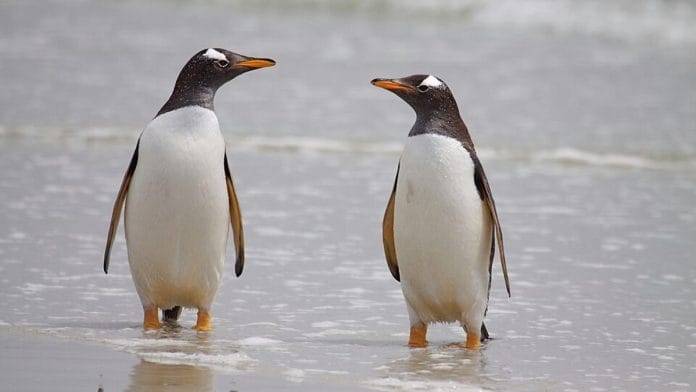


New Delhi: As heatwaves become more frequent, young chicks of Gentoo penguins on Martillo Island in Argentina are having trouble coping with the heat. A recent study found that the birds are shifting their breeding season earlier, ensuring vulnerable chicks grow before the most deadly, potentially fatal summer heat events.
“Gentoos are advancing their breeding season by 2 days per year, which is concurrently reducing the number of days exposed to high temperatures (more than equal to 20°C),” states the study.
Researchers at the Laboratory of Ecology and Wildlife Conservation in Argentina, along with colleagues at the School of Biological and Medical Sciences, Oxford Brookes University, monitored a colony of Gentoo penguins from 2013 to 2024. Their research, titled ‘Rare upside of climate-induced phenological changes: Gentoo penguins (Pygoscelis papua) avoid heat events at Martillo Isl., Tierra del Fuego, Argentina’ was published on 20 May in the PLOS One journal.
One of the most alarming moments of their study came during a heatwave in 2014 when temperatures rose to 24 degrees Celcius, and researchers saw five penguin chicks die within 45 minutes. Their deaths were captured on the time-lapse cameras set up for the study.
The camera caught the chicks panting before their death. As soon as temperatures neared 18 degrees Celcius, the chicks would begin panting, and as the temperature rose above 20 degrees Celcius, they would abandon their colonies in search of cooler areas.
Also read: 3 Kuno’s cheetahs will now be sent to Gujarat. They’re part of the Botswana batch
A rare upside
For humans, 20 degrees Celsius may be a pleasant temperature. But for animals that have evolved for extreme cold temperatures, the study states that “their bodies are designed to retain heat”. Due to their thick insulation, they cannot get rid of excess heat in the body easily. Even digestion can generate heat, making hot weather quickly dangerous.
During their initial growth, chicks must feed to grow. Researchers found that since food digestion increases metabolism and heat production, it may be the tipping point for chicks, making them more susceptible to hyperthermia.
The study also found that Gentoo penguins were most vulnerable to high temperatures during the ‘post guard’ phase, when they were no longer sheltered by their parents, but were not ready to go into the sea either.
During their decade-long observation, researchers saw that penguins adapted to breeding earlier every year. This meant that the chicks were born earlier and would be slightly better equipped to deal with the hotter days. Authors of the study said that among the several types of climate change-related adaptations across the planet, this was a “rare upside”.
While this study looked only at one colony of penguins in Martillo Island, the location remains significant. This colony is an ‘edge population’ which lives in an area where they are already nearing their thermal limits. Such populations are likely to face the consequences of climate change first. Since they are already living close to their threshold temperatures, if the climate warms faster than they can adapt, their species may face a greater risk of extinction.
(Edited by Saptak Datta)