





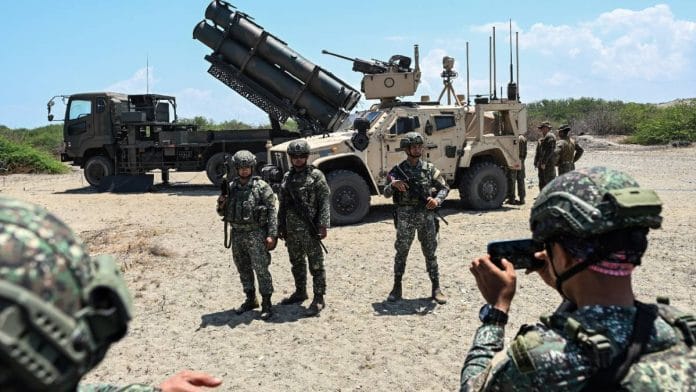


New Delhi: The US and Philippines held the annual Balikatan military exercises from 20 April to 8 May, focusing on large-scale combat operations that demonstrated allied resolve in the Indo-Pacific region amid rising tensions in the South China Sea.
While officially framed as a defensive and interoperability-focused exercises, Balikatan 2026 carried a broader geopolitical message, apparently targeted at China: regional allies are increasingly prepared to coordinate military capabilities in response to coercive actions and maritime instability in contested waters.
China and Southeast Asian countries like Vietnam, the Philippines, Brunei, Malaysia and Taiwan have had disputes over the contentious South China Sea region for centuries. The two primary points of contention are the Spratly Islands and the Paracel Islands.
Beijing stakes claim to most of the region and at the heart of this claim is the U-shaped “nine-dash line” that includes as much as 90 percent of these waters. This dotted line was adopted from Chinese maps in the 1940s, and represents Beijing’s claim over the sea and all the land features that are contained within the line.
The Philippines and China have been sparring over the Scarborough Reef and the Spratly Islands. While China has offered to negotiate the matter, the Philippines has said these territories are non-negotiable and have always been its part.
Also Read: Indo-Pacific security demands a strong India-Japan relationship
Why the exercise matters
The Balikatan exercises began in 1999 and have since evolved into one of the Indo-Pacific’s largest multinational military drills. Originally bilateral in nature, the drills have expanded significantly over the years in both scale and participation, reflecting changing regional security dynamics.
This year’s edition coincided with the 75th anniversary of the US-Philippines Mutual Defence Treaty (MDT), giving the drills additional symbolic and strategic significance. The Philippines hosted the exercise alongside the US, with participation from more than 17,000 troops representing seven countries, including Australia, Japan, Canada, France, and New Zealand.
Japan participated as a full-fledged participant for the first time, marking a significant expansion in regional defence cooperation. In addition, 17 countries attended as observers, reflecting strengthening diplomatic ties, a bid for transparency in regional security efforts and growing global interest in Indo-Pacific security and maritime stability.
Apart from the MDT, the Philippines and the US maintain the Enhanced Defense Cooperation Agreement (EDCA). Under the EDCA, Manila expanded American access from five to nine Philippine military bases in 2022.
Balikatan 2026 marked the 41st edition of the exercises and is widely regarded as the most expansive and operationally complex version to date. Unlike earlier editions focused largely on humanitarian assistance and counterterrorism operations, this year’s drills simulated full-scale combat scenarios.
The exercise incorporated maritime security operations, air and missile defence drills, amphibious assaults, joint logistics rehearsals, and integrated command-and-control operations.
The operational geography covered Luzon, the Visayas, and Mindanao—strategically important areas close to major maritime flashpoints in the South China Sea and the Luzon Strait.
Advanced military systems and concepts were also showcased, including Japanese coastal missile systems targeting mock enemy vessels, US unmanned maritime systems and marine drones, integrated coastal defence operations, and air and missile defence coordination.
The significance of Balikatan extends beyond the Philippines and the US. The exercises reflect a broader trend toward enhanced security cooperation among Indo-Pacific nations amid growing concerns over maritime coercion, territorial disputes, and freedom of navigation.
Strategically, the exercises reinforce the principle of a “free and open Indo-Pacific” and demonstrate the increasing willingness of regional states to coordinate security efforts.
China-Philippines dispute
The Philippines occupies a strategically critical location in Southeast Asia, consisting of more than 7,600 islands positioned near key maritime chokepoints linking the Pacific Ocean and the South China Sea. Its geographic position places it at the centre of competing territorial claims in the South China Sea, particularly within areas claimed by Beijing under the “nine-dash line”.
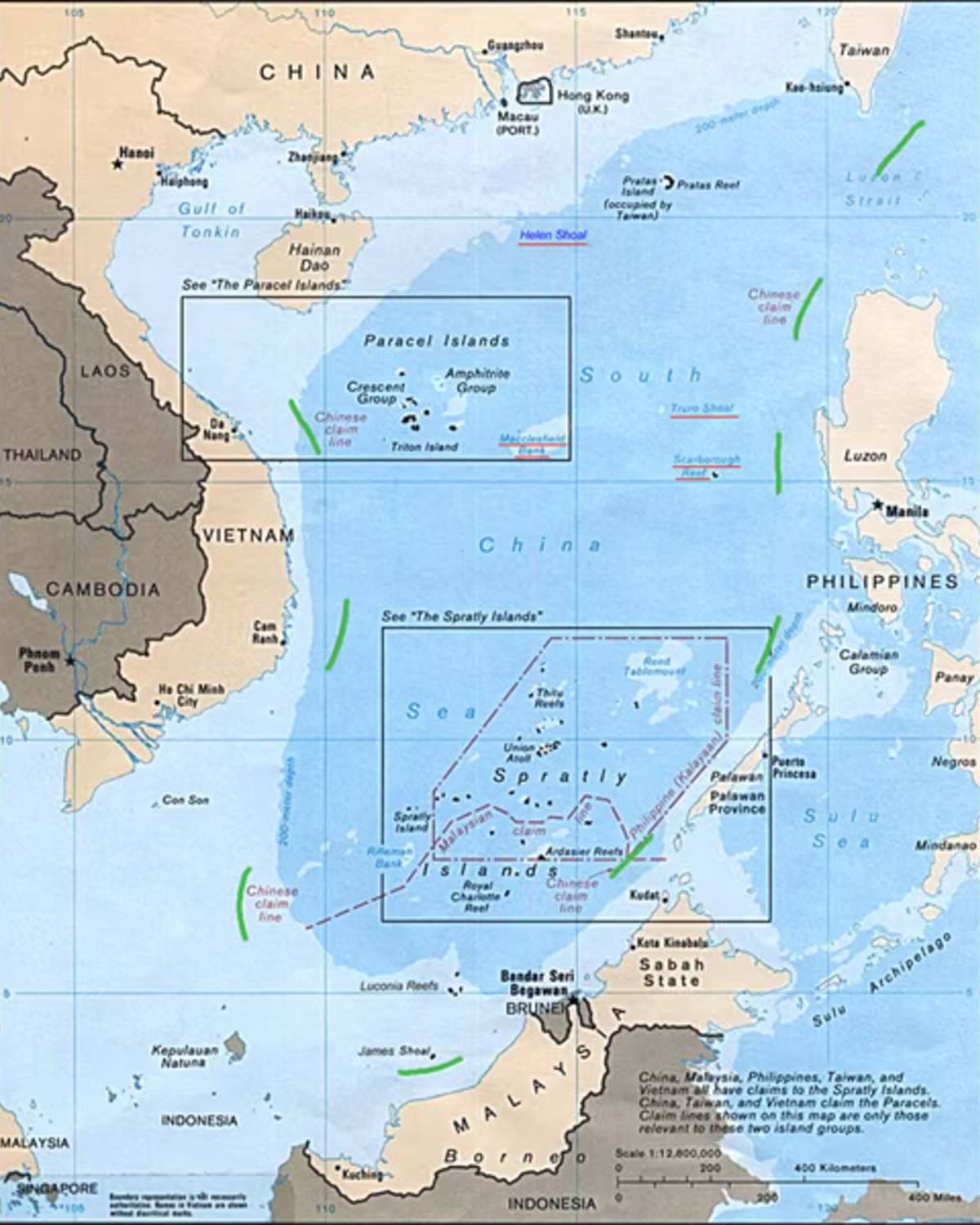
The China-Philippines dispute intensified after reports of oil and gas reserves in the Spratly Islands in the 1970s. Tensions escalated significantly in 2012 when China gained effective control over Scarborough Shoal following a maritime standoff with the Philippines. The event prompted the Philippines to file a historic international arbitration case against Beijing a year later, under the United Nations Convention on the Law of the Sea (UNCLOS), which Manila won in 2016.
The Permanent Court of Arbitration in The Hague ruled in 2016 that China’s “nine-dash line” claims had no legal basis under international law. China rejected the ruling and has continued to maintain a strong maritime and military presence in disputed areas.
The Philippines has repeatedly accused China of employing “grey zone” tactics—actions that remain below the threshold of conventional warfare but aim to alter the status quo incrementally.
These include water cannon incidents, laser targeting of vessels, dangerous manoeuvres at sea, ramming and obstruction of resupply missions, and maritime militia operations. Manila has alleged that such actions have intensified since 2022.
It has filed hundreds of diplomatic protests against Beijing over maritime incidents, while also launching a transparency initiative since 2023 that publicly releases videos and images of alleged confrontations in contested waters.
The US and several western allies have consistently reaffirmed support for the 2016 UNCLOS ruling in favour of Manila and freedom of navigation in the South China Sea.
China & ASEAN
China’s growing influence within the 11-member Association of Southeast Asian Nations (ASEAN) has created differing approaches among member states toward Beijing. While some ASEAN nations advocate stronger positions on maritime disputes, others prioritise economic engagement with China.
Beijing, on the other hand, is combining diplomatic and economic engagement, infrastructure investment, trade partnerships and security pressure while dealing with the nations.
Critics argue that these tools create strategic dependencies and complicate ASEAN’s ability to present a unified position on regional security matters.
At the same time, China views the “First Island Chain”—stretching from Japan through Taiwan and the Philippines—as part of a broader US-led containment strategy aimed at limiting Chinese strategic access in the Pacific.
The India angle
Balikatan 2026 carries significance for India’s growing strategic role in the Indo-Pacific region. The Philippines deployed the BrahMos supersonic cruise missile system during the simulation exercises, marking a major milestone in India-Philippines defence cooperation. The two countries had elevated ties to a strategic partnership in 2025, with maritime security emerging as a key pillar of cooperation.
The BrahMos coastal defence system, operated by the Philippine Marine Corps, is designed to strengthen anti-access and area-denial (A2/AD) capabilities in contested maritime zones.
Although no live missile firing took place during Balikatan, the simulation validated the integration of sensors, targeting systems, and operational command structures. The exercises also demonstrated growing interoperability between Indian-origin systems and US military platforms.
For India, the exercises showcased its emergence as a credible defence exporter and strategic security partner in Southeast Asia. Countries such as Indonesia and Vietnam have also shown interest in acquiring the BrahMos system.
The Chinese response
Beijing reacted sharply to the exercises, particularly to the deployment of advanced missile systems near the Luzon Strait—a critical waterway between the Philippines and Taiwan.
On 20 April, following the launch of the annual military exercises, China warned the US, Philippines and Japan that they were “playing with fire”. It also conducted naval and air patrols near contested areas, including Scarborough Shoal, during the exercise period.
Chinese officials warned against actions that could increase regional tensions, and Beijing has previously repeatedly criticised expanded US military deployments in the region, arguing they contribute to instability and bloc confrontation.
For the Philippines and its allies, the exercises represent a demonstration of collective defence readiness amid persistent regional tensions. For China, they highlight the growing consolidation of regional security partnerships along strategically sensitive maritime corridors.
As geopolitical competition intensifies across the Indo-Pacific, Balikatan is increasingly being viewed not merely as a military exercise, but as a strategic signal about the future balance of power in the region.
Lakshminarayanan Devaraj is an alum of ThePrint School of Journalism, currently interning with ThePrint.
(Edited by Nida Fatima Siddiqui)
Also Read: China is worried about US–Philippines military exercises. It’s too close for comfort